
Basic Operations Flight Certification Practice Exam
$69.00
- Buy to unlock unlimited access to all Quiz questions and Answers in this Quiz.
- After purchase you can print a PDF of the whole quiz at any point. The PDF will contain the questions and the correct answers.
About this Exam
The Basic Operations Flight Certification is an entry-level credential designed for aspiring aviation professionals, including student pilots, remote pilots (drone operators), and ground crew members. This exam acts as a crucial first step, validating your fundamental knowledge required for safe and regulated operations within the general aviation landscape. If you are launching your career or looking to reinforce your core knowledge, this practice exam is your essential preparation tool.
Ready to test your knowledge?
Buy Now to Access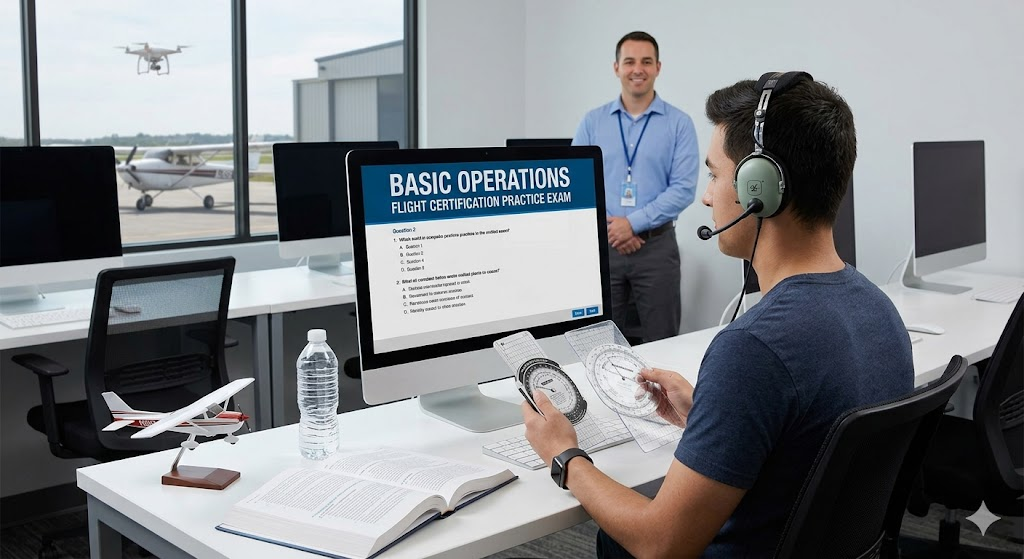
Additional Information
What the Course Entails and Exam Details
This comprehensive practice exam rigorously tests your understanding of core aviation principles. The syllabus is constructed around the essential areas mandated by international aviation standards.
The primary topics you will master and face on the exam include:
Aviation Regulations: Navigating international and regional rules of the air, including licensing, operating limitations, and documentation requirements for both manned and unmanned aircraft.
Airspace Classification and Operations: Identifying different classes of airspace, understanding entry and operating requirements for controlled and uncontrolled areas, and recognizing special-use airspace and temporary flight restrictions.
Weather and Aviation Services: Interpreting standard aviation weather reports, forecasts, and charts (such as METAR and TAF), recognizing hazardous weather phenomena, and knowing where to obtain official pre-flight weather briefings.
Aircraft Performance and Weight & Balance: Understanding basic aerodynamic concepts, calculating takeoff and landing distances, evaluating aircraft performance under varying density altitude conditions, and ensuring safe loading procedures.
Radio Communications and Navigation: Mastering standard phraseology, understanding effective communication with Air Traffic Control and other pilots, and the fundamentals of pilotage, dead reckoning, and modern navigation aids.
Operations and Emergency Procedures: Procedures for different phases of flight, risk management, accident reporting requirements, and recognizing and responding to inflight emergencies.
What to Expect in the Final Exam
While specific parameters for final exams vary slightly by jurisdiction and certifying body, this practice exam is structured to reflect the most common and standardized testing environments.
A representative final exam consists of approximately 60 to 75 multiple-choice questions.
You will typically have between 1.5 to 2.5 hours (90 to 150 minutes) to complete the computer-based assessment.
The passing score is usually set between 65% and 70%.
Results are typically provided immediately upon completion, with a detailed score breakdown highlighting your strengths and areas needing further review.
You may be permitted to use approved aids, such as a basic non-programmable calculator, a physical or electronic flight computer (e6b), and standard navigation tools (plotter and straightedge).
How to Study and Exam Centers
Effective preparation is the key to confidence on test day. We recommend a structured study plan that includes multiple approaches.
Structured Practice Exams: Utilize this practice exam repeatedly. It is designed not just to test your knowledge, but to identify the specific topics and ACS (Airman Certification Standards) codes where you are weak, allowing you to focus your study efforts efficiently.
Official Study Handbooks: Read the official foundational manuals for your region. Key resources include the FAA’s Pilot’s Handbook of Aeronautical Knowledge (PHAK), Aeronautical Information Manual (AIM), and Remote Pilot – Small Unmanned Aircraft Systems Study Guide.
Targeted Review: Analyze your practice exam results. If you consistently miss questions on weather, dedicate time to re-reading the corresponding chapters and taking focused mini-quizzes on that specific topic until you consistently achieve mastery.
Simulated Test Environment: Take full-length practice tests under timed, quiet conditions. This builds your stamina for the exam and helps perfect your time management, ensuring you can thoughtfully answer every question.
Where to Take the Exam:
Authorized Testing Centers: The final certification exam is usually administered through network of physical testing centers, such as those provided by PSI Services, Pearson VUE, or your national civil aviation authority’s designated facilities.
Online Proctored Options: In some regions and for certain basic certifications (especially remote pilot certificates), online proctored exams may be available, allowing you to take the test from your own location with strict virtual oversight.
Authorized Schools: Many certified flight schools and specialized aviation training academies are authorized to host testing for their students.
Job Opportunities from the Course
Earning your Basic Operations Flight Certification demonstrates fundamental safety and procedural knowledge that is sought after for various entry-level roles across the aviation sector.
Here are specific job titles and career paths this certification (along with requisite additional licenses) unlocks:
Drone Operator (Remote Pilot): Essential for commercial drone applications in aerial photography, infrastructure inspection, agriculture, and real estate.
Aviation Operations Specialist: Providing critical ground support, scheduling, and dispatch services for general aviation terminals, flight schools, and regional airlines.
Flight Dispatcher Apprentice: Assisting with flight planning, weather analysis, and aircraft tracking, preparing for full flight dispatcher certification.
Airport Operations Specialist: Ensuring safe, efficient, and regulatory-compliant operations on the airport field, including ramp management and runway inspections.
Ground School Instructor Assistant: Supporting aviation educators by assisting with instruction and test preparation for basic pilot knowledge tests.
Ground Crew Member (Handler): Fundamental safety knowledge benefits roles in aircraft maneuvering, marshaling, and basic support on the tarmac.
Frequently Asked Questions
Reviews
5.0
Based on 0 reviews
Leave a Review
No reviews yet. Be the first to review!