
Basic Orientation Plus (BOP) Practice Exam
$69.00
- Buy to unlock unlimited access to all Quiz questions and Answers in this Quiz.
- After purchase you can print a PDF of the whole quiz at any point. The PDF will contain the questions and the correct answers.
About this Exam
The Basic Orientation Plus (BOP) program is the industry standard safety awareness training required for contractor employees working in industrial facilities.
Developed by the Association of Reciprocal Safety Councils (ARSC), this orientation ensures that workers possess a foundational knowledge of essential safety practices before entering complex work environments.
It is designed for tradespeople, construction workers, maintenance personnel, and any contractors seeking access to refineries, chemical plants, and other high-hazard sites.
By establishing a baseline of safety knowledge, the BOP program helps create a safer, more compliant, and more productive workforce across the industrial sector.
Ready to test your knowledge?
Buy Now to Access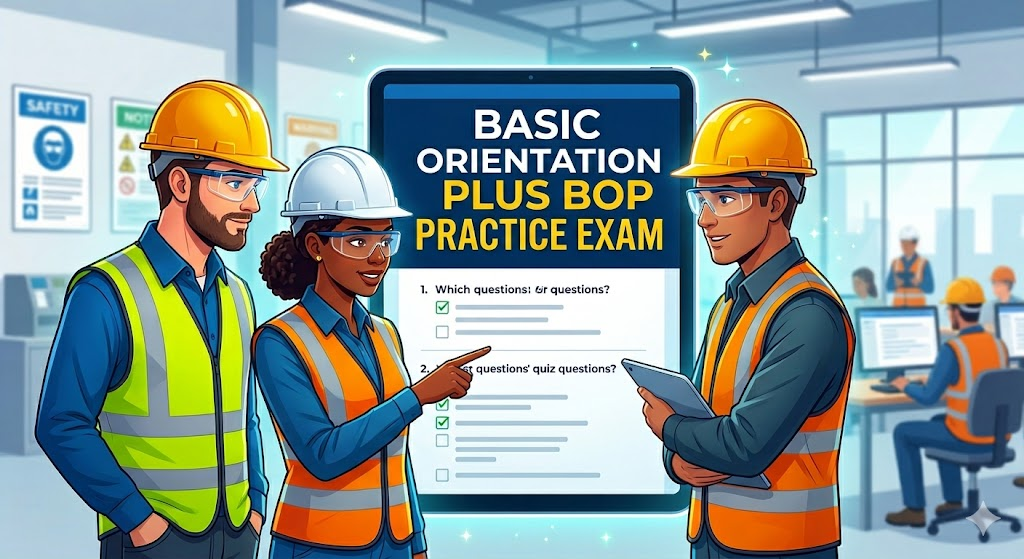
Additional Information
What the Course Entails and Exam Details
The BOP course covers a comprehensive range of safety topics tailored specifically for industrial settings.
The core syllabus focuses on vital areas such as the Hazard Communication Standard (GHS), proper use of Personal Protective Equipment (PPE), hearing conservation, and respiratory protection.
Additionally, the training details critical safety procedures including Lockout/Tagout (LOTO), fall protection, confined space entry awareness, and electrical safety.
Participants will also learn about general work permits, emergency response plans, and fire protection protocols to ensure they can navigate industrial risks effectively.
The overall goal is to equip workers with the knowledge required to identify hazards and strictly adhere to regulatory safety standards on the job.
What to Expect in the Final Exam
The final Basic Orientation Plus exam is a comprehensive assessment designed to test your retention and understanding of the safety material presented in the course.
While specific administration details may vary slightly by location, the exam generally follows standardized ARSC requirements.
Candidates can expect a multiple-choice exam administered via computer.
The exam usually consists of roughly 50 to 100 questions covering the various safety topics.
To successfully receive your certification card, candidates typically must achieve a high passing score, often 80% or greater.
The exam is proctored at a designated safety council or authorized training facility to ensure integrity.
A strict time limit, often around two to three hours, is enforced, requiring candidates to manage their time efficiently while answering the questions.
How to Study and Exam Centers
Preparation is the absolute key to succeeding on the BOP exam and ensuring you can work safely on-site.
Since the exam is closely based on the training presentation, your first priority must be paying attention and taking notes during the required classroom instruction or computer-based training.
To reinforce what you’ve learned, actively utilize official study guides provided by your regional safety council.
The most effective strategy is to take a Basic Orientation Plus practice exam; this familiarizes you with the question formats, phrasing, and the pace required for the real test.
The actual BOP exam is not taken online from home; it must be completed at an authorized ARSC safety council or approved proctored testing facility.
These physical testing centers are located strategically in industrial regions across North America to serve local contracting firms and facility owners.
Job Opportunities from the Course
Obtaining your BOP certification is a non-negotiable credential that acts as a vital gatekeeper to numerous high-demand, stable job opportunities.
This safety qualification is mandatory for almost all trade and maintenance roles within high-hazard industries like oil and gas, petrochemicals, manufacturing, and power generation.
Holding a valid BOP card unlocks the door to specific job titles, including:
Welder and Fabricator
Pipefitter
Industrial Electrician
Boilermaker
Millwright
Heavy Equipment Operator
Industrial Maintenance Technician
Insulator
Scaffolder
General Laborer
Construction Safety Monitor
Furthermore, many general industrial staffing agencies and prime contractors require this certification before even considering an applicant for refinery or chemical plant shutdown projects.
Frequently Asked Questions
Reviews
5.0
Based on 0 reviews
Leave a Review
No reviews yet. Be the first to review!