
Basic UAS Qualification (BUQ) End of Course Practice Exam
$69.00
- Buy to unlock unlimited access to all Quiz questions and Answers in this Quiz.
- After purchase you can print a PDF of the whole quiz at any point. The PDF will contain the questions and the correct answers.
About this Exam
The Basic UAS Qualification (BUQ) End of Course Practice Exam is a pivotal assessment tool for aspiring remote pilots. It is designed specifically for individuals seeking standard authorization to operate Small Unmanned Aircraft Systems (sUAS) within specific organizational structures. This often includes governmental agencies, public safety organizations, and military branches that utilize the BUQ standardization framework (such as BUQ-1 or BUQ-2). The practice exam serves as the final step in the initial educational pathway, ensuring a candidate possesses the foundational knowledge required for safe and responsible drone integration into professional airspaces.
Ready to test your knowledge?
Buy Now to Access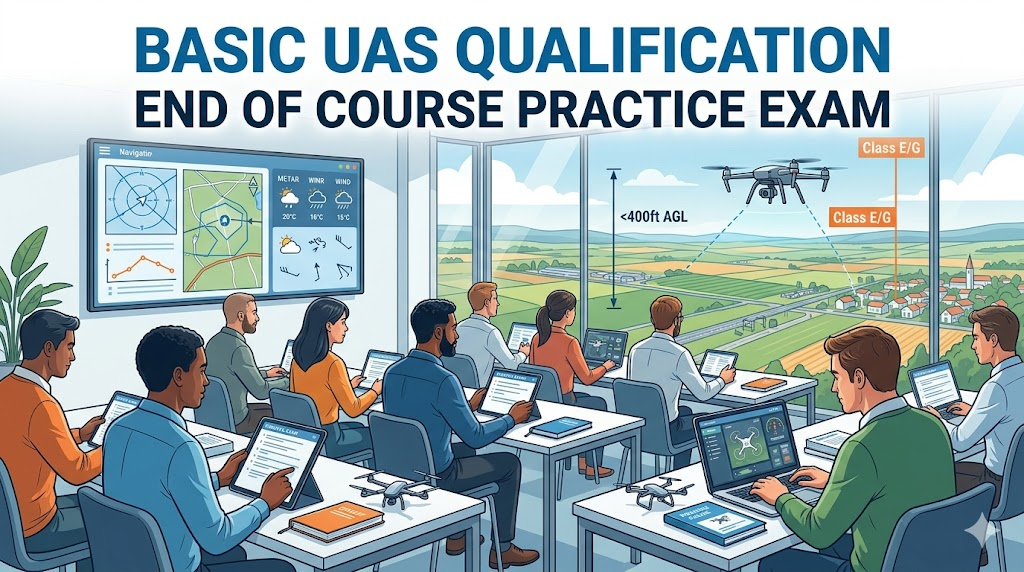
Additional Information
What the Course Entails and Exam Details
A standard BUQ certification course provides a rigorous overview of aviation fundamentals tailored to unmanned operations. You will delve into the regulatory frameworks governing sUAS, understanding the nuances of different airspace classifications and flight restrictions. Course modules meticulously cover weather theory, the interpretation of METARs and TAFs, and the critical effects of density altitude on aircraft performance. Candidates must also demonstrate proficiency in flight planning, hazard risk management, emergency procedures, and the mechanical understanding of sUAS components and battery safety.
What to Expect in the Final Exam
While exact parameters can shift between authorizing bodies, candidates should anticipate a final examination consisting of roughly 50 to 60 multiple-choice questions. A specific time limit, such as 90 to 120 minutes, is usually strictly enforced to simulate real-world operational pressure. A high standard of proficiency is required, with passing scores typically set between 70% and 80% as a minimum threshold. Some advanced BUQ levels may also include a practical flight evaluation or a proctored oral assessment to supplement the written test.
How to Study and Exam Centers
Effective preparation for the BUQ exam demands a strategic approach blending theoretical study with practical scenario application. Review the authorized course materials multiple times, focusing heavily on airspace charts and weather interpretation, as these areas trip up many candidates. Utilize this practice exam to identify your weak points and treat it like the real event—adhering to time limits and avoiding notes. BUQ exams are usually administered in several ways depending on the authorizing agency. For civilian-agency or commercial personnel, standardized centers like Pearson VUE may be used. For military or government-specific BUQ pathways, the exam is frequently proctored through secure internal online portals or taken at designated physical testing facilities located on military bases or agency headquarters.
Job Opportunities from the Course
Securing your Basic UAS Qualification unlocks a diverse array of specialized career paths, particularly within organizations that demand standardized, safe, and accountable operations. This certification is a required credential for many government and public safety roles that involve drone technology.
Specific job opportunities unlocked by this qualification include:
Public Safety UAS Pilot: Flying missions for police departments, fire services, or search and rescue (SAR) teams.
Military Unmanned Aerial Vehicle Operator: Serving as a designated operator for specific military platforms at the BUQ qualification level.
Government Agency Drone Operator: Performing surveys, monitoring infrastructure, or managing wildlife for agencies such as the Department of Interior or Department of Agriculture.
Corporate sUAS Pilot: Conducting specialized, standardized aerial inspections for major utility companies, construction firms, or environmental organizations.
UAS Training Instructor: Teaching foundational drone ground school courses at accredited training academies or organizational programs.
Frequently Asked Questions
Reviews
5.0
Based on 0 reviews
Leave a Review
No reviews yet. Be the first to review!