
Basics of Small Animal (SA) Dentistry Exam 1 Practice
$69.00
- Buy to unlock unlimited access to all Quiz questions and Answers in this Quiz.
- After purchase you can print a PDF of the whole quiz at any point. The PDF will contain the questions and the correct answers.
About this Exam
The Basics of Small Animal (SA) Dentistry Exam 1 represents a critical foundational milestone for veterinary professionals seeking to specialize in oral healthcare for companion animals. This comprehensive assessment is specifically designed for credentialed veterinary technicians, veterinary assistants, and veterinary students who need to validate their theoretical knowledge before moving into advanced practical training. This exam does not just test rote memorization; it evaluates a candidate’s understanding of essential dental concepts, preparatory steps, and pathology identification required to support a veterinary dentist effectively. Mastering this exam demonstrates a commitment to elevating the standard of dental care within general veterinary practice.
Ready to test your knowledge?
Buy Now to Access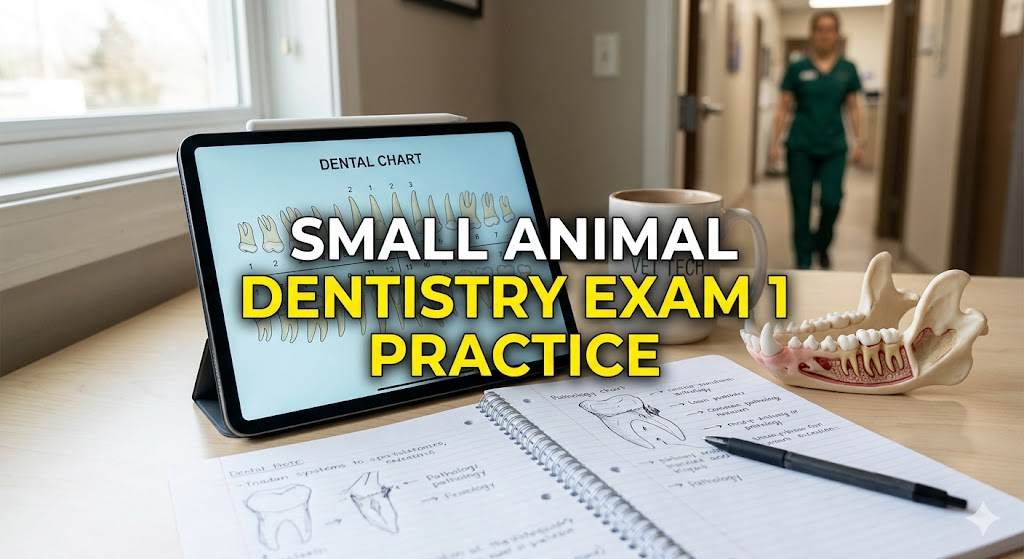
Additional Information
What the Course Entails and Exam Details
This examination covers the core theoretical pillars of standard veterinary dentistry. Candidates are expected to demonstrate proficiency across a broad syllabus focused primarily on canine and feline patients. The core domains include detailed head and dental anatomy, recognizing the differences between normal and abnormal structures, and mastering the terminology used in clinical charting.
The key topics covered within this practice exam include:
Dental and Craniofacial Anatomy: Identifying skull types, jaw structure, and the anatomy of individual teeth (enamel, dentin, pulp, periodontium).
Dental Formulas and Numbering: Mastery of the Modified Triadan System for both dogs and cats.
Oral Pathology Recognition: Differentiating between periodontal disease stages, identifying fractured teeth, resorptive lesions, and oral tumors.
Dental Charting: Correctly utilizing symbols and abbreviations to record findings during an oral examination.
Instrumentation: Identification and proper use of hand instruments (scalers, curettes, probes) and power equipment.
Dental Radiography Fundamentals: Understanding positioning basics, equipment safety, and identifying anatomical landmarks on a radiograph.
Prophylaxis Steps: The cognitive steps required for a complete professional dental cleaning and polishing procedure.
What to Expect in the Final Exam
While individual authorized testing centers may vary slightly, the final exam for the Basics of Small Animal Dentistry 1 is typically a rigorous, closed-book assessment. Candidates should expect a computer-based test format consisting primarily of multiple-choice questions, which may include image-based questions requiring the identification of pathology or anatomical structures. The exam usually has a set time limit, often ranging from 60 to 90 minutes, depending on the number of questions.
A passing score is generally set around 70% to 75%. This requires not just general familiarity, but a decisive understanding of the material. Because this is the first foundational exam, there is typically no practical component; however, success here is usually a prerequisite for entering wet labs or sitting for subsequent practical-based certifications.
How to Study and Exam Centers
Effective preparation for the SA Dentistry Exam 1 requires a structured study plan combining visual recall with theoretical application. Begin by utilizing this practice exam to identify weak points in your knowledge base.
Actionable study strategies include:
Flashcards for Numbering: Create flashcards for the Modified Triadan System. You must be able to instantly identify a tooth number by its location in a dog or cat.
Visual Charting Practice: Print out blank dental charts and practice recording conditions from case photographs.
Radiographic Anatomy Review: Spend significant time looking at normal dental radiographs to learn standard positioning and structure appearance.
Terminology Mapping: Do not just memorize definitions; understand how terms like "apical," "coronal," "buccal," and "lingual" relate to each other in a clinical setting.
Regarding exam centers, this foundational exam is often administered through the authorized online portals of veterinary technology schools, specialized veterinary dental training academies, or through learning management systems provided by continuing education (CE) providers. Some larger veterinary hospital groups may offer internal testing for their staff. In some cases, it may be proctored at specific physical testing sites or approved schools; verify the specific location requirements with your course administrator.
Job Opportunities from the Course
Successfully passing this exam and completing the corresponding course provides a significant competitive advantage in the veterinary job market. It validates to employers that you possess specialized knowledge that enhances patient care and clinic revenue.
This certification unlocks and enhances several career paths, including:
Specialized Veterinary Dental Technician (VTS-Dentistry candidate)
Lead Dental Technician in a General Practice
Veterinary Dental Assistant
Veterinary Continuing Education Instructor (Foundational Levels)
Veterinary Dental Equipment Sales Representative
Practice Manager with a focus on Dental Service Growth
Frequently Asked Questions
Reviews
5.0
Based on 0 reviews
Leave a Review
No reviews yet. Be the first to review!