
Bates’ Physical Assessment Practice Exam
$69.00
- Buy to unlock unlimited access to all Quiz questions and Answers in this Quiz.
- After purchase you can print a PDF of the whole quiz at any point. The PDF will contain the questions and the correct answers.
About this Exam
The Bates’ Physical Assessment Practice Exam is a foundational cornerstone for aspiring healthcare professionals seeking to master the art and science of patient clinical evaluation. This comprehensive guide is designed specifically for nursing students (RN, LPN/LVN), Nurse Practitioner candidates, Physician Assistant students, and medical students who are integrating theoretical knowledge with practical skills. The exam references the gold-standard criteria established in "Bates' Guide to Physical Examination and History Taking," focusing on a clinician's ability to gather a holistic health history and perform accurate physical examination techniques. Mastering this content is not merely about passing a test; it is about building the necessary confidence to provide safe, competent, and compassionate patient care in the real world.
Ready to test your knowledge?
Buy Now to Access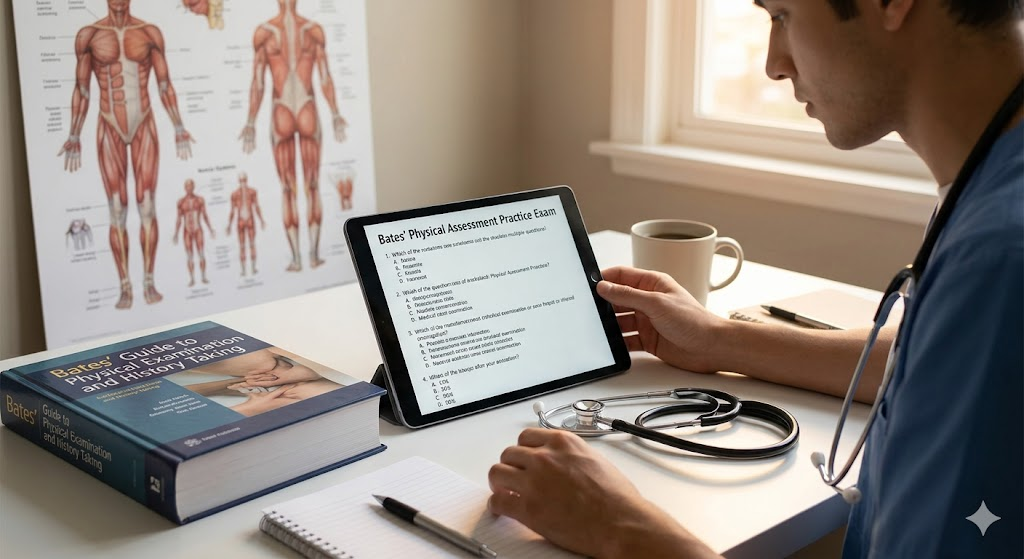
Additional Information
What the Course Entails and Exam Details
This examination evaluates your proficiency in the entire continuum of the health assessment process. Students are tested on their understanding of the foundations of interviewing, including communication techniques and cultural competence. The core of the exam details your knowledge of detailed body systems, including the integumentary, respiratory, cardiovascular, gastrointestinal, musculoskeletal, and neurological systems.
A primary focus is placed on the standardized examination techniques: Inspection, Palpation, Percussion, and Auscultation (IPPA). You must differentiate normal findings from common abnormalities and evidence-based variations across the lifespan, including special considerations for pediatric and geriatric populations. Furthermore, the exam requires students to apply clinical reasoning, translating collected subjective and objective data into proper documentation and assessment findings.
What to Expect in the Final Exam
While physical assessment is inherently a hands-on skill, the Bates’ Physical Assessment Practice Exam typically serves as the comprehensive theoretical component to support your practical training. The exam most commonly follows a standardized, computer-based format consisting of multiple-choice, select-all-that-apply, and image-based identification questions. You will be expected to identify the correct position for checking a specific pulse or the accurate anatomical location for auscultating heart sounds.
Specific constraints regarding the number of questions, time limits, and passing scores vary significantly depending on whether the exam is administered by your individual university, a specialized nursing program, or an advanced practice licensing board. Students should prepare for a rigorous time limit, often averaging approximately one minute per question, and a passing threshold aligned with healthcare proficiency standards (often 75% or higher). Remember that this theoretical exam is frequently a prerequisite for a final practical Objective Structured Clinical Examination (OSCE).
How to Study and Exam Centers
Effective study for physical assessment requires a dual-focus approach. Your first priority must be a deep-dive review of the latest edition of "Bates' Guide to Physical Examination and History Taking." Pay close attention to the textbook’s standard two-column format, which contrasts techniques and findings with potential abnormalities. We highly recommend utilizing adaptive learning quiz tools, such as Lippincott PrepU if available through your institution, as these directly mimic the question style and difficulty of the final exam.
Because this is a practice exam, your primary exam center is typically your own institution. Most schools administer this test via their internal Learning Management System (LMS) portals, such as Canvas or Blackboard, often requiring a lockdown browser or live proctoring. For those preparing for external certification that utilizes this knowledge base, check your specific board’s requirements for authorized Pearson VUE testing centers. Finally, the best way to solidify theoretical knowledge is physical practice; practice the IPPA sequence on classmates, family members, or physical simulation mannequins whenever possible to visualize what you are studying.
Job Opportunities from the Course
Mastery of physical assessment skills, as validated by this exam, is not just a requirement for graduation; it is the absolute foundation for nearly every clinical career path in healthcare. A strong proficiency in physical assessment makes you a more competitive candidate and a more effective clinician in any of these roles:
Registered Nurse (RN) - Med-Surg, ICU, ER, Pediatrics
Nurse Practitioner (NP) - Family, Adult-Gerontology, Acute Care
Physician Assistant (PA)
Licensed Practical/Vocational Nurse (LPN/LVN)
Medical Doctor (MD/DO)
Home Health Nurse
Public Health Nurse
Clinical Nurse Educator
Frequently Asked Questions
Reviews
5.0
Based on 0 reviews
Leave a Review
No reviews yet. Be the first to review!