
BBC Global Climate Change – Examining Ocean Floor Sediments Practice Test
$69.00
- Buy to unlock unlimited access to all Quiz questions and Answers in this Quiz.
- After purchase you can print a PDF of the whole quiz at any point. The PDF will contain the questions and the correct answers.
About this Exam
The BBC Global Climate Change – Examining Ocean Floor Sediments Practice Test is a crucial assessment tool designed for individuals looking to validate their understanding of paleoclimatology and sedimentology.
This practice exam serves environmental science students, professionals seeking a career change into climate data analysis, and general climate enthusiasts. It rigorously tests the foundational knowledge and practical skills required to interpret historical climate data locked within marine sediment cores. Successfully completing this practice test demonstrates a strong grasp of how ocean floor records reveal Earth's past, which is essential for predicting future climate shifts. This practice exam acts as a definitive benchmark, preparing users for more advanced certifications or academic pursuits in environmental and climate sciences.
Ready to test your knowledge?
Buy Now to Access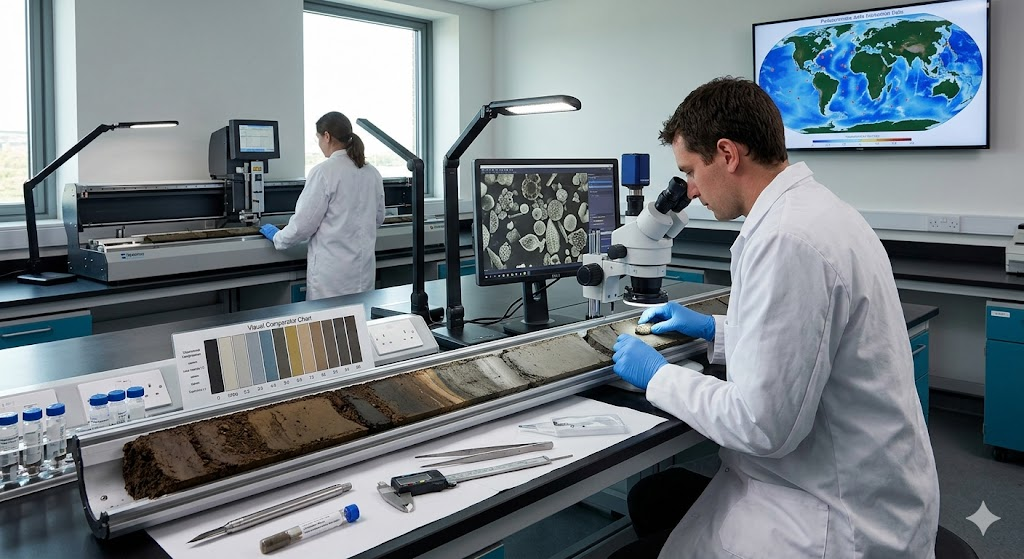
Additional Information
What the Course Entails and Exam Details
This practice test draws from a comprehensive curriculum that explores the intersection of geology and climatology. Candidates will demonstrate understanding of the methodologies used to analyze sediment cores and extract relevant climate data.
Key topics covered within the practice assessment include:
Sediment Core Mechanics: Understanding core sampling techniques and recognizing different types of marine sediments (terrigenous, biogenous, etc.).
Visual Core Description: Mastering the standard methods for describing and logging sediment cores, including color, texture, and structure.
Microfossil Analysis: Identifying key microfossils such as foraminifera, diatoms, and radiolarians, which are vital bio-indicators of past environmental conditions.
Stable Isotope Geochemistry: Applying principles of stable isotopes, particularly oxygen isotopes (δ18O), to reconstruct past ocean temperatures and ice volume.
Radiometric Dating: Understanding the use of isotopes like Carbon-14 (C14) for establishing accurate timelines in relatively recent sediments.
Paleoclimate Reconstructions: Interpreting derived data to reconstruct major historical climate events, such as glacial-interglacial cycles, the Paleocene-Eocene Thermal Maximum (PETM), and rapid climate fluctuations.
What to Expect in the Final Exam
While this is a practice test, it mimics the structure and difficulty of a professional certification or advanced academic exam.
Candidates can expect the following structure when attempting the final version of this assessment:
Exam Format: A mix of detailed multiple-choice and short-answer practical questions. The practical sections will likely involve analyzing images of sediment cores, identifying microfossils, or interpreting geochemical data plots.
Time Limit: Approximately 90 minutes to complete the exam.
Passing Score: Typically, a passing grade requires achieving 70% or higher.
Examination Environment: The exam is usually proctored and taken digitally. No external notes, smartphones, or other unauthorized resources are permitted. Scientific calculators may be allowed or provided within the digital interface.
How to Study and Exam Centers
Effective preparation for this practice test, and any resulting official exam, demands a targeted approach that blends theoretical knowledge with practical skill application.
Here are highly effective study strategies:
Practice with Real Core Data: Review published scientific articles that focus on ocean sediment core analysis. Familiarize yourself with how data like δ18O curves and microfossil counts are presented.
Leverage Visual Guides: Use illustrated guides to practice identifying major groups of microfossils. Recognizing these indicators is a core skill tested.
Utilize this Practice Test Systematically: Do not just take the test once. Review all questions, understand the reasoning behind correct answers, and research any topics you find challenging.
Focus on Calculations: Review the mathematics behind common geochemical calculations, such as temperature conversions derived from isotope ratios.
Exam Centers: This specific practice test is delivered online. Official certifications or exams linked to this type of content are typically administered through secure online proctoring platforms (such as those associated with major educational providers or university portals). Candidates register online and must adhere to strict integrity requirements while taking the assessment from a private, controlled location. If a physical testing center is required, details would be provided during the registration process for the actual examination.
Job Opportunities from the Course
A strong understanding of Examining Ocean Floor Sediments is highly sought after in a variety of scientific and analytical fields. Completing this practice exam positions you as a strong candidate for several exciting career paths.
Potential job opportunities include:
Marine Geologist / Sedimentologist: Investigating ocean floor composition and history.
Paleoclimatologist: Specializing in the study of past climate data.
Environmental Consultant: Assessing historical climate risks for infrastructure projects and development.
Laboratory Technician (Sedimentology/Micropaleontology): Processing and analyzing core samples in a research or commercial lab.
Research Assistant (Climate Science): Supporting advanced academic research into ocean and climate systems.
Climate Data Analyst: Interpreting complex datasets derived from proxy records to inform policy and modeling.
Frequently Asked Questions
Reviews
5.0
Based on 0 reviews
Leave a Review
No reviews yet. Be the first to review!