
BCIN Designer Legal/Process Practice Exam
$69.00
- Buy to unlock unlimited access to all Quiz questions and Answers in this Quiz.
- After purchase you can print a PDF of the whole quiz at any point. The PDF will contain the questions and the correct answers.
About this Exam
The BCIN Designer Legal/Process examination is the foundational requirement for individuals seeking to qualify as Registered Building Practitioners (RBPs) in the Province of Ontario, Canada. Administered under the Ontario Building Code Act, this crucial test validates an applicant's knowledge of the complex legal and administrative framework governing construction within the province. It is designed for aspiring residential and commercial building designers who wish to offer their services directly to the public, as well as those looking to work within municipal building departments or architectural and engineering firms. The primary objective is to ensure that all practitioners responsible for designing buildings that are not part of the standard architect or engineer scope are proficient in the application of the relevant laws and the complex regulatory processes. Obtaining your BCIN number (Building Code Identification Number) is the necessary gateway to legally submitting designs and construction documents for permit applications in Ontario.
Ready to test your knowledge?
Buy Now to Access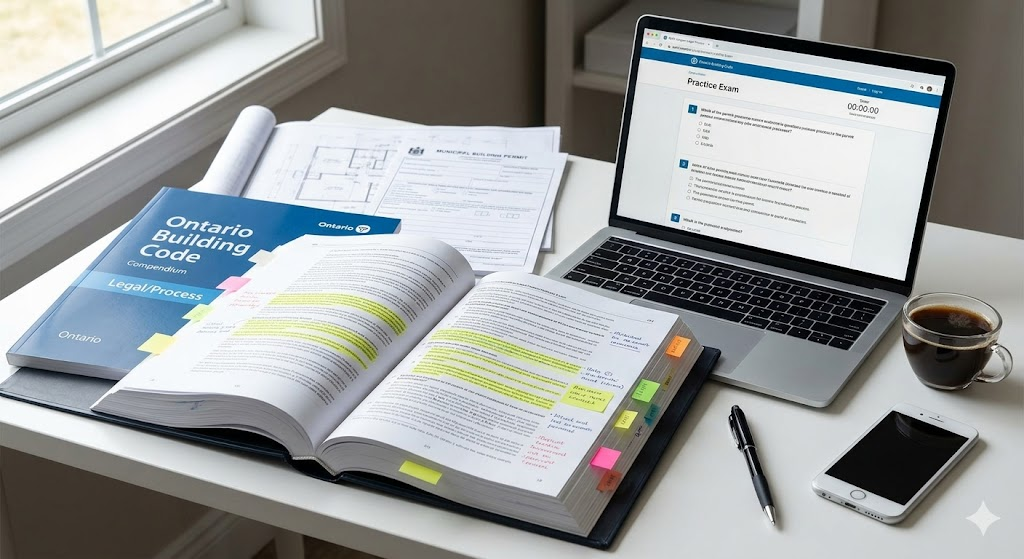
Additional Information
What the Course Entails and Exam Details
This examination does not test technical design principles or structural engineering calculations; rather, it is purely focused on the administrative, procedural, and legal aspects of construction in Ontario. The exam content is primarily drawn from the Building Code Act, 1992, and Division C of the 2012 Ontario Building Code (the Administrative Provisions). Students preparing for this test must acquire a deep understanding of the regulatory landscape and the interplay between different levels of government and key stakeholders.
The core syllabus and topics covered in the BCIN Designer Legal/Process exam include:
The Ontario Building Code Act, 1992: Comprehensive study of the primary legislative document, including its structure, intent, and application.
The 2012 Building Code (Division C - Administrative Provisions): An in-depth examination of the actual regulations that implement the Act, focusing on permitting, inspections, and enforcement.
Roles and Responsibilities: Understanding the specific powers, duties, and functions of the Chief Building Official (CBO), municipal building departments, inspectors, and the designer's legal obligations.
Permit Application Processes: Mastery of the steps, documentation, and procedures required for different types of building and demolition permits, including complete applications, permit issuance timelines, and permit revocation.
Inspections and Compliance: Knowledge of mandatory inspection stages, conditional permits, alternative compliance methods, and the legal tools for enforcement (Orders to Comply, Unsafe Orders).
Designer Registration and Qualification: Clear understanding of the BCIN system, professional liability insurance requirements, code of conduct, and different classes of registration.
Appeals and Legal Recourse: Understanding the process for appealing decisions to the Building Code Commission (BCC) or the courts.
Administration Law Principles: Familiarity with concepts like procedural fairness, natural justice, and the statutory powers of the CBO as they relate to code implementation.
What to Expect in the Final Exam
The BCIN Designer Legal/Process exam is notoriously demanding, designed to rigorously assess your ability to quickly and accurately navigate the dense legal and regulatory language. While the specific number of questions and exact time limits may vary slightly, here are the general parameters you can expect:
Exam Format: The test is a 100-question, multiple-choice examination.
Testing Method: It is usually administered as an "open-book" exam. However, this is NOT an invitation to under-prepare; the time limit makes it impossible to research every answer from scratch. Efficiency is paramount.
Required Materials: Candidates are permitted (and expected) to bring physical, bound copies of the Building Code Act and the Ontario Building Code into the testing room. Electronic versions or loose-leaf papers are strictly prohibited.
Passing Score: The required passing grade is 70% (70 out of 100 questions correct).
Time Limit: Expect a strict time window, typically 3 to 4 hours (for example, 3.5 hours). This translates to approximately 2.1 minutes per question, highlighting the critical need for speed and effective referencing.
Content Breakdown: The questions are divided into general administrative law principles and specific code-based administrative scenarios. Success hinges on knowing not just what the rules are, but where exactly to find the authoritative reference to back your answer.
How to Study and Exam Centers
Effective preparation for the BCIN Designer Legal/Process exam requires a strategic combination of thorough reading and practical, hands-on practice. It is less about memorizing every regulation and more about developing an elite ability to navigate the Building Code quickly and accurately.
Study Strategies:
Read and Reread the Sources: Thoroughly study the Building Code Act and Division C of the 2012 Building Code to understand the overall structure, themes, and logic behind the regulations. Identify key terms and definitions.
Learn the Index: Mastering the index of both documents is your single most important skill. Practice finding specific concepts, terms, and sections solely using the index as your starting point.
Tab and Highlight Your Copies: Legally permissible tabbing (using clear, non-detachable plastic tabs and color-coding) is your secret weapon. Strategically tab crucial sections like roles, permits, inspections, and classes of registration to slash reference time. Highlight important deadlines, definitions, and statutory powers.
Take Multiple Timed Practice Exams: Simulate real exam conditions as often as possible. Use practice tests to build up your referencing speed and stamina, aiming to complete each exam well within the time limit. Treat the open-book aspect as a speed tool, not a crutch.
Focus on Specific Scenarios: Instead of memorizing abstract concepts, practice applying the code to practical legal questions. Understand the specific procedures required for complex permitting situations, alternative design approvals, or appealing CBO decisions.
Exam Centers:
The BCIN Designer Legal/Process exams are official provincial examinations, administered by the Ministry of Municipal Affairs and Housing (MMAH) or their authorized testing partners.
Authorized Testing Centers: Exams are offered at various municipal centers, colleges, and other private authorized testing facilities across Ontario. You must register directly through the MMAH's official BCIN portal (often hosted on external registration sites).
Educational Institutions: Many community colleges (e.g., Humber College, George Brown College, Algonquin College) are official BCIN partners, delivering both prep courses and the exams themselves. Taking the exam where you took your preparatory training can offer a familiar environment.
Third-Party Vendors: In some cases, the province may utilize large-scale testing vendors for delivery. Always consult the official Ministry website for the most current information and designated test centers.
Job Opportunities from the Course
Successfully passing this exam is the prerequisite to obtaining your BCIN number. It doesn't just grant you a qualification; it is the cornerstone that builds the trust municipalities require to approve your designs. This foundation opens up a diverse and rewarding range of career paths within Ontario's thriving building and construction sector.
Registered Building Practitioner (RBP): This is the primary destination, enabling you to legally design residential buildings (houses, cottage, townhomes) or small commercial structures for the public.
Independent Residential Designer: Run your own firm, designing custom low-rise homes, renovations, and additions for clients.
Architectural Technologist/Technician: Apply your regulatory expertise as a specialized code compliance expert within larger architectural and design firms.
CADD/BIM Operator and Designer: Increase your value within construction companies by ensuring designs are fully compliant with legal processes before they hit the CBO.
Building Inspector / Plans Examiner (with additional technical exams): Use this foundation as a critical stepping stone toward a career within municipal building departments, reviewing plans for code compliance and conducting on-site inspections.
Real Estate Code Consultant: Advise developers, real estate agents, and investors on complex zoning, permitting, and building code compliance issues.
Zoning and Planning Consultant: Specialize in the preliminary stages of development, navigating municipal official plans and bylaws as they interface with the Building Code Act.
Construction Project Manager: Master the critical timelines and permitting processes that determine project success, ensuring smooth handoffs from design to construction.
We hope this study guide article provides a clear roadmap for your journey toward mastering the BCIN Designer Legal/Process examination. Remember, success comes from meticulous preparation and developing swift navigation skills. Best of luck in your studies!
Frequently Asked Questions
Reviews
5.0
Based on 0 reviews
Leave a Review
No reviews yet. Be the first to review!