
Beaumont Fire/Rescue Patient Care Protocols Practice Test
$69.00
- Buy to unlock unlimited access to all Quiz questions and Answers in this Quiz.
- After purchase you can print a PDF of the whole quiz at any point. The PDF will contain the questions and the correct answers.
About this Exam
Welcome to your essential resource for mastering the Beaumont Fire/Rescue Patient Care Protocols Practice Test. This examination is a critical component for Emergency Medical Services (EMS) professionals looking to operate within the specific guidelines and high standards set by Beaumont Fire/Rescue. This practice test is specifically designed for Paramedics (EMTP), Advanced EMTs (AEMT), and EMTs currently serving or aspiring to join the emergency medical response teams in the region. Understanding and applying these distinct clinical guidelines is vital for ensuring the highest level of consistent, evidence-based care for every patient you encounter in the pre-hospital setting. Mastering these protocols is not just about passing an exam; it is about guaranteeing patient safety and enhancing survival outcomes in critical situations.
Ready to test your knowledge?
Buy Now to Access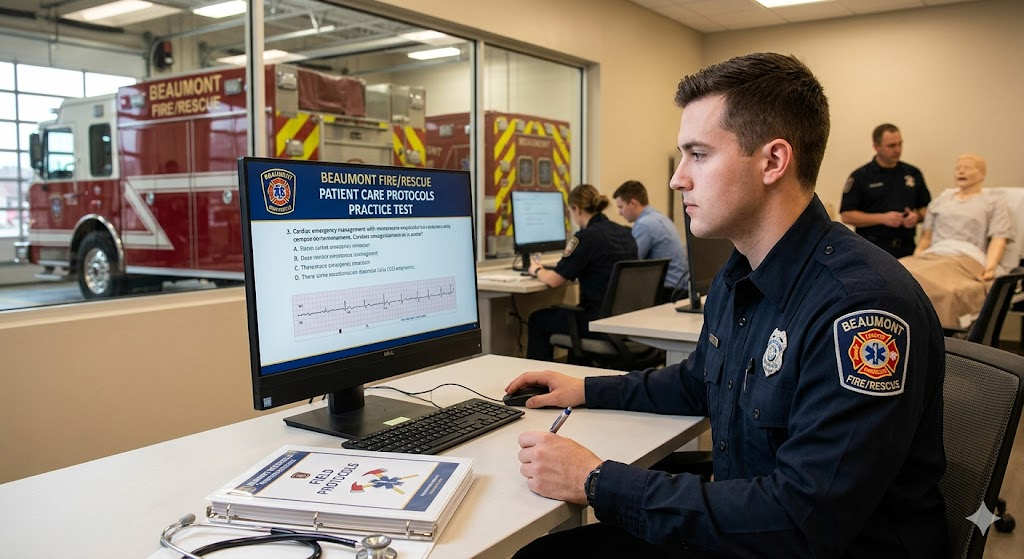
Additional Information
What the Course Entails and Exam Details
Preparing for this assessment involves an in-depth review of the current Beaumont Fire/Rescue clinical operating procedures. The exam does not create new medical science but tests your ability to strictly adhere to the specific algorithm-based care authorized by the regional Medical Director.
The practice test encompasses the full spectrum of EMS operations, including:
Clinical Protocols: This is the core of the exam. You must know the exact algorithms for Adult Medical Emergencies (such as cardiac arrest/STEMI, stroke, respiratory distress, and dynamic arrhythmias) and Adult Trauma Management.
Special Populations: The protocols dictate distinct treatments for specific groups. You will be tested on Pediatric Medical and Trauma Protocols, as well as critical Obstetrics and Neonatal Resuscitation guidelines.
Pharmacology and Dosages: You must master the indications, contraindications, and specific dosages allowed under the Beaumont Fire/Rescue system for all formulary medications (e.g., Amiodarone, Fentanyl, Epinephrine, Zofran, etc.).
Skill Performance and Procedures: While this is a cognitive practice test, the questions will reflect the operational knowledge required to perform procedures such as advanced airway management, intraosseous access, synchronized cardioversion, and chemical restraint.
Operational and Administrative Policies: This section may cover standing orders vs. required online medical control consultation, patient refusal criteria, and documentation standards specific to the jurisdiction.
What to Expect in the Final Exam
While the final credentialing or continuing education exam is administered directly by or on behalf of Beaumont Fire/Rescue, it typically follows a standard professional licensure format. It is crucial to check the specific details provided by your department or the regional medical authority before test day.
Generally, you can expect the following structure for the final examination:
Format: The exam usually consists of complex multiple-choice questions (MCQs) designed to test critical thinking. Rather than just asking for definitions, the scenarios will present a patient situation and require you to select the next appropriate step in the sanctioned Beaumont protocol.
Passing Score: Because clinical protocols are tied to patient safety, the passing score is historically high. You should aim for a score of 80% to 90%, depending on the current regional training standard.
Time Limits: The examination is timed to assess your ability to recall critical information quickly, simulating the pressure of field operations. A common time allocation is approximately one to two minutes per question.
Exam Rules: The actual test is a high-stakes, proctored event. You are not allowed access to protocol handbooks, smartphones, or external notes during the test. Verification of licensure (EMT, Paramedic) is usually required before taking the exam.
How to Study and Exam Centers
Successfully passing the Beaumont Fire/Rescue Patient Care Protocols exam requires dedication, repetition, and practical application of the knowledge.
Effective Study Strategies:
Study the Source: Do not only rely on study guides. Download the official current Beaumont Fire/Rescue Patient Care Protocols PDF. Read it carefully from cover to cover.
Create Treatment Algorithms: Do not memorize isolated facts. Draw flowcharts based exactly on the protocols for complex conditions like chest pain, asthma, and altered mental status. Visualizing the steps will help on test day.
Use Flashcards for Meds: Focus specifically on the dosages allowed by Beaumont Fire/Rescue. National Registry standard doses might differ slightly from specific regional standing orders. Flashcards are ideal for mastering these specifics.
Practice with Real-World Scenarios: With a study partner, practice running scenarios. One person describes the patient and dynamic vitals; the other must verbalize the protocol-driven steps to treatment. This mimics clinical reality.
Exam Centers and Testing Locations:
This exam is localized. It is not generally taken at national centers like Pearson VUE or Prometric unless specifically contracted for continuing education tracking.
You will typically register for and take the actual credentialing exam through the following local entities:
Beaumont Fire/Rescue Training Academy: Contact the training officer at the academy directly to schedule your exam or inquire about upcoming continuing education testing windows.
Authorized Regional Medical Control Offices: The test may be proctored through the regional EMS coordinator’s office (Southeast Texas Regional Advisory Council - SETRAC).
Departmental Online Portals: For continuing education recertification, many departments utilize secure, proctored internal Learning Management Systems (LMS). Ensure your department credentials are active.
Job Opportunities from the Course
Successfully demonstrating mastery of the Beaumont Fire/Rescue Patient Care Protocols is the fundamental requirement for beginning or continuing employment in several key roles within the regional emergency response network. This certification ensures you are medically authorized to practice under the specific guidance of the system.
Achieving success on this exam is required for the following career paths:
Beaumont Fire Department Firefighter/Paramedic
Beaumont Fire Department Single-Role Paramedic (if offered)
Critical Care Transport (CCT) Paramedic for contracted services
Clinical Supervisor or EMS Field Training Officer (FTO) in Beaumont-based agencies
911 Dispatcher with Emergency Medical Dispatch (EMD) and Protocol Oversight duties
Emergency Room Technician at Beaumont regional trauma centers
Oil and Gas/Industrial Site Paramedic within the Beaumont/Golden Triangle economic zone
By investing the time to master these protocols, you are not only securing your position but also dedicating yourself to providing the highest quality, most advanced medical care to the citizens of Beaumont. Good luck!
Frequently Asked Questions
Reviews
5.0
Based on 0 reviews
Leave a Review
No reviews yet. Be the first to review!