
BECO Post Course Assessment Practice Test
$69.00
- Buy to unlock unlimited access to all Quiz questions and Answers in this Quiz.
- After purchase you can print a PDF of the whole quiz at any point. The PDF will contain the questions and the correct answers.
About this Exam
The BECO Post Course Assessment is the definitive final examination designed to measure a student’s comprehensive understanding of foundational and applied principles of Business Economics.
This assessment is typically the capstone component of a dedicated Business Economics (BECO) module within a broader academic program, such as a Bachelor’s degree in Business Administration, Finance, or Accounting, or a specialized professional development certification.
The exam is meticulously crafted for students, aspiring financial analysts, business managers, and anyone seeking to demonstrate mastery in applying economic theory to practical business decision-making.
By passing this assessment, candidates prove their ability to analyze market trends, understand consumer behavior, evaluate costs, and strategic forecasting—skills critical for success in today’s competitive global economy.
Ready to test your knowledge?
Buy Now to Access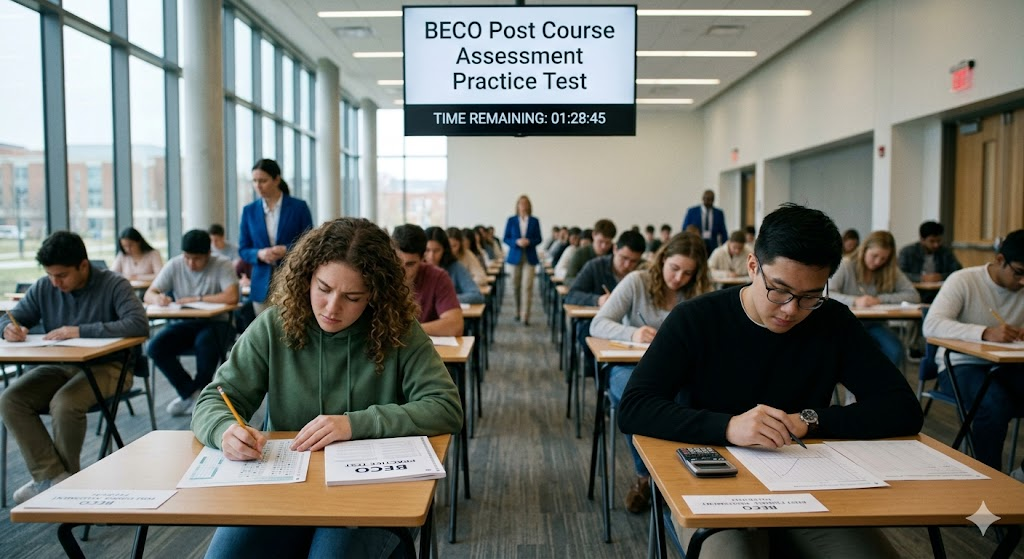
Additional Information
What the Course Entails and Exam Details
A standard BECO course covers the intersection of microeconomic theory and practical business management. The syllabus is rigorous, focusing on how businesses can optimize their operations and strategy within various market structures.
Candidates preparing for the assessment should have a strong grasp of the following core areas:
Foundations of Business Economics: The scope of managerial economics, the theory of the firm, and the role of profit.
Demand Analysis and Forecasting: Consumer choice theory, elasticity of demand (price, income, and cross-price), and demand forecasting techniques.
Production and Cost Analysis: Production functions, law of diminishing returns, economies and diseconomies of scale, and short-run versus long-run cost curves.
Market Structures and Pricing: Perfect competition, monopoly, monopolistic competition, and oligopoly. Strategies for pricing under different market conditions, including price discrimination.
Game Theory and Strategic Behavior: Analyzing competitive interactions, Nash equilibrium, and pricing strategies in oligopolistic markets.
Regulation and Antitrust Policy: The role of government in regulating markets, understanding market failures, and the impact of antitrust laws on business strategy.
Capital Budgeting and Risk Analysis: Investment decisions, net present value (NPV) analysis, and assessing risk in business ventures.
The corresponding assessment is designed to test not only the theoretical recall of these concepts but also the ability to apply quantitative methods to solve real-world business problems.
What to Expect in the Final Exam
While specific formats may vary by institution or standardizing body, the BECO Post Course Assessment generally adheres to a structured, timed format to ensure a fair measurement of competency.
Candidates should expect the following:
Exam Format: Most BECO final assessments are a hybrid model. The first component usually consists of multiple-choice questions (MCQs) designed to test breadth of knowledge and speed. The second component often involves descriptive or scenario-based questions that require numerical calculation, graphical analysis, and structured essay answers.
Total Questions: Typically ranges from 50 to 100 MCQs, plus 3 to 5 comprehensive descriptive/calculation problems.
Time Limit: A standard sitting is usually between 2 and 3 hours.
Passing Score: The passing threshold is typically set between 60% and 70%. It is crucial to review the specific requirements of your course syllabus.
Specific Rules: This is a closed-book exam. Candidates are usually permitted a non-programmable financial calculator. Graph paper might be provided or required for market structure and cost curve analysis.
How to Study and Exam Centers
Effective preparation for the BECO Post Course Assessment requires a balanced approach of theoretical review and practical application.
Here are actionable strategies to ensure success:
Master the Formulas and Graphs: Business Economics is visually and mathematically intensive. Dedicate specific study time to drawing and interpreting cost curves, revenue curves, and supply/demand diagrams. Create a formula sheet for elasticities, cost functions, and pricing strategies, and practice using them until they become second nature.
Utilize Official Practice Tests: The "BECO Post Course Assessment Practice Test" is your most valuable resource. Take it under timed conditions to identify your weak areas and familiarize yourself with the question style and difficulty level.
Solve Descriptive Case Studies: Do not rely solely on multiple-choice practice. Practice writing out solutions to complex, multi-part problems that require you to analyze a market scenario, recommend a pricing strategy, or calculate optimal production levels.
Form Study Groups: Explaining economic concepts to peers is one of the best ways to solidify your own understanding. Study groups can also help you tackle difficult descriptive questions from different perspectives.
Regarding Exam Centers, the location of your test depends on whether you are taking the course through a university, an online platform, or a professional body.
University/College Students: If you are a registered student, the exam will typically be held at your institution’s designated testing hall during the final examination period.
Online Course Learners: For courses completed through online portals (e.g., Coursera, edX, or an institution’s learning management system like Canvas), the assessment may be offered through an online proctoring service (such as ProctorU), allowing you to take the test from home under strict monitoring.
Professional Certification Candidates: If the BECO course is part of a professional charter, you may need to register to take the exam at an authorized physical testing center, such as Pearson VUE or Prometric, which have locations globally.
Job Opportunities from the Course
Mastery of Business Economics is a highly transferable skill set that is attractive to employers across a multitude of industries. Successfully completing this course and assessment signals to employers that you possess advanced analytical and decision-making capabilities.
Below are specific job titles and career paths that a strong foundation in BECO unlocks:
Business Analyst
Financial Analyst
Market Research Analyst
Pricing Strategist
Economic Consultant
Data Analyst (Business Intelligence)
Management Trainee
Operations Manager
Supply Chain Analyst
Policy Analyst (Government or NGO)
Project Manager
Graduates often find lucrative opportunities in banking, manufacturing, healthcare management, tech firms, and government agencies, where their ability to interpret data and forecast trends directly impacts a company's bottom line.
Frequently Asked Questions
Reviews
5.0
Based on 0 reviews
Leave a Review
No reviews yet. Be the first to review!