
Beechcraft Travel Air BE‑95 Practice Test
$69.00
- Buy to unlock unlimited access to all Quiz questions and Answers in this Quiz.
- After purchase you can print a PDF of the whole quiz at any point. The PDF will contain the questions and the correct answers.
About this Exam
The Beechcraft Travel Air BE‑95 is a legendary light twin‑engine aircraft, often revered as the premier platform for pilots taking the next step in their aviation career. This comprehensive study guide and practice environment is designed specifically for pilots seeking to add an Airplane Multi‑Engine Land (AMEL) rating to their existing Private or Commercial Pilot Certificate.
Mastering the BE‑95 demonstrates your proficiency in handling complex systems, managing asymmetric thrust, and operating advanced aircraft. This practice environment helps bridge the gap between ground school and the flight deck, ensuring you are prepared for the demanding standards of the official practical test.
Ready to test your knowledge?
Buy Now to Access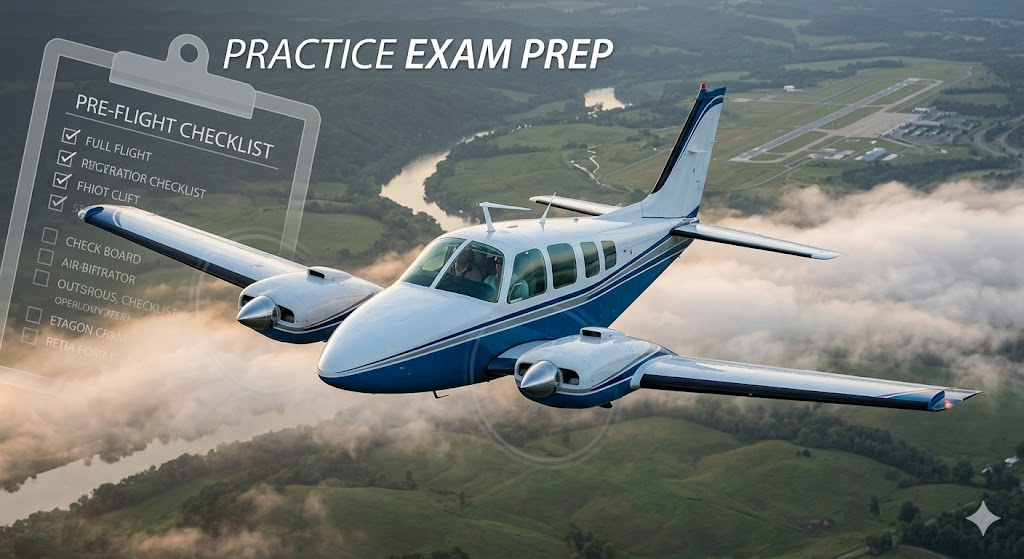
Additional Information
What the Course Entails and Exam Details
Preparation for the BE‑95 exam involves a deep dive into both the theoretical knowledge and practical application of multi‑engine operations. You will spend significant time studying the Beechcraft Travel Air Pilot’s Operating Handbook (POH) and FAA Airman Certification Standards (ACS).
The core syllabus covers multi‑engine aerodynamics, including critical engine factors and V‑speeds such as Vmc and Vyse. You will learn the intricate details of the BE‑95’s specific systems, focusing heavily on fuel management, electrical systems, and landing gear operation.
Emergency procedures comprise a substantial portion of the training. You must master single‑engine operations, including engine failure during takeoff, en route, and on approach. The goal is to develop instinctive, accurate, and safe decision‑making skills under pressure.
What to Expect in the Final Exam
It is important to understand that there is no single "written exam" for the BE‑95 itself. The culmination of your training is the FAA Practical Test, commonly known as the checkride. This test is administered by a Designated Pilot Examiner (DPE) and consists of two primary components.
The first part is the Ground Oral Exam. The DPE will question you extensively on the BE‑95’s POH, weight and balance calculations, performance planning, and multi‑engine aerodynamics. You must answer thoroughly and accurately, demonstrating advanced knowledge.
The second part is the Flight Test. You will be required to perform all maneuvers listed in the Multi‑Engine ACS within specific tolerances. The DPE will simulate emergencies, including engine failures, and evaluate your ability to maintain aircraft control, follow correct checklists, and make sound aeronautical decisions. A passing score is a "Satisfactory" performance in all areas of operation.
How to Study and Exam Centers
Effective study for the BE‑95 practical test requires a balanced approach. Start by memorizing the "Memory Items" for emergency procedures straight from the POH; there is no substitute for instantaneous recall during a simulated failure. Create flashcards for all relevant V‑speeds and system limitations.
Utilizing a Flight Simulation Training Device (FSTD) or a high‑quality desktop simulator configured for a light twin can be incredibly beneficial. This allows you to practice cockpit flows, checklist usage, and emergency procedures in a safe environment.
Because the final exam is a practical flight test, you do not take it at a standard computer testing center like Pearson VUE. Instead, you will coordinate with your authorized flight instructor or flight school to schedule the checkride. They will facilitate the connection with a DPE who will conduct the examination at your local airport or a designated flight school base.
Job Opportunities from the Course
Earning your Multi‑Engine Rating in a BE‑95 is often described as the "gateway" rating for professional pilots. This qualification drastically increases your employability and opens the door to numerous high‑paying career paths.
Most standard professional flying positions require at least a Commercial Multi‑Engine Rating. This includes paths to become a Regional Airline Pilot or a Corporate Aviation Pilot, flying business jets or turboprops.
You may also pursue roles in Cargo Operations, Air Ambulance services, or Aerial Surveying, all of which heavily utilize multi‑engine aircraft. Many pilots choose to become a Multi‑Engine Flight Instructor (MEI), a role that is in high demand and allows you to build necessary turbine‑transition hours. This rating is an indispensable step toward your Airline Transport Pilot (ATP) certificate.
Frequently Asked Questions
Reviews
5.0
Based on 0 reviews
Leave a Review
No reviews yet. Be the first to review!