
Beginner Scuba Certification Practice Test
$69.00
- Buy to unlock unlimited access to all Quiz questions and Answers in this Quiz.
- After purchase you can print a PDF of the whole quiz at any point. The PDF will contain the questions and the correct answers.
About this Exam
Your gateway to the underwater world begins with the beginner scuba certification, most commonly known as the Open Water Diver course.
This globally recognized certification is designed for absolute beginners and individuals who want to explore the oceans safely and confidently.
It is the essential first step that equips you with the fundamental knowledge and practical skills required to dive independently with a buddy, to a maximum depth of 18 meters (60 feet).
Ready to test your knowledge?
Buy Now to Access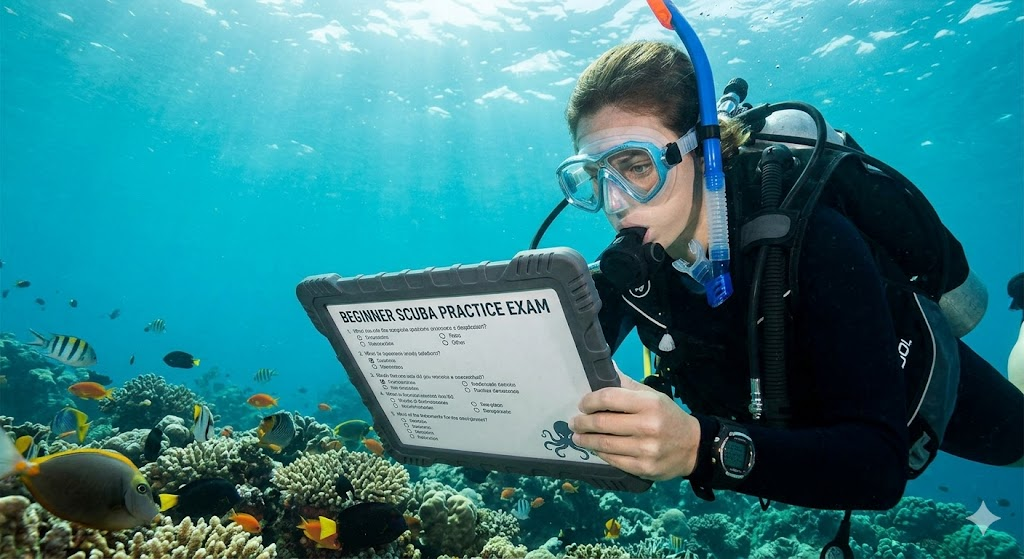
Additional Information
What the Course Entails and Exam Details
The path to becoming a certified diver is structured into three key phases, designed to build your competence progressively.
First is Knowledge Development. This covers the principles and theory of scuba diving, including equipment selection, safety procedures, the physics of diving, and the aquatic environment. This is often completed via eLearning, a manual, or classroom sessions.
Second is Confined Water Dives. In a controlled environment like a swimming pool, you will learn and practice essential scuba skills, such as clearing your mask, retrieving your regulator, and mastering buoyancy control, under the direct supervision of an instructor.
Finally, you will complete Open Water Dives. Over four or more dives in the ocean or a clear lake, you will apply your skills in a real-world setting, demonstrating your ability to dive safely and explore.
What to Expect in the Final Exam
To assess your mastery of the Knowledge Development phase, you must pass a final written exam.
This exam typically consists of approximately 50 multiple-choice questions designed to test your understanding of critical safety rules and diving theory.
You will encounter scenarios regarding dive planning, emergency procedures, the effects of pressure, and equipment usage.
The required passing score is generally around 75% to 80%. While a specific time limit might be set by your instructor, the focus is on ensuring you understand the material thoroughly rather than speed.
You must pass this exam before you can participate in the Open Water Dives phase.
How to Study and Exam Centers
Preparation is key to passing your written exam with ease.
Begin by thoroughly reading your training agency’s Open Water Diver Manual or completing all eLearning modules. Pay close attention to the Knowledge Reviews at the end of each chapter.
Utilize practice tests and quizzes provided by your training organization (such as PADI, NAUI, or SSI) or authorized schools. These resources are specifically designed to mimic the format and content of the final exam.
Focus your study time on critical safety concepts, such as the buddy system, RDP (Recreational Dive Planner) or dive computer usage, and emergency ascent procedures.
For the theory part of the certification, you can take the exam through the online portal of your chosen training agency.
The practical components (confined and open water) and sometimes the written exam itself must be taken through an authorized physical Dive Center or Resort.
Job Opportunities from the Course
Earning your beginner scuba certification is not just about recreational fun; it is the prerequisite for a wide range of exciting career paths in the thriving global dive industry.
This certification unlocks entry-level positions and is the required starting point for all professional-level dive training. Here are the specific job titles and career paths this course makes possible:
Divemaster (Entry-Level Professional): Leads certified divers on underwater tours and assists instructors with training classes.
Open Water Scuba Instructor: Teaches all core certification courses, from beginner to professional levels.
Dive Shop or Resort Manager: Oversees daily operations, equipment sales, and staff management at a dive center.
Underwater Photographer/Videographer: Captures images and video of marine life for media, tourism, or research.
Marine Biologist: Conducts research and conservation work, often requiring diving for sample collection and habitat surveys.
Scientific Diver: Performs underwater tasks for research institutions, archaeological surveys, or environmental monitoring.
Public Safety Diver: Works with law enforcement and emergency services for search, rescue, and recovery operations.
Commercial Diver (with advanced training): Performs underwater construction, welding, or inspection tasks (Open Water is the fundamental first requirement).
Frequently Asked Questions
Reviews
5.0
Based on 0 reviews
Leave a Review
No reviews yet. Be the first to review!