
Beginning Pneumatics Practice Test
$69.00
- Buy to unlock unlimited access to all Quiz questions and Answers in this Quiz.
- After purchase you can print a PDF of the whole quiz at any point. The PDF will contain the questions and the correct answers.
About this Exam
The Beginning Pneumatics Practice Test is a crucial diagnostic tool for individuals starting their journey into the world of fluid power and automated systems. This exam is designed for entry-level technicians, maintenance personnel, engineering students, and anyone seeking to validate their understanding of fundamental pneumatic principles. It assesses knowledge necessary for careers in manufacturing, automation, and industrial maintenance, ensuring a solid foundation before moving on to more complex systems.
Ready to test your knowledge?
Buy Now to Access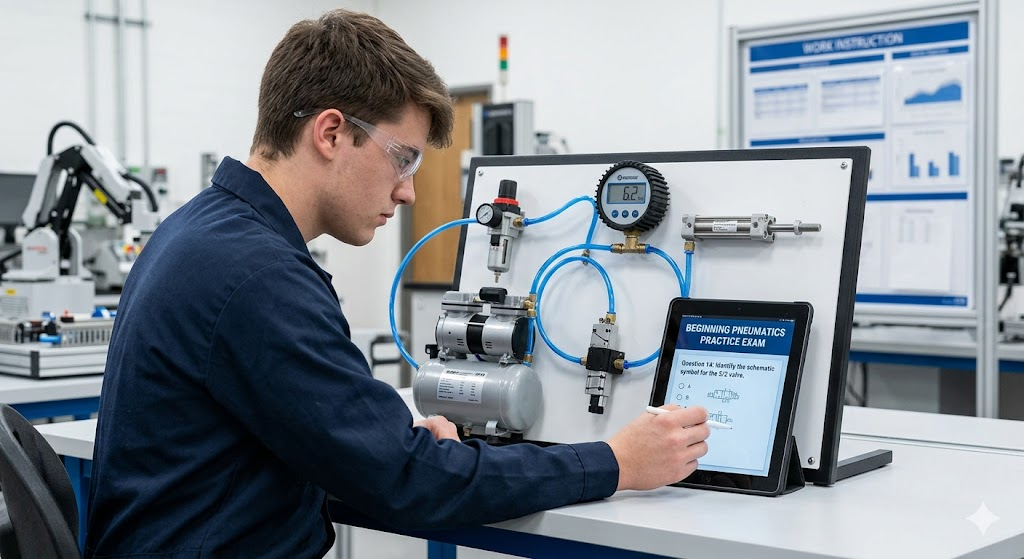
Additional Information
What the Course Entails and Exam Details
This examination focuses on the core concepts of pneumatic technology. Candidates must demonstrate proficiency in understanding the properties of compressed air and how it is used to transmit power. The syllabus typically covers identifying basic pneumatic components such as compressors, regulators, filters, directional control valves, and actuators (both linear and rotary). Students are expected to understand the function of these components and how they interact within a system. Additionally, the course emphasizes reading and interpreting basic pneumatic schematic diagrams, troubleshooting common circuit issues, and understanding crucial safety protocols when working with pressurized systems.
What to Expect in the Final Exam
The final exam for Beginning Pneumatics usually takes the form of a closed-book, multiple-choice assessment. While specific formats can vary by certifying body, it typically consists of approximately 40 to 60 questions to be completed within a standard time limit, often around 60 to 90 minutes. Candidates generally need a score of 70% or higher to pass. The questions test a blend of theoretical knowledge, component identification, and practical problem-solving using schematics and hypothetical troubleshooting scenarios.
How to Study and Exam Centers
Effective preparation requires a mix of theoretical study and practical familiarity. Begin by thoroughly reviewing your course textbook or training materials, focusing specifically on definitions, component functions, and safety rules. Spend significant time practicing schematic reading; redraw basic circuits and explain the air flow in different valve positions. Actively taking the Beginning Pneumatics Practice Test is vital to familiarize yourself with the question formatting and identify knowledge gaps. Hands-on experience with trainers in a lab setting is highly recommended. The final exam can often be taken through the authorizing school, specific physical testing centers, or authorized professional organizations such as the International Fluid Power Society (IFPS).
Job Opportunities from the Course
A certification or solid performance in Beginning Pneumatics opens the door to numerous entry-level technical roles in manufacturing, processing, and automation sectors.
Pneumatic Technician
Maintenance Mechanic
Assembly Technician
Machine Operator
Automation Technician Apprentice
Field Service Technician
Industrial Maintenance Technician
Frequently Asked Questions
Reviews
5.0
Based on 0 reviews
Leave a Review
No reviews yet. Be the first to review!