
Bennett Mechanical Comprehension Practice Test
$69.00
- Buy to unlock unlimited access to all Quiz questions and Answers in this Quiz.
- After purchase you can print a PDF of the whole quiz at any point. The PDF will contain the questions and the correct answers.
About this Exam
The Bennett Mechanical Comprehension Test (BMCT) is a premier, gold-standard assessment used for over 60 years to measure an individual's mechanical aptitude and ability to understand physical principles.
This exam is not designed to test specific job knowledge or advanced mathematics.
Instead, it evaluates your intuitive understanding of how the physical world works and your ability to apply mechanical reasoning to solve practical problems.
It is primarily used by employers during the hiring process to screen candidates for technical, industrial, maintenance, manufacturing, and engineering roles.
If you are applying for a position that requires you to work with machinery, tools, or complex systems, a strong score on the BMCT demonstrates that you have the innate potential to learn quicky and succeed in a mechanically demanding environment.
Ready to test your knowledge?
Buy Now to Access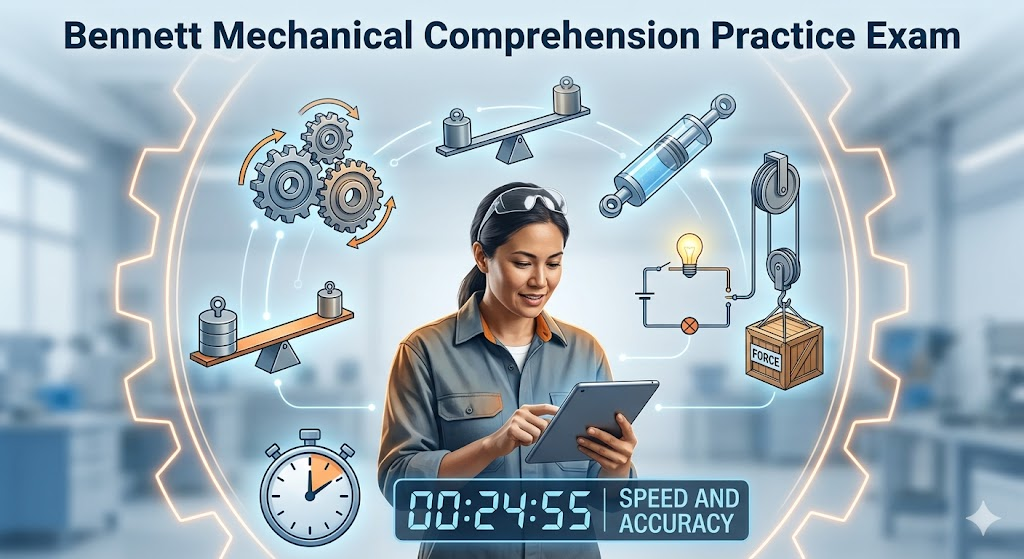
Additional Information
What the Course Entails and Exam Details
This exam covers a broad spectrum of fundamental mechanical and physical concepts.
While it is called a "test," think of your preparation as a "course" in developing a technical mindset.
The key areas you must understand are not complex theories, but how basic principles interact in everyday scenarios.
The syllabus primarily focuses on twelve key categories:
Pulleys and Levers: Understanding mechanical advantage, equilibrium, and how force is transferred through simple machines.
Gears and Belt Drives: Determining direction of rotation, speed ratios, and torque trade-offs.
Force and Motion: Recognizing the effects of inertia, momentum, friction, and Newton’s laws.
Hydraulics and Fluids: Basic understanding of fluid pressure, buoyancy, and how systems like hydraulic presses function.
Gravity and Velocity: Predicting the path of objects in motion and the influence of gravity on falling bodies.
Electricity: Basic principles of circuits, logic, and component function.
Heat and Thermodynamics: Understanding heat transfer, expansion, and contraction.
Acoustics and Optics: Basic properties of sound and light transmission.
Structures and Planes: Identifying structural integrity, center of gravity, and the use of inclined planes.
Shape and Volume: Basic spatial visualization and reasoning.
The exam assesses your skill in interpreting diagrams and images that present a mechanical dilemma and choosing the most logical outcome based on these principles.
What to Expect in the Final Exam
The modern version of the exam, the BMCT-II, is a timed, multiple-choice assessment that is typically administered online.
Unlike exams that allow ample time to ponder each question, the Bennett Test is designed to measure how quickly and accurately you can process mechanical information under pressure.
You should expect the following format details:
Number of Questions: 55 questions.
Time Limit: 25 minutes.
Pacing: This averages out to approximately 27 seconds per question. Speed and decision-making are crucial.
Format: Multiple-choice. Most questions consist of an illustration or drawing followed by a question and three potential answers.
Passing Score: There is no universal "passing" score for the BMCT. Employers receive your score relative to a normative group (e.g., in a percentile ranking). The score needed depends entirely on the job role and the standards set by the hiring company. However, achieving a percentile of 60 or higher is generally considered strong for technical roles.
No Pen and Paper: Generally, you are not permitted to use calculators or scratch paper, as the test measures mental comprehension and deduction, not calculation.
How to Study and Exam Centers
Preparation is vital for this exam because the time pressure is intense.
Here are the best strategies to optimize your study time:
Effective Study Methods
Take Diagnostic Practice Tests: This is the most critical step. Practice tests simulate the real exam format and timing. They will immediately highlight which of the twelve mechanical concepts are your weakest areas.
Focus on Visual Reasoning: Do not just memorize formulas. Instead, look at diagrams of gears, pulleys, and hydraulics. Actively visualize how the forces are interacting and trace the "motion" from input to output.
Refresh Basic Physics: You do not need to be a physicist, but reviewing high-school-level physical science topics—specifically mechanics, electricity, and fluids—will provide the necessary foundational knowledge.
Master Pacing: When practicing, focus on moving quickly. If you do not know an answer after 15 seconds, eliminate impossible choices, make an educated guess, and move on. It is better to answer every question than to leave some blank.
Exam Centers and Administration
You cannot typically register to take the BMCT on your own to receive a general certification.
It is an employment screening tool administered directly by employers, government agencies, or union apprenticeship programs.
Employer Testing: Most often, a company you have applied to will send you a link to take the test remotely through a secure, proctored online portal.
Physical Testing Centers: In some cases, particularly for union apprenticeships or government roles, you might be required to take the test in person at a designated testing facility, a HR office, or a local community college that partners with the employer.
Pearson VUE: Since the BMCT is owned by Pearson, it is sometimes administered through Pearson VUE professional testing centers when a high degree of security is required.
Job Opportunities from the Course
A strong performance on the Bennett Mechanical Comprehension Test is a powerful asset that can unlock careers across many high-demand sectors.
Employers view high scores as a reliable predictor of your ability to succeed in training and perform safely on the job.
Unlocking this certification potential can lead to the following job titles and career paths:
Maintenance Technician
Industrial Mechanic
Mechatronics Engineer
HVAC Technician
Electrician (Apprentice and Journeyman)
Plumber and Pipefitter
Aerospace Mechanic
Automotive Service Technician
Heavy Equipment Operator
Machinist
Plant Operator
Elevator Constructor
Military Technical Specialist
Civil Engineering Technician
Firefighter (often used in the recruitment process)
By dedicating yourself to understanding the fundamental mechanical principles covered in this study guide, you are proving your aptitude and readiness for a dynamic career in the technical workforce. Good luck with your preparation!
Frequently Asked Questions
Reviews
5.0
Based on 0 reviews
Leave a Review
No reviews yet. Be the first to review!