
Best Warrior Board Practice Test
$69.00
- Buy to unlock unlimited access to all Quiz questions and Answers in this Quiz.
- After purchase you can print a PDF of the whole quiz at any point. The PDF will contain the questions and the correct answers.
About this Exam
The Best Warrior Board is a crucial, demanding component of the broader Best Warrior Competition, a premier event within the US military (most notably the US Army) that aims to identify and recognize the most competent, fit, and professional soldiers and non-commissioned officers (NCOs). While the overarching competition tests physical fitness, marksmanship, and tactical skills, the Board phase is a formal appearance before a panel of senior military leaders.
This specific practice test is not a certification itself but an indispensable preparation tool. It is designed to simulate the rigorous knowledge-based and situational questions that competitors will face, helping them build the confidence, composure, and breadth of knowledge required to excel.
The competition is primarily for active, Guard, and Reserve soldiers in the ranks of Private through Sergeant First Class (for the NCO category).
Ready to test your knowledge?
Buy Now to Access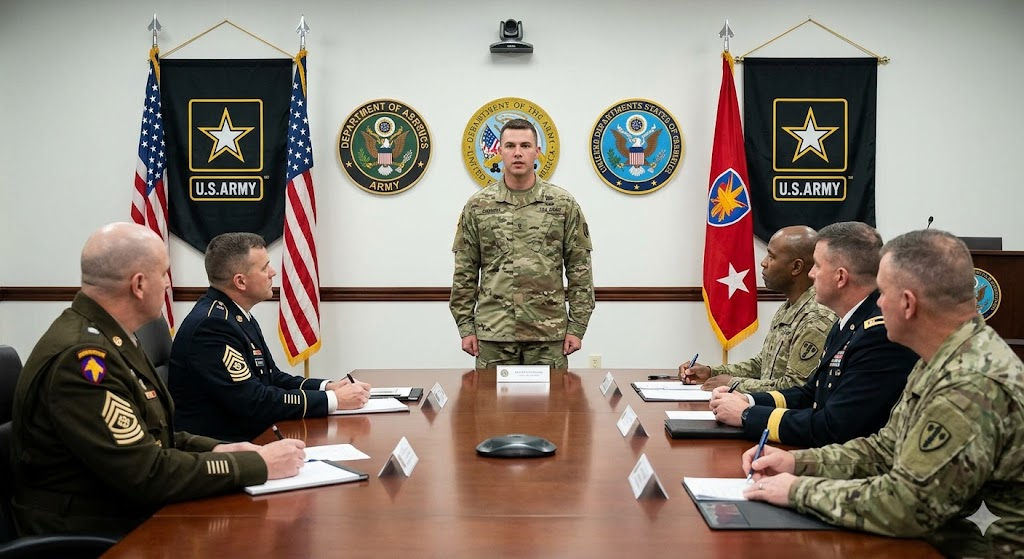
Additional Information
What the Course Entails and Exam Details
This "practice test" functions as a simulated knowledge assessment and mock board preparation course. It entails a rigorous self-study and review of critical Army knowledge areas. By utilizing this practice exam, candidates can expect to cover a wide array of subjects derived from relevant Army regulations (ARs), Department of the Army Pamphlets (DA Pam), and Field Manuals (FMs).
Core Syllabus and Skills Covered
Our practice materials are meticulously structured to cover the likely topics for the actual board, including but not limited to:
Army History and Traditions: Key events, dates, notable figures, and customs.
Uniform and Bearing (AR 670-1): Correct wear and appearance of all Army uniforms.
Drill and Ceremonies (TC 3-21.5): Movements, formations, and commands.
Customs and Courtesies: Saluting, military etiquette, and proper address.
Code of Conduct and NCO Creed: Verbatim knowledge and understanding of principles.
Land Navigation and Map Reading (TC 3-25.26): Grid coordinates, symbols, and orientation.
First Aid (TC 4-02.1): Basic life-saving steps, types of injuries, and treatments.
Leadership Principles (ADP 6-22): Attributes, competencies, and ethics.
Weapon Systems (e.g., M4/M16, M17/M18): Function, maintenance, and safety characteristics.
Physical Readiness Training (FM 7-22): Knowledge of PRT principles and drills.
Current Events and General Army Knowledge: Key recent defense news and policies.
Situational Leadership and Warrior Tasks: Applying regulations to practical, real-world scenarios.
Exam Details
The actual Best Warrior Board is an oral exam conducted in person before a panel. However, this [Best Warrior Board Practice Test] provides a structured environment to practice that oral response capability:
Format: A curated list of questions (both direct knowledge and situational) commonly asked in previous Best Warrior Boards, along with detailed, regulation-supported answers. It can be used for flashcard-style study or mock board scenarios.
Passing Requirements: In the actual competition, there is no "fixed passing score." Soldiers are scored based on their knowledge, confidence, military bearing, and ability to articulate their answers. The highest cumulative score across all competition events (including the Board) determines the winner.
Time Limit: Boards are typically time-managed, with soldiers given a reasonable window to answer each question comprehensively. The focus is on quality and precision rather than speed.
What to Expect in the Final Exam
Entering the room for the actual Best Warrior Board is a powerful and potentially nerve-wracking experience. Knowing what to expect is your first step to success. Here is a breakdown of the standard flow:
The Environment and Format
Setting: A formal, quiet, and high-pressure environment, usually a designated boardroom or official meeting space.
Panel: The panel typically consists of 4 to 5 senior NCOs (Command Sergeants Major, Sergeants Major, etc.), often with a President of the Board (e.g., a Garrison or Division Command Sergeant Major).
The Sequence
Entrance: You will report to the Board President in a precise, military fashion, adhering to all customs and courtesies (e.g., saluting, "Sergeant Major, [Rank and Name] reports"). Your bearing must be immaculate from this moment forward.
Introduction: You may be asked to introduce yourself, briefly summarizing your background, military career, and goals.
The NCO Creed or Code of Conduct: Be prepared to recite either or both perfectly and with conviction. This is a common and critical first step.
Questioning: The panel members will take turns asking questions from the topics mentioned above. This is not just a test of what you know, but how you answer.
Situational Questions: The panel will often present hypothetical scenarios ("What would you do if...") to assess your leadership judgment and decision-making abilities based on Army values and regulations.
The "Gotcha" or Stress Questions: Be prepared for challenging or unexpected questions designed to test your composure under pressure. Maintain your cool and professionalism.
What the Panel is Looking For
Knowledge: Accurate, clear, and regulation-supported answers.
Confidence and Articulation: Speaking clearly, confidently, and using proper military terminology. Avoid "ums" and fillers.
Bearing: Your posture, eye contact, and overall physical presence. Stay composed, stand at attention (or ease if directed), and never lose your professional edge.
Honesty: If you don't know the answer, it is often better to state, "Sergeant Major, I do not know the answer at this time, but I will look it up and get back to you," than to guess incorrectly. However, this response should be used sparingly.
How to Study and Exam Centers
Preparation for the Best Warrior Board cannot be done in a single night. It requires consistent, dedicated study and rehearsal.
Actionable Study Strategies
Use the [Best Warrior Board Practice Test]: Go through every question in our practice test. Research the answers in the cited Army regulations to truly understand the why behind the answer. This builds a foundational knowledge base.
Organize with Flashcards: Create flashcards for key regulations, dates, creeds, and weapon characteristics. Digital flashcard apps are excellent for study on the go.
Conduct Mock Boards: This is crucial. Assemble a "board" with your sponsor, NCOs, or peers to simulate the actual environment. Rehearse your entrance, the creed recitation, and answering diverse questions. Filming these sessions can help you identify bearing or articulation issues.
Practice Speaking in Front of a Mirror: Work on eye contact, clarity of speech, and removing filler words like "um," "uh," and "like." Practice delivering your answers with conviction.
Develop Your "Why": Be prepared to clearly and genuinely articulate why you deserve to be the "Best Warrior." This personal connection resonates with the board.
Physical and Uniform Readiness: Do not neglect physical fitness; it impacts your confidence and endurance. Ensure your Service Uniform (ASU or AGSU) is perfectly prepared, aligned with AR 670-1, and immaculate.
Where and How to Take the Exam (The Competition)
It is important to remember that the Best Warrior Competition is not a test administered at a Pearson VUE center. It is an internal military event.
Online Portals: While there isn't an online location to "take" the Board, you can find practice questions and resources on official Army portals (like Army Knowledge Online - AKO, if applicable) and trusted soldier professional development sites.
Exam Centers (Unit Locations): The competition—including the Board—is conducted at various levels, typically starting within your company or battalion and progressing through brigade, division, and major command levels (e.g., FORSCOM, TRADOC). The specific physical location will be within your military installation or a designated competition site.
Authorized Schools: While not a "school," the Best Warrior Competition is authorized and managed by the chains of command and Senior Enlisted Advisors at each echelon. Winners often earn priority for attending prestigious Army schools like Ranger School, Air Assault, and Airborne.
Job Opportunities from the Course
Succeeding in a Best Warrior Board is not just about the immediate competition win; it is a catalyst for your entire military career. While it doesn't "unlock" a specific job title like a technical certification might, it opens doors and increases your competitiveness for various high-impact roles and opportunities within the Army.
Excelling in this process significantly enhances your standing for:
Accelerated Promotion (NCO Promotion Points): Winners of Best Warrior Competitions at higher levels can often receive automatic promotion points or be highly recommended for accelerated promotion.
Highly Desirable Duty Assignments: Your record of excellence will make you a prime candidate for premier assignments within prestigious units or special duty positions (e.g., Recruiter, Drill Sergeant, Instructor).
Selection for Specialized Schools: Winning, or even competing at a high level, is a major advantage when applying for challenging and career-enhancing schools such as:
Ranger School
Airborne School
Air Assault School
Pathfinder School
Special Forces Assessment and Selection (SFAS)
Leadership Visibility: Excelling in front of senior leaders (including Command Sergeants Major) increases your profile, creating opportunities for mentorship and key leadership roles within your unit.
Improved Evaluation Reports (OER/NCOER): A "Best Warrior" distinction is a significant and powerful accomplishment to include in your evaluations, demonstrating superior competence and leadership.
Preparing for the Best Warrior Board is a challenge that reveals your true character and potential as a soldier. Use this guide and our practice test to sharpen your knowledge and build the confidence necessary to make your mark. We are dedicated to supporting your journey. Good luck, warrior!
Frequently Asked Questions
Reviews
5.0
Based on 0 reviews
Leave a Review
No reviews yet. Be the first to review!