
BHEL Engineer and Supervisor Trainee Recruitment Practice Test
$69.00
- Buy to unlock unlimited access to all Quiz questions and Answers in this Quiz.
- After purchase you can print a PDF of the whole quiz at any point. The PDF will contain the questions and the correct answers.
About this Exam
Kickstart your prestigious career with Bharat Heavy Electricals Limited (BHEL) by mastering the official recruitment process. This specific practice test is explicitly designed for ambitious engineering graduates and diploma holders aiming to secure positions as Engineer Trainees or Supervisor Trainees within this Maharatna public sector undertaking.
Whether you are seeking a role in Mechanical, Electrical, Civil, or Electronics disciplines, this comprehensive practice tool simulates the actual competitive environment you will face. It is an essential resource for candidates looking to validate their technical knowledge, improve their non-technical aptitude, and gain the necessary confidence to excel in the final Computer-Based Test (CBT).
Ready to test your knowledge?
Buy Now to Access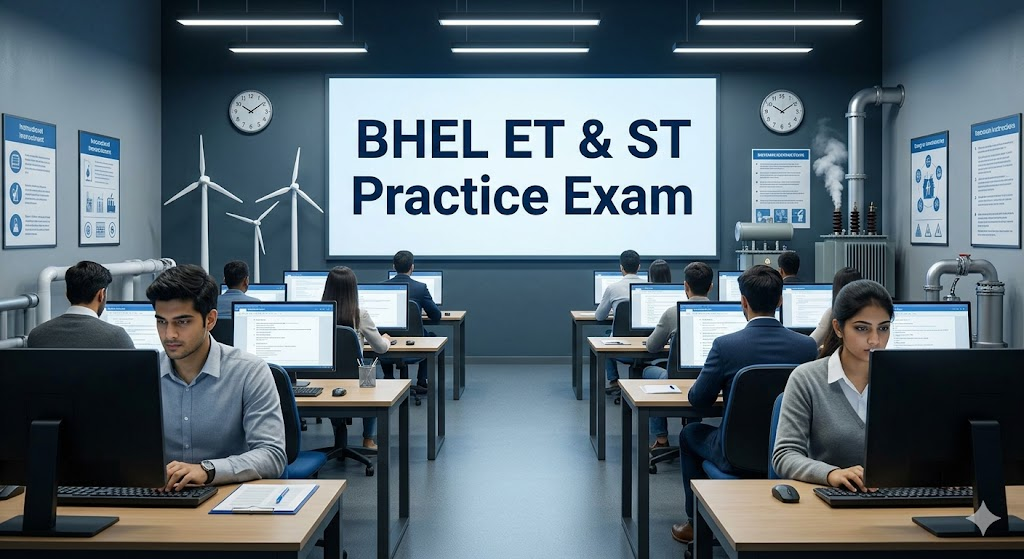
Additional Information
What the Course Entails and Exam Details
The BHEL Trainee Recruitment examination evaluates a candidate’s holistic suitability for a demanding technical and managerial role. The syllabus is rigorous and requires a balanced preparation strategy covering both core engineering concepts and general aptitude. This practice exam mirrors the official breakdown to ensure targeted revision.
The core technical syllabus aligns with four-year engineering degree standards for Engineer Trainees and three-year diploma standards for Supervisor Trainees across respective disciplines such as Mechanical, Electrical, Civil, Electronics, and Instrumentation. Parallelly, the non-technical sections are vital for shortlisting and focus on crucial employability skills. These include Reasoning Ability (analytical and logical puzzles), General English (grammar, vocabulary, and comprehension), and General Awareness (current affairs, Indian economy, and relevant industry knowledge).
What to Expect in the Final Exam
The final selection hurdle is a high-stakes, competitive Computer-Based Test (CBT). The exam exclusively uses an objective format, consisting entirely of multiple-choice questions (MCQs) available in both English and Hindi, though the English section remains solely in English. The exact number of questions may vary by notification but typically ranges from 150 to 240 questions.
Candidates must manage their time effectively, usually within a strict 150-minute (2.5 hours) window. A critical factor in this exam is the negative marking policy; typically, one-fourth (0.25) of the marks assigned to a question will be deducted for every incorrect answer, making accuracy just as important as speed. While BHEL does not always set sectional cut-offs, candidates must secure high overall merit scores to be shortlisted for the subsequent interview round.
How to Study and Exam Centers
Success in the BHEL Trainee exam requires a data-driven study plan and disciplined practice. Begin by thoroughly revising your core engineering textbooks, focusing on fundamental principles and frequently asked formula-based questions. However, the technical section only accounts for a portion of the total score; do not neglect General English, Reasoning, and General Awareness, which often act as tie-breakers.
The most effective way to prepare is by taking full-length practice tests that accurately simulate the actual CBT environment. Utilize this practice exam to identify weak areas, improve your speed, and, crucially, learn to manage the stress of negative marking. BHEL conducts the final CBT at secure, authorized third-party testing centers across major cities throughout India. Your specific test center location, date, and session will be strictly mandated on your official admit card, which is only generated after a successful online application through the BHEL careers portal.
Job Opportunities from the Course
Successfully navigating the recruitment process and excelling in the CBT and interview unlocks a lucrative and stable career path within India's premier engineering enterprise. The standard career trajectory begins with a designated training period, leading to permanent absorption based on performance.
Potential specific job titles and career paths available include:
Engineer Trainee (ET): Recruited at E1 grade; progresses to Engineer, Senior Engineer, Deputy Manager, and eventually into senior executive management roles within engineering, manufacturing, or project sites.
Supervisor Trainee (ST): Recruited for supervisory cadres; progresses to Assistant Engineer, Engineer, and Assistant Manager roles, taking charge of crucial shop floor operations or field projects.
Technical Executive: General cadre for engineering professionals handling planning, quality control, or commercial functions.
Project Engineer: Specific roles dedicated to large-scale power, industry, or transportation project execution.
Maintenance Engineer: Roles focused on the upkeep and operational efficiency of BHEL’s massive manufacturing facilities or client sites.
Frequently Asked Questions
Reviews
5.0
Based on 0 reviews
Leave a Review
No reviews yet. Be the first to review!