
BICSI Registered Telecommunications Project Manager (RTPM) Practice Exam
$69.00
- Buy to unlock unlimited access to all Quiz questions and Answers in this Quiz.
- After purchase you can print a PDF of the whole quiz at any point. The PDF will contain the questions and the correct answers.
About this Exam
Ready to test your knowledge?
Buy Now to Access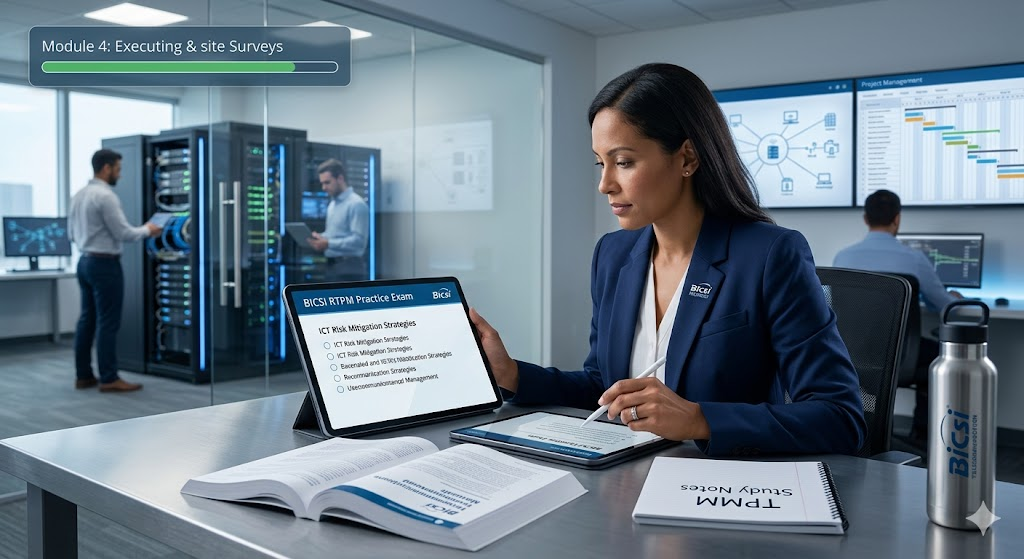
Additional Information
What the Course Entails and Exam Details
This program focuses on integrating rigorous general project management principles with the technical and operational realities unique to telecommunications infrastructure. The comprehensive curriculum and syllabus prepare you to understand and apply a vast array of concepts.
Key topics covered in the program include:
Project Initiation and Scoping: Identifying project objectives, stakeholder needs, and setting a firm foundation for low-voltage systems.
Planning and Resource Management: Detail allocation of personnel, specialized tooling, and high-tech materials.
Executing and Site Surveys: Managing the boots-on-the-ground reality, coordinating vendors, and conducting crucial preliminary assessments.
Monitoring and Controlling: Implementing tracking mechanisms to manage budgets, schedules, quality assurance, and scope creep.
Risk Mitigation: Anticipating and planning for the unique technical and physical challenges of ICT installations.
Project Closing and Handoff: Managing documentation, user testing, final inspections, and operational handoff protocols.
What to Expect in the Final Exam
The final BICSI RTPM exam is a computer-based assessment that thoroughly evaluates your comprehension of the Registered Telecommunications Project Manager body of knowledge. This is a closed-book examination.
Exam Format: The exam consists of multiple-choice questions designed to test both your theoretical understanding and your ability to apply concepts to real-world scenarios.
Passing Score: BICSI uses a scaled scoring method; candidates must achieve a passing score set by the BICSI Credentialing Committee. It is recommended to check the official BICSI website for the current scaling model.
Time Limit: Candidates are generally given a specific time limit to complete the exam. You are encouraged to manage your time effectively, pacing yourself across all questions.
Specific Rules: All standard testing protocols apply. No outside study materials, electronics, or unauthorized items are allowed in the testing area. Proctors strictly enforce these rules.
How to Study and Exam Centers
Preparation for the RTPM exam demands a dedicated approach. Start by mastering the official BICSI Telecommunications Project Management Manual (TPMM) or the recommended preparation courses offered directly by BICSI.
Actionable study strategies include:
Practice Exams: Regular practice with simulation exams is essential for familiarizing yourself with the multiple-choice format, managing your time, and identifying knowledge gaps.
Study Groups: Collaborating with other ICT professionals can provide new perspectives and bolster your understanding of complex regulatory and logistical concepts.
Hands-on Application: Relate theoretical knowledge to your practical daily work experiences to solidify the concepts.
You can take the official examination at approved exam centers globally. BICSI partners with Pearson VUE, which provides a massive network of authorized physical testing centers in most major cities. Alternatively, Pearson VUE offers an online proctored testing option (OnVUE), allowing you to take the exam from the comfort of your home or office, provided you meet strict system and environmental requirements.
Job Opportunities from the Course
Earning your RTPM certification demonstrates a unique blend of technical mastery and leadership capability. This makes you an invaluable asset to any organization involved in the physical layer of networks and high-tech construction.
The specific job titles and career paths this certification unlocks include:
Senior Telecommunications Project Manager
Low Voltage Superintendent
Outside Plant (OSP) Project Manager
ICT Operations Manager
Structured Cabling Supervisor
Network Infrastructure Project Leader
Telecom Field Supervisor
Frequently Asked Questions
Reviews
5.0
Based on 0 reviews
Leave a Review
No reviews yet. Be the first to review!