
BICSI Systems Verification Practice Exam
$69.00
- Buy to unlock unlimited access to all Quiz questions and Answers in this Quiz.
- After purchase you can print a PDF of the whole quiz at any point. The PDF will contain the questions and the correct answers.
About this Exam
The BICSI Systems Verification path validates the crucial skills required to properly test, troubleshoot, and certify information and communications technology (ICT) systems. This program is expertly designed for installers, technicians, and supervisors who are responsible for ensuring that complex structured cabling infrastructures meet all performance standards. It provides the official recognition needed to prove you can guarantee the reliability of a client's critical network.
Ready to test your knowledge?
Buy Now to Access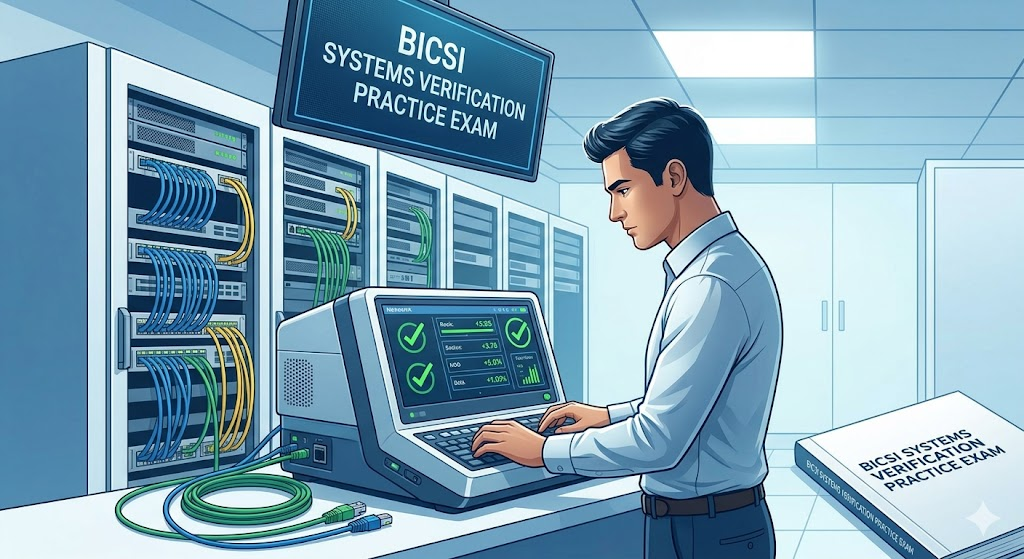
Additional Information
What the Course Entails and Exam Details
This comprehensive assessment covers a vast array of topics focused on the final phase of system implementation. Candidates are tested on their theoretical knowledge of transmission principles across both copper and optical fiber media. The syllabus places a heavy emphasis on understanding relevant codes and standards, such as those from TIA and ISO. Practical expertise is required in the correct setup and operation of advanced field-testing instruments, including cable analyzers and optical time-domain reflectometers (OTDRs). Additionally, you must demonstrate the ability to accurately interpret test results, generate proper documentation, and apply efficient troubleshooting methodologies.
What to Expect in the Final Exam
While a practice exam is a simulation tool, the final certification pathway usually consists of two distinct parts: a written exam and a hands-on performance evaluation. The written portion is often a comprehensive, computer-based test comprising 100 or more multiple-choice questions. These questions are drawn from BICSI’s authoritative manuals, assessing both knowledge and practical application scenarios. Candidates generally have a limited time, such as two to three hours, to complete the written section. A passing score, typically around 70 percent, is required to proceed. The rigorous hands-on evaluation requires you to perform specific verification tasks under the watchful eye of a proctor, adhering to strict industry standards on a pass/fail basis.
How to Study and Exam Centers
Effective preparation requires a blend of theoretical study and practical application. We highly recommend enrolling in an authorized BICSI training course to gain standard-aligned knowledge. Utilize the relevant BICSI manuals as your primary study resource, creating flashcards for key terms, standards, and formula. Dedicate significant time to hands-on practice with the exact testing equipment you will use in the field; proficiency in tool operation is vital for the practical exam. Finally, taking a simulated BICSI Systems Verification Practice Exam is essential to identify knowledge gaps and get accustomed to the question formats and time constraints you will face.
BICSI written examinations are primarily administered globally through Pearson VUE testing centers, offering many physical locations and sometimes online proctoring options. Hands-on performance exams are typically conducted at the conclusion of an authorized training course at a specific training school or at designated BICSI events.
Job Opportunities from the Course
Earning this credential severely boosts your profile in the competitive ICT market. Successfully validating your systems verification expertise unlocks advanced career paths and specialized roles, including:
Structured Cabling Technician
Field Verification Specialist
Telecommunications Foreman
Quality Control Inspector (ICT)
Data Center Infrastructure Technician
Network Commissioning Agent
ICT Project Lead or Supervisor
Frequently Asked Questions
Reviews
5.0
Based on 0 reviews
Leave a Review
No reviews yet. Be the first to review!