
BICSI Technician Practice Exam
$69.00
- Buy to unlock unlimited access to all Quiz questions and Answers in this Quiz.
- After purchase you can print a PDF of the whole quiz at any point. The PDF will contain the questions and the correct answers.
About this Exam
The BICSI Technician (TECH) credential represents the apex of the Installer program and is designed for highly skilled Information and Communication Technology (ICT) professionals. This certification validates an individual's elite status, proving they have the comprehensive knowledge and advanced hands-on skills necessary to lead installation teams, plan project steps, and solve complex cabling issues in data, voice, video, and grounding systems. It is intended for experienced installers looking to formally recognize their proficiency and elevate their career to a leadership level within the ICT industry.
Ready to test your knowledge?
Buy Now to Access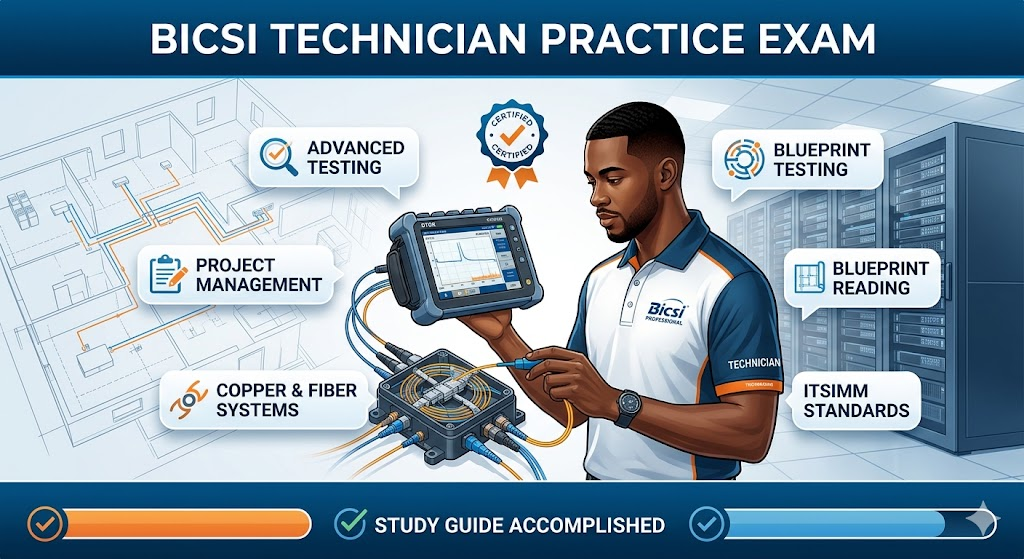
Additional Information
What the Course Entails and Exam Details
To earn this prestigious designation, candidates must master a robust curriculum that blends theoretical knowledge with precise practical application, often reinforced through the TE350 BICSI Technician training course. The core competencies covered in the examination encompass a wide range of advanced topics:
Project Planning and Management: Interpreting blueprints, managing workflow, and overseeing site safety and compliance.
Advanced Copper Cabling: Installation, termination, and high-level troubleshooting of Category 6A, patch panels, and 110-blocks.
Fiber Optic Cabling: Mastery of both single-mode and multimode fiber, including fusion splicing, mechanical splicing, and connectorization.
Testing and Certification: Utilizing sophisticated tools like Optical Time-Domain Reflectometers (OTDRs) and copper cable certifiers to validate system performance against industry standards (ANSI/TIA).
Bonding and Grounding: Implementation of complex telecommunications bonding and grounding infrastructure to ensure safety and system reliability.
Firestopping: Selection and installation of appropriate firestop systems for various penetrations.
Codes and Standards: In-depth familiarity with the latest codes, standards, and best practices relevant to residential and commercial ICT installations.
What to Expect in the Final Exam
The BICSI Technician examination is uniquely challenging because it requires candidates to prove their competence in two distinct phases: a written portion and a hands-on performance evaluation. Candidates must pass both components to earn the certification.
Written Exam: This component is designed to test your theoretical understanding. It features approximately 100 multiple-choice questions that cover all aspects of the BICSI Technician curriculum, including standards, safety, and troubleshooting methodology. The written exam is generally administered with a 2-hour time limit.
Hands-on Performance Exam: This practical evaluation is where you prove you can perform the work. Under the supervision of a BICSI-approved Proctor, you will be required to successfully complete specific installation tasks within predetermined time constraints. These tasks are typically identical or very similar to the ones practiced during the TE350 training course, such as terminating fiber optic connectors or troubleshooting a copper link.
To be successful, candidates must demonstrate both speed and a high level of accuracy, adhering strictly to the workmanship standards defined by BICSI.
4. How to Study and Exam Centers
Effective preparation for the BICSI Technician exam must integrate both cognitive study and repetitive physical practice to build muscle memory.
Study Strategies: Start by thoroughly reviewing the BICSI Telecommunications Distribution Methods Manual (TDMM) or the Information Technology Systems Installation Methods Manual (ITSIMM), depending on the specific exam focus. Leverage official BICSI practice questions and study guides, as these will directly mirror the structure of the written exam. Form study groups to discuss and quiz each other on complex standards and codes.
Hands-on Practice: The most critical part of Technician prep is time "on the tools." Spend dedicated hours practicing fusion splicing, OTDR operation, and termination techniques until you can perform them efficiently and flawlessly under pressure. Remember, you must be precise with standard safety procedures during the hands-on exam, as safety violations can lead to an immediate failure.
Exam Centers and Scheduling:
The written exam is conveniently administered at computer-based Pearson VUE testing centers worldwide. Candidates can find locations and schedule their appointments directly on the Pearson VUE website.
The hands-on performance exam is typically scheduled immediately following the completion of an authorized TE350 course at a BICSI-Authorized Training Facility. Alternatively, it can be arranged at select BICSI events, though this requires separate coordination with BICSI. Candidates are responsible for ensuring both exam components are completed to achieve certification.
Job Opportunities from the Course
Earning the BICSI Technician certification immediately distinguishes you as an elite expert, unlocking high-level career opportunities and significantly increasing your earning potential. This credential is widely respected across the telecommunications, construction, and IT sectors. Common job titles and career paths available to certified BICSI Technicians include:
Lead ICT Installer
Project Lead
Fiber Optic Technician Specialist
Data Center Infrastructure Technician
Network Infrastructure Supervisor
ICT Project Manager
Telecommunications Foreman
Frequently Asked Questions
Reviews
5.0
Based on 0 reviews
Leave a Review
No reviews yet. Be the first to review!