
Biology 30 Diploma Practice Test
$69.00
- Buy to unlock unlimited access to all Quiz questions and Answers in this Quiz.
- After purchase you can print a PDF of the whole quiz at any point. The PDF will contain the questions and the correct answers.
About this Exam
The Alberta Biology 30 Diploma Exam is a mandatory, province-wide standardized test taken by high school students completing the Biology 30 course in Alberta, Canada.
It is designed to assess cumulative understanding of advanced biological concepts and your ability to apply this knowledge to real-world scenarios.
This final exam constitutes a significant portion of your overall final grade, usually worth 30% or 50?pending on current government regulations, making comprehensive preparation essential for students aiming for post-secondary programs in sciences or healthcare.
By utilizing this study guide in conjunction with our Alberta Biology 30 Diploma Practice Exam, you are taking a crucial step toward reinforcing your understanding and boosting your confidence for the final test.
Ready to test your knowledge?
Buy Now to Access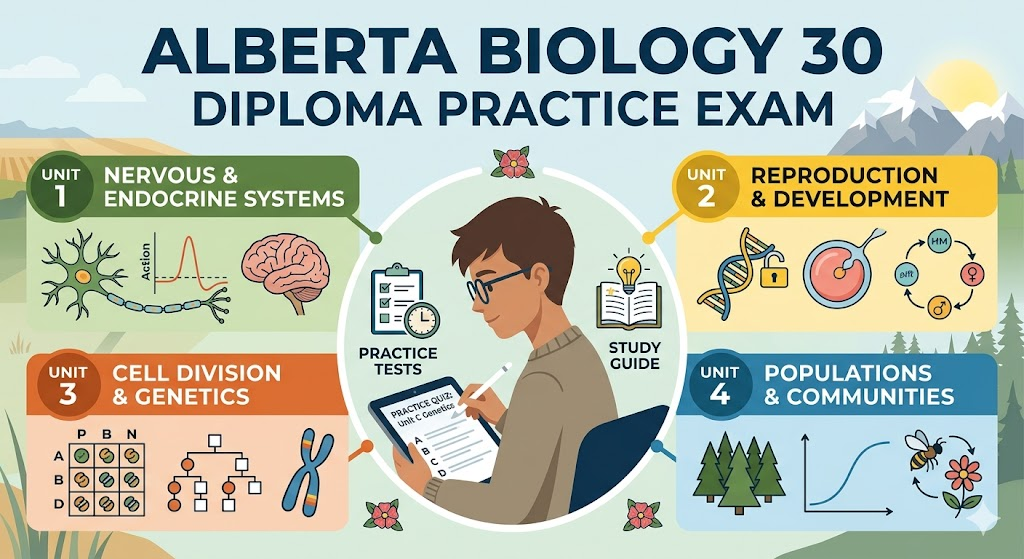
Additional Information
What the Course Entails and Exam Details
The Biology 30 curriculum is extensive and demanding, focusing on how living systems regulate themselves and interact with their environments.
The course is structured into four primary units, each carrying specific weightings on the final diploma exam.
You must develop a deep understanding of the following areas to succeed:
Unit A: Nervous and Endocrine Systems (20–25%)
Structure and function of neurons and the brain.
Transmission of action potentials and synaptic signals.
The role of hormones in maintaining homeostasis, including feedback loops.
Human sensory organs (eye and ear).
Unit B: Reproduction and Development (20–25%)
Male and female reproductive structures.
Hormonal regulation of reproductive cycles.
Stages of embryonic development, including differentiation and the role of extra-embryonic membranes.
Unit C: Cell Division, Genetics, and Molecular Biology (25–30%)
The processes of mitosis and meiosis.
Mendelian genetics, Punnett squares, and pedigree analysis.
Incomplete dominance, codominance, and sex-linked inheritance.
DNA structure, replication, protein synthesis, and mutations.
Unit D: Populations and Community Dynamics (15–20%)
Factors affecting population growth (natality, mortality, migration).
Population genetics and the Hardy-Weinberg principle.
Interactions within communities, such as symbiosis, predation, and succession.
What to Expect in the Final Exam
The official Alberta Biology 30 Diploma Exam is a comprehensive assessment that must be completed within a strict, standardized environment.
Here are the critical details you need to know about the exam structure:
Format: The exam consists entirely of machine-scored questions. There are no written-response sections.
Question Types: The test features approximately 48 to 60 multiple-choice questions and about 8 to 12 numerical-response questions. Both types are equally valued.
Time Limit: Students are officially allocated 3 hours to complete the exam. However, an additional hour is typically permitted for those who require it, for a total of 4 hours max.
Passing Score: While there is no single "passing" grade for the diploma itself, the results are combined with your school-awarded mark to determine your final Biology 30 grade. A final combined mark of 50% is generally required to pass the course.
Required Materials: You are expected to bring an approved scientific or graphing calculator, HB pencils, and an eraser. The exam includes tear-out data pages for reference.
How to Study and Exam Centers
Successfully navigating the Biology 30 Diploma Exam requires active studying rather than passive reading.
We highly recommend the following strategies to maximize your score:
Use Practice Exams Extensively: This is the single most effective way to prepare. Practice questions help you understand how concepts are tested. Analyze your mistakes on our practice test to identify knowledge gaps.
Review Past Diploma Exams: Alberta Education releases some past exams. These are excellent resources for understanding the unique style and tone of diploma questions. Access them via official government portals or your school.
Create Concept Maps and Master Diagrams: Biology is information-heavy. Connect concepts, such as relating hormone feedback loops to specific physiological responses, visually. Draw and label processes like meiosis and protein synthesis.
Simulate Exam Conditions: When using the Alberta Biology 30 Diploma Practice Exam, set a 3-hour timer, clear your workspace, and complete it without using your notes. This builds stamina and reduces anxiety.
Focus on Weighted Units: Since Genetics and Molecular Biology (Unit C) carries the highest weighting, allocate significant study time to mastering its challenging problem-solving components.
Exam Centers and Location:
You do not take the final Diploma Exam at a random test center.
School-Based Students: If you are currently enrolled in a regular high school in Alberta, you will take the exam at your school during the standardized provincial testing window (usually January and June).
Mature or Non-School Students: If you are writing as a mature student or through distance learning, you must register through Alberta Education. They will assign you to an authorized writing center, which is usually a designated school or college.
Job Opportunities from the Course
A strong performance on the Alberta Biology 30 Diploma Exam is the prerequisite gateway for entry into many competitive post-secondary programs.
This course is the foundation for numerous vital and high-paying career paths.
It unlocks opportunities in the following fields:
Medicine and Healthcare
Physician
Pharmacist
Registered Nurse
Physician Assistant
Veterinarian
Physical Therapist
Research and Laboratory Sciences
Biotechnologist
Microbiologist
Geneticist
Medical Laboratory Technologist
Forensic Scientist
Environmental and Life Sciences
Ecologist
Marine Biologist
Wildlife Biologist
Conservation Officer
Environmental Scientist
Education and Communication
High School Biology Teacher
Science Writer
Health Educator
This practice guide is your key to reinforcing the essential knowledge needed to master these complex systems and succeed on your final provincial exam.
Keep studying actively, practice often, and trust in your preparation.
Frequently Asked Questions
Reviews
5.0
Based on 0 reviews
Leave a Review
No reviews yet. Be the first to review!