
Biology CLEP Prep Practice Exam
$69.00
- Buy to unlock unlimited access to all Quiz questions and Answers in this Quiz.
- After purchase you can print a PDF of the whole quiz at any point. The PDF will contain the questions and the correct answers.
About this Exam
The Biology College-Level Examination Program (CLEP) test offers students a highly efficient opportunity to demonstrate college-level proficiency in basic biology and earn real academic credit. This exam is specifically designed for motivated high school students seeking to place out of introductory courses, home-schooled students, adult learners returning to education, and current college students looking to accelerate their degree path. By achieving a passing score, you can potentially save thousands of dollars in tuition and significantly reduce the time required to complete your degree. It is an ideal way to validate your existing scientific knowledge in a formalized academic setting.
Ready to test your knowledge?
Buy Now to Access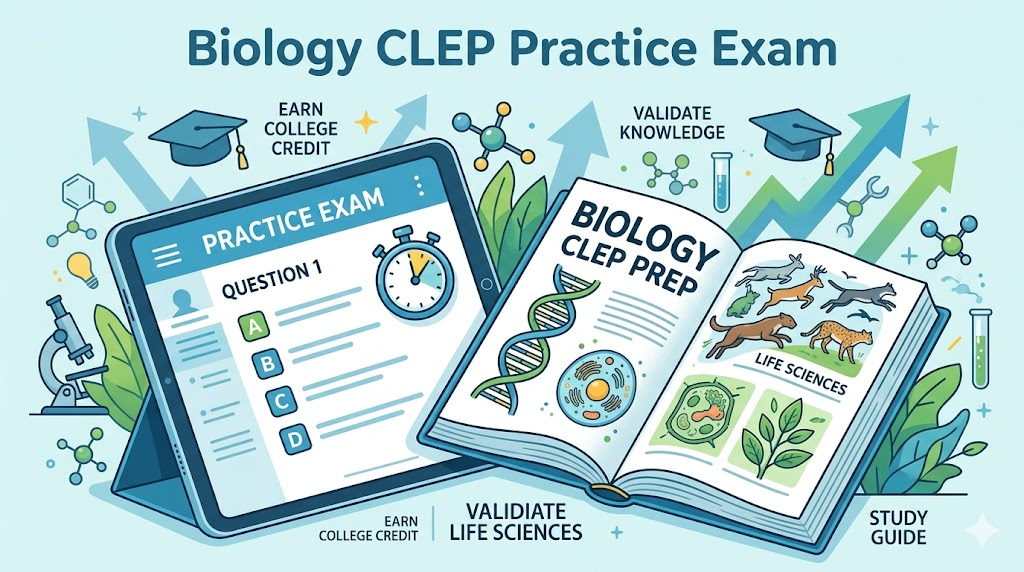
Additional Information
What the Course Entails and Exam Details
The Biology CLEP exam requires a comprehensive understanding of three major biological areas: molecular and cellular biology, organismal biology, and population biology. While there is no mandatory prerequisite course, the material covered is generally equivalent to what is taught in a year-long introductory college biology sequence.
The core areas and skills assessed include:
Molecular and Cellular Biology (33%): This section focuses on the chemical composition of organisms, cell structure and function, and the fundamental principles of heredity and gene expression.
Organismal Biology (34%): This section examines the structure, function, and development of organisms, including standard systems in plants and animals.
Population Biology (33%): This portion covers ecology, evolution, and behavioral biology, emphasizing the relationships between organisms and their environments.
What to Expect in the Final Exam
The Biology CLEP exam consists of approximately 115 multiple-choice questions that must be completed within a 90-minute time limit. This requires not only a strong grasp of the material but also efficient time management and decisive test-taking skills.
Format: The test is composed entirely of multiple-choice questions. Some questions may require the interpretation of diagrams, charts, or experimental data.
Passing Score: CLEP exams are scored on a scale of 20 to 80. While the College Board recommends a standard credit-granting score of 50, it is crucial to remember that individual colleges and universities set their own standard scores for granting credit. You must check the specific policy of your target institution.
Rules: Standard standardized testing procedures apply. You will be required to present valid identification at the testing center. No external calculators, textbooks, or notes are permitted during the examination.
How to Study and Exam Centers
Effective preparation is essential for succeeding on the Biology CLEP. A proactive and structured study plan should be your first priority.
Actionable Study Strategies:
Utilize a Biology CLEP Study Guide: Invest in a reputable study guide that is specifically tailored to the current CLEP curriculum. These guides provide focused content reviews and targeted practice questions.
Take Multiple Practice Exams: This is the single most effective way to prepare. Regularly taking a timed Biology CLEP Practice Exam will help you build stamina, identify knowledge gaps, and become comfortable with the question formats.
Focus on weak areas: Use the results of your practice exams to prioritize your studying. Dedicate more time to the topics where you consistently score lower.
Use Visual Aids: Biology is a highly visual subject. Study diagrams of cellular respiration, photosynthesis, genetic crosses, and ecological food webs.
Locating Exam Centers: The CLEP exam is administered year-round at over 2,000 testing centers across the United States and internationally. These are typically located at colleges, universities, and dedicated testing facilities.
You can easily locate the nearest testing center by using the official search tool on the College Board website.
Once you choose a location, you will need to register and pay the exam fee through the College Board portal, and then contact the specific test center directly to schedule your appointment.
Job Opportunities from the Course
Earning college credit through the Biology CLEP is an excellent fundamental step toward a wide array of career paths in the life sciences and related fields. This credit contributes directly toward qualifying for positions that require a scientific background.
Career paths and specific job titles unlocked by continuing study in this field include:
Biological Technician
Laboratory Coordinator
Clinical Research Assistant
Environmental Consultant
Conservation Officer
Science Teacher (requires licensure)
Pharmaceutical or Medical Device Sales Representative
Health Educator
Quality Control Analyst
Frequently Asked Questions
Reviews
5.0
Based on 0 reviews
Leave a Review
No reviews yet. Be the first to review!