
Biology Major Field Test Practice
$69.00
- Buy to unlock unlimited access to all Quiz questions and Answers in this Quiz.
- After purchase you can print a PDF of the whole quiz at any point. The PDF will contain the questions and the correct answers.
About this Exam
The Biology Major Field Test (MFT) is a comprehensive, standardized assessment designed specifically for graduating college seniors who are completing their undergraduate degree in Biology. Unlike individual course exams that focus on specific semesters of material, the Biology MFT measures a student’s holistic understanding of the entire discipline. It is a critical tool used by universities to assess the effectiveness of their life sciences programs and by students to demonstrate their mastery of core biological concepts to potential employers or graduate schools. This exam provides a unified benchmark of knowledge across the diverse subfields that constitute a modern biology curriculum.
Ready to test your knowledge?
Buy Now to Access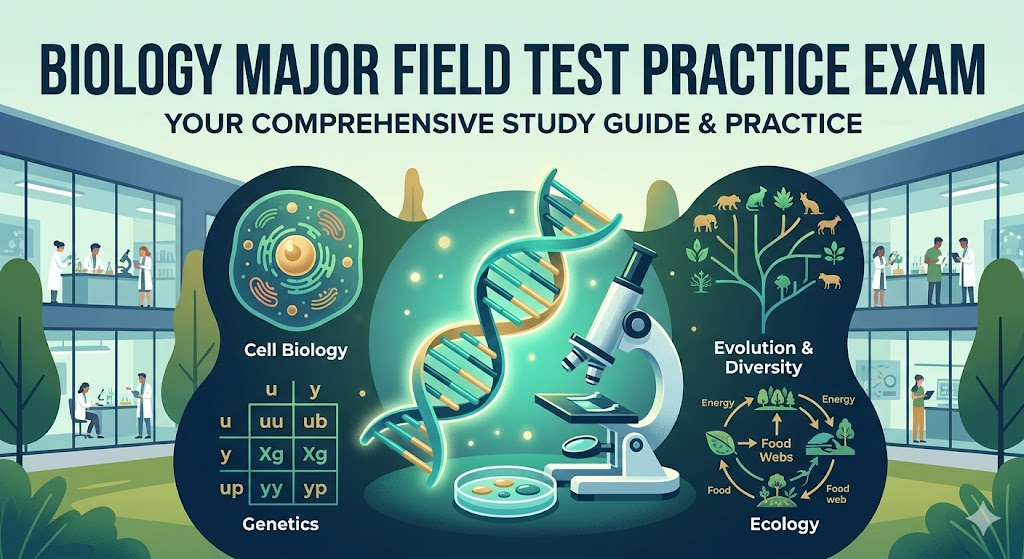
Additional Information
What the Course Entails and Exam Details
Because the Biology Major Field Test assesses four years of undergraduate study, it covers a wide spectrum of topics. The exam does not require completion of a specific "course" but rather synthesizes knowledge gained from several core classes. The major content areas typically include:
Cell Biology: Structure and function of organelles, membrane transport, cell cycle, and metabolic pathways.
Genetics and Molecular Biology: Mendelian genetics, DNA replication, transcription, translation, gene regulation, and biotechnology techniques.
Organismal Biology: Comparative anatomy and physiology of plants and animals, diversity of life, and developmental biology.
Population Biology, Evolution, and Ecology: Mechanisms of evolution, population genetics, community ecology, ecosystems, and behavioral ecology.
Students must demonstrate analytical skills, including the ability to interpret experimental data, read graphs, and apply mathematical concepts to biological problems.
What to Expect in the Final Exam
The Biology Major Field Test is typically administered digitally and consists solely of selected-response (multiple-choice) questions. The test is standardized, meaning all students take the same core exam, allowing for accurate comparison of results across different institutions. The exam is divided into two major sections, with a total time limit usually around two to three hours. There is typically no single "passing score" set by the testing organization (such as ETS). Instead, scores are reported on a scaled range, often between 120 and 200, with subscores provided for the major content areas. Your university will use these scores to evaluate the strengths and weaknesses of its own program, and they may use your individual score as part of a capstone course grade or as a distinction on your academic record. It is vital to check with your department regarding their specific requirements for the test.
How to Study and Exam Centers
Preparing for the Biology Major Field Test requires a systematic review of your entire undergraduate curriculum. Actionable study strategies include:
Create a Review Timeline: Start studying at least two months before the exam date. Allocate specific weeks to review major subfields (e.g., two weeks for Genetics, two weeks for Ecology).
Synthesize Your Notes: Revisit your notes from core classes. Focus on integrating concepts between disciplines, such as how genetic regulation (Molecular Biology) affects organismal development (Organismal Biology).
Use Visual Aids: Biology is highly visual. Review labeled diagrams of physiological processes, cellular structures, and phylogenetic trees.
Take Practice Exams: This is the single most effective way to prepare. Utilize official ETS practice questions or high-quality practice exams from reputable educational sources to familiarize yourself with the pacing and question style.
Regarding exam centers, the Major Field Test is typically administered directly by your university, often within a computer lab on campus or via a secure online portal provided by the institution during your final semester. It is rarely taken at external centers like Pearson VUE, as it is designed for institutional assessment rather than individual professional licensure. Contact your academic advisor or the chair of the Biology department for specific dates, registration procedures, and location details.
Job Opportunities from the Course
While the Biology Major Field Test itself is not a license, a high score demonstrates comprehensive discipline mastery, which can significantly enhance your resume and bolster applications for graduate study or specialized career paths. Achieving distinction on this test unlocks numerous opportunities, including:
Biological Technician or Research Assistant
Environmental Scientist or Specialist
Quality Control Technician (Pharmaceuticals/Food Science)
High School Science Teacher (Biology)
Forensic Science Technician
Conservation Biologist
Pharmaceutical Sales Representative
Medical or Clinical Laboratory Technologist
Genetic Counselor (Requires Graduate Study)
Ecologist
Zoologist or Wildlife Biologist
By demonstrating a strong understanding of the foundation of life sciences, you position yourself as a competitive candidate in a diverse range of growing fields.
Frequently Asked Questions
Reviews
5.0
Based on 0 reviews
Leave a Review
No reviews yet. Be the first to review!