
Biomechanics Practice Exam
$69.00
- Buy to unlock unlimited access to all Quiz questions and Answers in this Quiz.
- After purchase you can print a PDF of the whole quiz at any point. The PDF will contain the questions and the correct answers.
About this Exam
Biomechanics is the fascinating study of the structure and function of biological systems using the methods of mechanics. It acts as the critical bridge between conventional physics principles and the complexities of human movement. This Biomechanics Practice Exam is a specialized preparatory tool designed for university students, aspiring Kinesiologists, Physical Therapy candidates, and sports scientists. It allows individuals to test their understanding of how forces affect the body before they face official academic or certification finals. This guide ensures you have the necessary knowledge base to confidently analyze motion and apply mechanical concepts to injury prevention and performance enhancement.
Ready to test your knowledge?
Buy Now to Access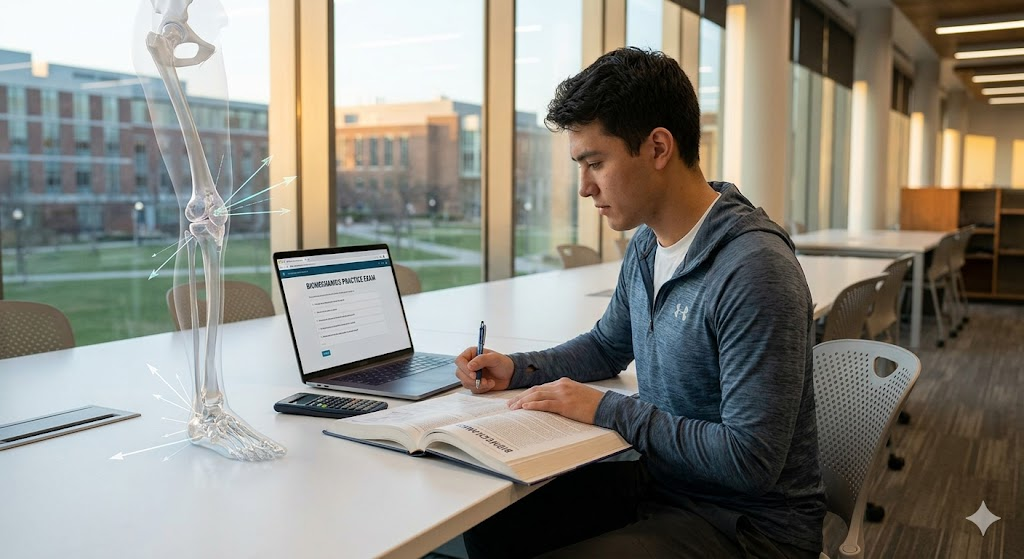
Additional Information
What the Course Entails and Exam Details
The foundation of a biomechanics curriculum shifts theoretical physics concepts into applicable physiological contexts. You must develop a deep fluency in both qualitative and quantitative analysis of human motion. The core material you are expected to master is extensive. The syllabus typically covers foundational concepts of linear and angular kinematics. This involves the precise measurement of displacement, velocity, and acceleration. Furthermore, you will delve deeply into linear and angular kinetics. Kinetics is the crucial study of the forces and torques that cause motion. Significant emphasis is also placed on tissue mechanics. This includes the mechanical properties of bones, muscles, ligaments, and tendons under stress. Additionally, you will apply the principles of statics and dynamics to various movement patterns to determine the loading on specific joints.
What to Expect in the Final Exam
While specific formatting will always depend on your university or certifying body, a biomechanics final exam generally demands a blend of theory recall and computational analysis. You should expect a rigorous combination of question formats. Standard exams usually feature complex multiple-choice questions designed to test your conceptual clarity. They also incorporate structured-response problems. In these sections, you are required to perform multi-step calculations using relevant formulas to solve scenario-based questions. The exam often runs between 90 and 180 minutes depending on the institution. A passing score is typically set around 70%. It is crucial to have a functional understanding of trigonometry, geometry, and basic algebra as you will be required to calculate vectors and angles under pressure.
How to Study and Exam Centers
Achieving mastery in biomechanics requires a strategic study approach that prioritizes conceptual application over simple memorization. Do not just memorize formulas; you must understand why they work in specific physiological context. Start your preparation by creating a comprehensive formula sheet. Organize it logically by kinetic and kinematic categories for easy recall. Use flashcards for essential anatomical and mechanical terminology. You should prioritize solving practice problems as the single most effective study method. Utilize this official Biomechanics Practice Exam repeatedly. Track your performance to identify persistent weaknesses. Re-review difficult concepts immediately after each practice attempt. Many students find it helpful to visually apply forces to skeletal models or draw free-body diagrams to understand joint loading.
Where you take the final exam depends entirely on whether it is an academic or professional certification requirement. If this is part of your degree program, the exam will be held at your university's official proctoring centers or within dedicated lecture halls during finals week. Online courses may utilize secure remote proctoring software. If you are taking the practice exam to prepare for a specialized national certification, you will typically need to register through the official organization’s portal. The actual final exam is then administered at Pearson VUE testing centers or other authorized physical locations worldwide.
Job Opportunities from the Course
A strong, validated foundation in biomechanics is highly sought after by employers across the health, science, and engineering sectors. Demonstrating proficiency through this exam process positions you for numerous dynamic career paths. Many individuals leverage this knowledge for advanced professional roles.
Common job opportunities and career paths unlocked by mastering this content include:
Physical Therapist
Occupational Therapist
Biomechanist (Research or Clinical)
Ergonomist
Sports Scientist
Gait Analyst
Kinesiologist
Strength and Conditioning Specialist
Orthotics and Prosthetics Technician
Rehabilitation Engineer
Human Performance Lab Coordinator
Frequently Asked Questions
Reviews
5.0
Based on 0 reviews
Leave a Review
No reviews yet. Be the first to review!