
BioMedical Admissions Test (BMAT) Practice Test
$69.00
- Buy to unlock unlimited access to all Quiz questions and Answers in this Quiz.
- After purchase you can print a PDF of the whole quiz at any point. The PDF will contain the questions and the correct answers.
About this Exam
The BioMedical Admissions Test (BMAT) is a critical step for students aspiring to enter prestigious medical, dental, and veterinary schools. It is not a test of knowledge alone, but rather an assessment of the fundamental skills required to thrive in a demanding clinical environment. This exam is designed for bright, ambitious individuals who wish to showcase their problem-solving, critical thinking, and communication abilities to admissions tutors across the globe. By excelling in the BMAT, you are proving you possess the potential to become a leader in the healthcare sector.
Ready to test your knowledge?
Buy Now to Access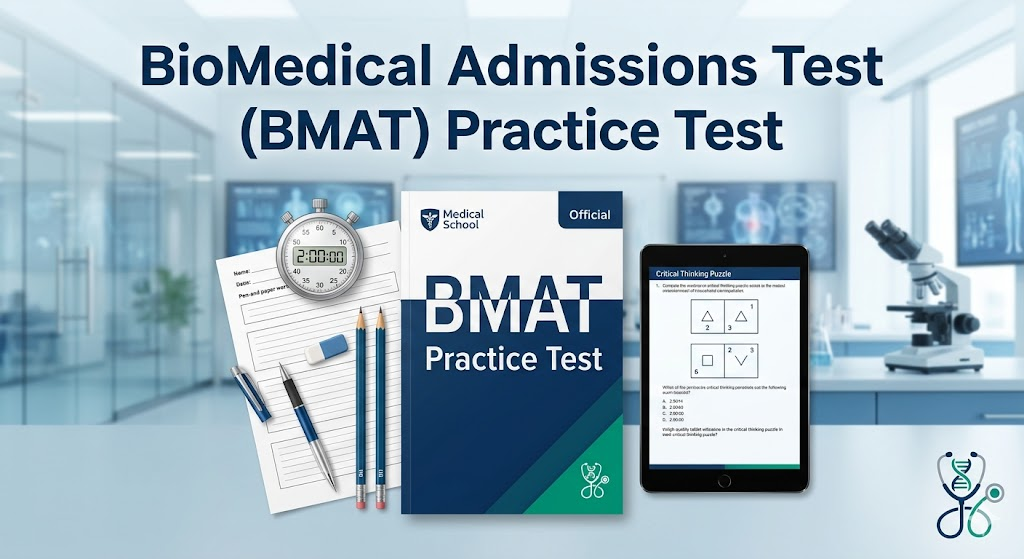
Additional Information
What the Course Entails and Exam Details
The BMAT does not have a formal, standardized course syllabus, as it is a standardized admissions test rather than a course completion exam. The focus is on testing your application of existing core knowledge and inherent cognitive skills. The exam is divided into three distinctive sections designed to evaluate different aspects of your academic potential.
Section 1: Aptitude and Skills. This section focuses on evaluating your ability to approach novel problems, understand and evaluate arguments, and interpret data. You must demonstrate quick, logical thinking.
Section 2: Scientific Knowledge and Applications. Here, you are tested on your ability to apply scientific and mathematical knowledge. The content is generally based on non-specialist school science and mathematics (up to GCSE or equivalent level). It requires you to make connections and apply concepts accurately under pressure.
Section 3: Writing Task. This final section assesses your ability to select, develop, and organize ideas and to communicate them clearly in writing. You will be given a choice of essay prompts. The objective is to produce a well-structured argument rather than showcasing factual recall.
What to Expect in the Final Exam
You must prepare yourself for a fast-paced, high-intensity testing experience. The BMAT is a two-hour pen-and-paper test. The format differs strictly between the three sections, and you are not permitted to use calculators or dictionaries.
Total Duration: 2 hours.
Section 1 Format: 32 multiple-choice questions in 60 minutes.
Section 2 Format: 27 multiple-choice questions in 30 minutes.
Section 3 Format: One essay from a choice of four questions in 30 minutes.
Scoring: Sections 1 and 2 are marked on a scale of 1.0 to 9.0, with most students scoring around 5.0. Section 3 is marked by two examiners, who provide a quality score (1–5) and an English language quality score (A, C, E).
Passing Requirements: There is no standard "passing" score for the BMAT. Instead, your numerical and essay scores are reported directly to your chosen universities, who use them to compare your potential against other applicants.
How to Study and Exam Centers
Effective preparation for the BMAT is about honing your cognitive speed and scientific application rather than memorizing new data. Your study strategy should focus on a combination of familiarization and stamina.
Actionable Study Strategies: Start by focusing on Section 2, reviewing your core Biology, Chemistry, Physics, and Mathematics concepts until you are extremely fluent. For Sections 1 and 3, practice is essential. Use official past papers to familiarize yourself with the question styles and the exact time pressures you will face. When writing practice essays, focus on clarity, logical flow, and answering the prompt exactly.
Taking the Exam: The BMAT is taken at authorized testing centers. If you are a current student, you will most likely take the exam at your school or college, provided they are registered to administer it. If your school is not a center, you must find an open center that accepts external candidates. Cambridge Assessment Admissions Testing provides a search tool on their official website to locate authorized centers globally. Ensure you coordinate with your chosen center’s exam officer well in advance to register before the strict deadlines.
Job Opportunities from the Course
A high BMAT score does not directly unlock a job; instead, it provides the essential entry ticket to the rigorous academic programs required to enter the medical and clinical professions. By achieving an excellent BMAT result, you are gaining admission to degrees that lead to highly prestigious, rewarding careers in healthcare. These career paths include:
Doctor (including general practitioners, surgeons, and specialists)
Dentist (including orthodontists and dental surgeons)
Veterinary Surgeon
Biomedical Scientist
Clinical Researcher
Healthcare Administrator
Medical Educator
By preparing thoroughly for this practice test and the final exam, you are setting the foundation for an extraordinary career dedicated to i
Frequently Asked Questions
Reviews
5.0
Based on 0 reviews
Leave a Review
No reviews yet. Be the first to review!