
Biomedical Equipment Technician (BMET) CDC Set A Volume 4 Practice Exam
$69.00
- Buy to unlock unlimited access to all Quiz questions and Answers in this Quiz.
- After purchase you can print a PDF of the whole quiz at any point. The PDF will contain the questions and the correct answers.
About this Exam
The Biomedical Equipment Technician (BMET) field is the backbone of modern healthcare, ensuring that life-saving medical technology operates at peak performance. The BMET CDC Set A Volume 4 certification—or its corresponding practice exam—is a specialized assessment designed for technicians who have already mastered the fundamentals and are progressing toward advanced-level competence. This volume typically focuses on intricate, high-acuity medical equipment and systems. It is ideal for experienced BMETs looking to validate their specialized knowledge, or for students finalizing their preparation for advanced certification in a dedicated subset of healthcare technology management. Passing this practice exam is a powerful indicator of readiness for the final specialized credential.
Ready to test your knowledge?
Buy Now to Access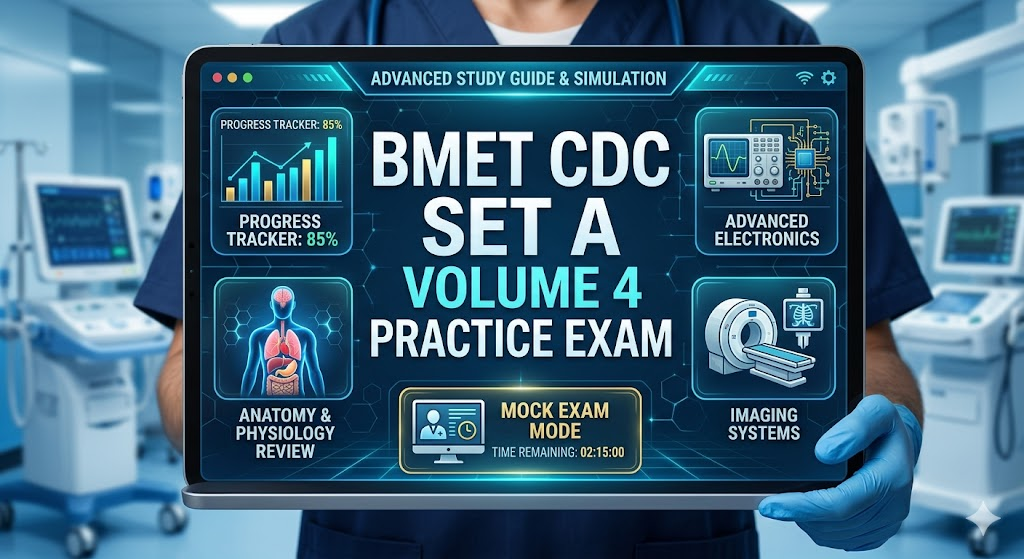
Additional Information
What the Course Entails and Exam Details
This volume delves into the specialized, complex systems that require a higher level of analytical and technical skill. While the foundation of any BMET credential involves electronics and anatomy, Volume 4 transitions into the specific maintenance, troubleshooting, and theory of operation for critical care and diagnostic imaging technology.
Core competencies covered in the study material for this set often include:
Advanced medical imaging systems (e.g., complex X-ray, basic CT, and Ultrasound).
High-acuity patient monitoring networks and telemetry.
Anesthesia delivery systems and ventilators.
Specialized laboratory equipment and dialysis machines.
Healthcare Information Technology (HIT) integration and cybersecurity for medical devices.
Advanced therapeutic devices (e.g., lasers, surgical robots).
Strict regulatory compliance and safety standards specific to high-risk environments.
What to Expect in the Final Exam
The actual certification exam this practice test prepares you for is rigorous. It is designed to simulate a real-world high-pressure environment where accurate diagnosing is paramount.
You can typically expect the following format in the official proctored test:
Format: A computer-based test consisting primarily of multiple-choice questions. These questions are scenario-based, requiring the application of knowledge rather than simple recall.
Question Count: Typically ranges from 100 to 150 questions.
Time Limit: You will generally be given 2 to 3 hours to complete the exam.
Passing Score: A minimum scaled score, often equivalent to 70% to 75%, is required to pass.
Key Rules: Valid government-issued photo ID is required. The exam is closed-book, and no personal electronics are allowed in the testing chamber.
How to Study and Exam Centers
Effective study strategies are crucial for success in a specialized volume like this one.
Actionable Study Strategies:
Simulate the Environment: Use the practice exam to take timed, full-length simulations without interruptions to build endurance and time management skills.
Analyze Rationales: Do not just look at correct answers. The real value is in understanding why a distractor answer is wrong and the technical logic behind the correct one.
Spaced Repetition: Use digital flashcards to master acronyms, specialized equipment functions, and regulatory codes.
Hands-on Review: If possible, correlate your theoretical study with hands-on time with the specific equipment mentioned in the Volume 4 syllabus.
Exam Centers and Access: Because this is a specialized "CDC Set A Volume 4" product, you must verify the exact nature of the final proctored exam.
If this is a practice test associated with a military career development course (CDC), the final proctored exam will be administered within specialized military testing facilities (such as a base education office).
If this is a practice test preparing you for a general civilian advanced certification (like the CBET with specialized focus), the actual proctored test is administered through official partners such as Pearson VUE or special authorized academic institutions.
Practice Exam Access: The practice exam itself is typically accessed through an online learning portal or designated educational software.
Job Opportunities from the Course
Earning a specialized BMET certification, supported by the knowledge gained from CDC Set A Volume 4, significantly enhances your career trajectory and earning potential. This validation marks you as an expert in high-complexity medical technology.
Completing this advanced path unlocks specialized roles such as:
Specialized Biomedical Equipment Technician (Imaging/HCD)
Healthcare Technology Manager (HTM)
Field Service Engineer (FSE) for Medical Device Manufacturers
Clinical Engineering Specialist
Biomedical Equipment Inspector for Regulatory Agencies
Laboratory Equipment Specialist
Medical Device Cybersecurity Analyst
In-House Imaging Service Technician
Frequently Asked Questions
Reviews
5.0
Based on 0 reviews
Leave a Review
No reviews yet. Be the first to review!