
Biotechnician Assistant Credentialing Practice Exam
$69.00
- Buy to unlock unlimited access to all Quiz questions and Answers in this Quiz.
- After purchase you can print a PDF of the whole quiz at any point. The PDF will contain the questions and the correct answers.
About this Exam
The Biotechnician Assistant Credentialing Exam (BACE), developed by Biotility, is an industry-recognized credential designed to validate the core knowledge and practical laboratory skills required for entry-level positions in the biotechnology and bioscience sectors. This comprehensive exam serves as a bridge between educational training and career-ready competency, vetting candidates annually against national industry standards. It is ideally suited for high school students completing biotechnology pathways, college students aiming to bolster their resumes, and existing professionals looking to document their mastery of essential laboratory techniques, regulatory compliance, and quality systems.
Ready to test your knowledge?
Buy Now to Access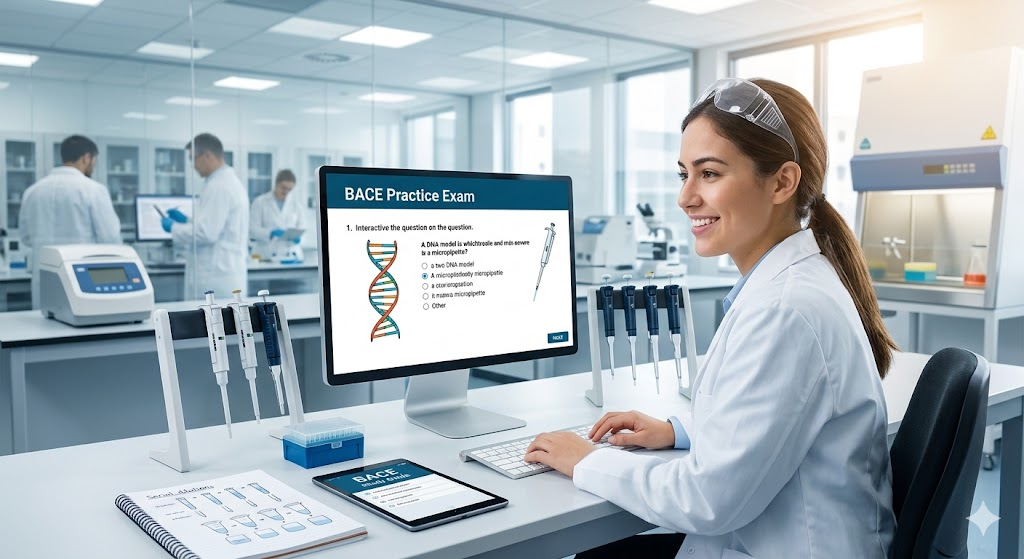
Additional Information
What the Course Entails and Exam Details
The BACE course or curriculum covers the multi-faceted landscape of the modern bioscience industry, emphasizing both foundational scientific knowledge and hands-on laboratory proficiency. Candidates are expected to have a strong grip on fundamental biotechnology concepts, laboratory safety protocols, and standard operating procedures. The exam details a candidate’s competence in the following core areas:
Laboratory Safety & Workplace Culture: Demonstrating knowledge of personal protective equipment (PPE), hazardous waste disposal, and ethical professional conduct.
Regulatory Compliance & Quality Systems: Understanding Current Good Manufacturing Practices (cGMP), Good Documentation Practices (GDP), and quality control principles.
Molecular Biology & Biochemistry: Proving comprehension of DNA extraction, polymerase chain reaction (PCR), protein analysis, cell culture maintenance, and microbial techniques.
Applied Mathematics: Solving calculations related to molarity, dilution factors, scientific notation, significant figures, and statistical data analysis.
Standard Laboratory Equipment: Mastering the use of analytical balances, micropipettes, centrifuges, spectrophotometers, and microscopy.
What to Expect in the Final Exam
The final BACE is a rigorous assessment delivered in one four-hour session via computer-based testing. It uniquely contains both a Knowledge portion and a Practical portion, ensuring candidates are not only book-smart but also technically proficient.
Exam Structure: The assessment is a single exam that requires the completion of both a comprehensive knowledge test (multiple choice questions) and a skill-verification practical component administered digitally.
Passing Requirements: While exact scoring structures may vary annually based on difficulty normalization, candidates must demonstrate proficiency across all tested domains to receive the credential.
Time Limit: Candidates are allotted a maximum of four hours to complete both the Knowledge and Practical segments. It is crucial to manage your time effectively between reviewing regulatory questions and simulating complex math calculations.
Retake Policy: In the event of a non-passing score, candidates may retake the exam up to three times per year, though a mandatory 20-day waiting period must be observed between attempts.
How to Study and Exam Centers
Preparation is paramount for success on the BACE. Actionable study strategies include integrating reflective practice to identify weakness areas, dedicating significant time to practice serial dilutions and solution preparation math, and utilizing practice quiz modules that align directly with the eight BACE exam categories. Hands-on verification of pipette accuracy and a thorough review of cGMP documentation standards are highly recommended.
Candidates take the BACE through two primary pathways: Computer-Based Testing (CBT) at an approved Exam Site, such as authorized schools, college-based "bootcamps," or official Exam Site Support Hubs. Alternatively, candidates may use the Computer-Based Testing via Remote Testing Option (RTO), which allows individual students to take the exam remotely while being monitored live by an authorized third-party proctoring service.
Job Opportunities from the Course
Earning the BACE credential signals to employers that you possess the verified skills needed for immediate productivity in a technician-level role. This designation unlocks several diverse and high-demand career paths within research, development, and manufacturing environments:
Laboratory Technician
Research Assistant
Manufacturing Associate
Quality Control (QC) Technician
Microbiology Lab Technician
Manufacturing Lab Assistant
Clinical Research Coordinator
Quality Assurance (QA) Technician
Research Associate
Frequently Asked Questions
Reviews
5.0
Based on 0 reviews
Leave a Review
No reviews yet. Be the first to review!