
Biotechnology Aptitude & Competency Exam (BACE) Practice
$69.00
- Buy to unlock unlimited access to all Quiz questions and Answers in this Quiz.
- After purchase you can print a PDF of the whole quiz at any point. The PDF will contain the questions and the correct answers.
About this Exam
The Biotechnology Aptitude & Competency Exam (BACE) is an industry-recognized credentialing exam widely respected within the bioscience sector. This comprehensive assessment is designed to validate the foundational knowledge and necessary practical skills required for entry-level positions in biotechnology laboratories. It bridges the gap between theoretical education and industry needs, ensuring that successful candidates possess the competencies that employers value most. The BACE is primarily targeted toward high school students in biotechnology programs and post-secondary students seeking an accredited industry credential to launch their careers in the life sciences. It is an excellent opportunity for aspiring biotechnicians to prove their readiness for the professional workforce.
Ready to test your knowledge?
Buy Now to Access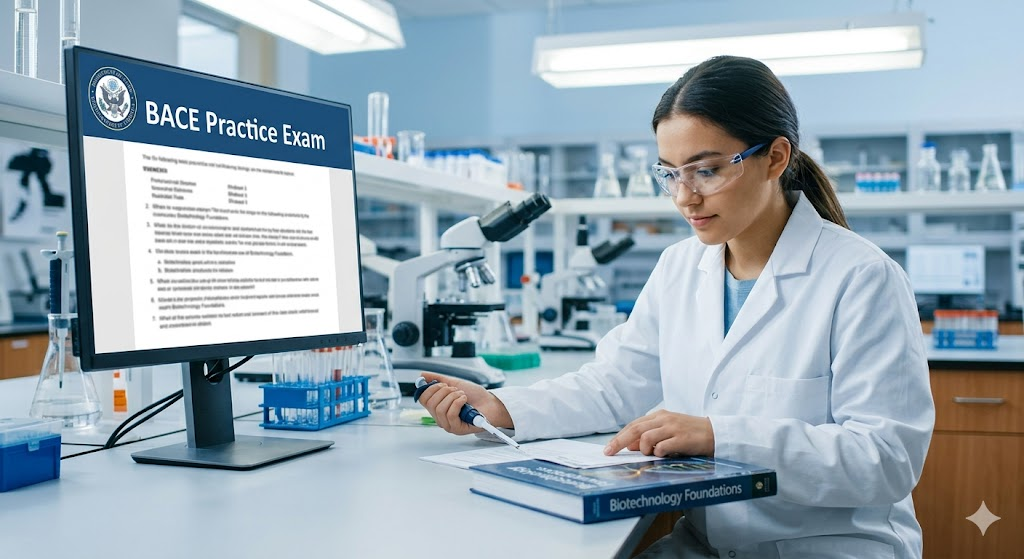
Additional Information
What the Course Entails and Exam Details
To prepare for the BACE, students typically complete a robust curriculum focusing on both molecular biology theory and standard laboratory procedures. The syllabus encompasses several core domains vital to industry operations.
Candidates must master topics in workplace safety and documentation, standard operating procedures (SOPs), and quality control principles. They are required to demonstrate deep knowledge of foundational biology, including cell biology, genetics, and molecular biology. Furthermore, the exam details encompass chemistry concepts critical to the lab, such as understanding pH, buffer preparation, and solutions.
Competency is also measured in specific laboratory math applications. Finally, the practical application of essential techniques, such as pipetting, solution making, titration, DNA extraction, microscopy, and gel electrophoresis, is integral to the qualification.
What to Expect in the Final Exam
The final BACE is rigorous, usually consisting of two mandatory components: a knowledge-based assessment and a practical skills assessment. Candidates must typically pass both sections to receive certification.
The Knowledge Exam is generally delivered in an online format and consists of multiple-choice questions that evaluate theoretical understanding across all the domains listed above. Students should expect challenging scenarios and calculation problems within this section. Strict time limits are applied, requiring efficient time management.
The Practical Exam is a hands-on assessment where candidates are required to perform specific laboratory procedures under the direct observation of a certified proctor. Candidates will be evaluated on their ability to accurately prepare solutions, operate common equipment, follow protocols, record data correctly, and, most importantly, adhere to essential safety standards throughout the process. Proper safety attire, including lab coats and eye protection, is mandatory.
How to Study and Exam Centers
Effective preparation for the BACE requires a balanced strategy that addresses both the theoretical and practical components. A vital first step is to diligently utilize the official BACE Practice Exam materials provided by Biotility or the administering body. These practice materials are invaluable for familiarizing yourself with the formatting, question structure, and difficulty level of the theoretical exam.
Furthermore, students should carefully review their textbook materials on molecular biology and laboratory math, paying close attention to calculations involving molarity, dilutions, and unit conversions.
The key to success on the practical portion is repetitive, dedicated practice in the lab. Rehearse core skills, such as micropipetting and solution preparation, until they become second nature. When practicing, always follow standard operating procedures and prioritize perfect safety form.
The BACE is typically administered at academic institutions, registered secondary schools, and established biotechnology training centers that have been authorized by Biotility. Candidates can generally take the online knowledge component at these secure locations, and the practical skills component is scheduled in their approved laboratory facilities. Students should coordinate with their program instructors or the official BACE website to identify nearby testing dates and authorized centers.
Job Opportunities from the Course
Earning the BACE credential demonstrates to potential employers that you have attained industry-vetted competencies, making you an attractive candidate for entry-level roles in the bioscience industry. This certification can serve as a powerful differentiator in the job market and opens doors to several rewarding career paths in biotechnology. Potential job opportunities unlocked by this credential include:
Laboratory Assistant
Biotechnician I
Quality Control (QC) Analyst
Quality Assurance (QA) Technician
Research and Development (R&D) Assistant
Manufacturing Associate
Environmental Lab Technician
Media Preparation Technician
Frequently Asked Questions
Reviews
5.0
Based on 0 reviews
Leave a Review
No reviews yet. Be the first to review!