
Black Seal TC Practice Exam
$69.00
- Buy to unlock unlimited access to all Quiz questions and Answers in this Quiz.
- After purchase you can print a PDF of the whole quiz at any point. The PDF will contain the questions and the correct answers.
About this Exam
The Black Seal Boiler Operator license is the foundational certification required for stationary engineers operating high- or low-pressure boiler systems within the state of New Jersey. This designation is essential for personnel responsible for the safe maintenance, inspection, and daily operation of these critical vessels. The certification serves as an entry point into the skilled trade of safe energy management. It is designed specifically for building superintendents, maintenance technicians, facilities managers, and apprentices looking to legitimize their skills and advance their careers in commercial and industrial environments. Earning this license proves your proficiency in protecting both personnel and equipment.
Ready to test your knowledge?
Buy Now to Access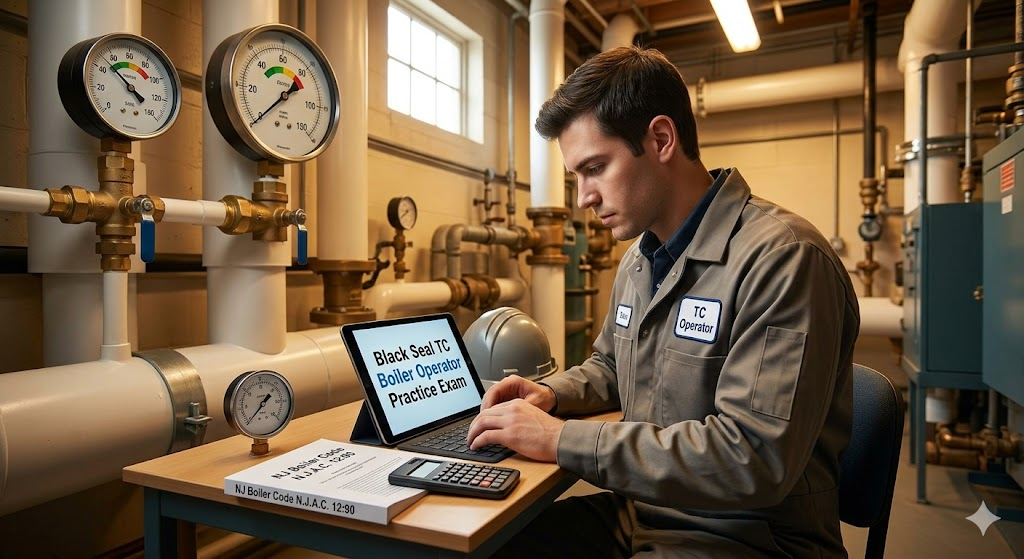
Additional Information
What the Course Entails and Exam Details
Preparation courses for the Black Seal license focus on equipping candidates with both the theoretical knowledge and the practical awareness necessary to manage diverse boiler systems. The curriculum typically branches into two primary classifications: Low Pressure (LP) and High Pressure (HP). A candidate must have documented operational experience under the supervision of a licensed operator before they are eligible to apply for the state licensing exam.
For the Low Pressure classification, the training and subsequent exam cover heating systems that generate steam at pressures under 15 psi or hot water heating boilers operating below 160 psi and 250°F.
For the High Pressure classification, the course covers powerful steam-generating plants where pressures exceed 15 psi. High Pressure operators manage more complex systems requiring a deeper understanding of pressure dynamics and heavy-duty safety protocols.
Across both classifications, the core topics you must master include:
Boiler Operation Theory
Advanced Safety Valve Regulations
Low-Water Cut-Off Devices
Combustion Control Systems
Feed Water Treatment and Management
New Jersey Administrative Code (N.J.A.C.) 12:90
What to Expect in the Final Exam
The New Jersey Department of Labor and Workforce Development (LWD) administers the official licensing examination. Unlike many private certifications, this is a formal government-regulated test. The exam is typically delivered in a standardized written format.
Candidates should expect to face approximately 50 multiple-choice questions designed to assess their understanding of practical scenarios and code regulations. The questions will cover a broad spectrum of information, from interpreting gauge readings to detailing proper boiler blowdown sequences.
To pass, candidates must achieve a minimum score of 70% or higher. The time limit for the exam is strictly enforced and generally ranges between two and four hours, depending on the specific license classification you are attempting. The exam environment is proctored, and candidates are forbidden from using reference materials during the test.
How to Study and Exam Centers
The most effective approach to passing the Black Seal exam is combining formal course instruction with a dedicated regimen of practice questions. If you are preparing through a private training center (TC), they will often provide simulated exams. However, do not mistake private practice for the actual state test.
To optimize your study time, focus on memorizing the N.J.A.C. 12:90 regulations regarding boiler operations. You must know the exact terminology for safety devices and the standard procedures for emergency scenarios. Use flashcards for key definitions and mathematical formulas required for pressure calculations.
It is critical to understand that official licensing exams are not held at private training centers (TCs). The NJ Department of Labor and Workforce Development designates specific physical locations throughout the state of New Jersey for testing. Candidates cannot schedule their own exam time; they must submit a formal application to the state including proof of experience. Once the application is approved, the Bureau of Boiler and Pressure Vessel Compliance will notify the candidate by mail of their assigned examination date and the physical location of the state testing center.
Job Opportunities from the Course
Earning your Black Seal license significantly boosts your employability, unlocking immediate career opportunities in facilities management and industrial sectors. Licensed operators are mandated by law in many buildings to ensure safe steam and hot water production.
Upon certification, you are qualified for the following career paths:
Boiler Operator (Low or High Pressure)
Stationary Engineer Apprentice
Facility Maintenance Technician
Licensed Building Engineer
Maintenance Superintendent
These roles are vital across multiple industries, including hospitals, universities, public school systems, manufacturing facilities, commercial real estate complexes, and government buildings.
Frequently Asked Questions
Reviews
5.0
Based on 0 reviews
Leave a Review
No reviews yet. Be the first to review!