
BLET First Responder Practice Exam
$69.00
- Buy to unlock unlimited access to all Quiz questions and Answers in this Quiz.
- After purchase you can print a PDF of the whole quiz at any point. The PDF will contain the questions and the correct answers.
About this Exam
Basic Law Enforcement Training (BLET) is the essential foundation for anyone seeking a career as a sworn law enforcement officer in North Carolina. A critical component of this comprehensive curriculum is the First Responder block of instruction. This specific module is designed to empower future officers with the knowledge and practical skills necessary to provide immediate, lifesaving medical intervention at an emergency scene. Because law enforcement officers are frequently the first public safety assets to arrive at a crisis, their ability to act decisively can mean the difference between life and death before Emergency Medical Services (EMS) personnel arrive. The BLET First Responder training is mandatory for all trainees and is vital for anyone preparing for the subsequent state comprehensive examination.
Ready to test your knowledge?
Buy Now to Access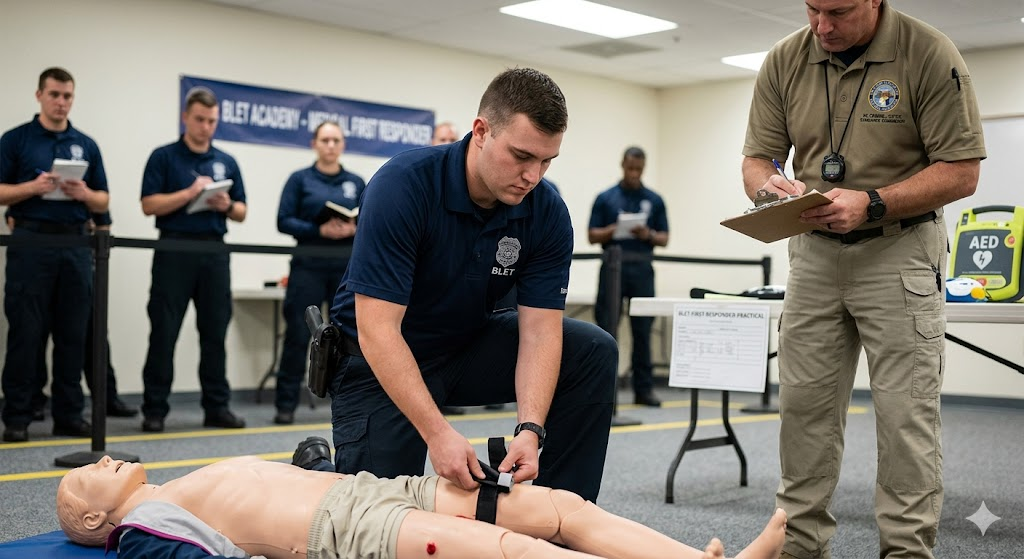
Additional Information
What the Course Entails and Exam Details
The First Responder course within the BLET curriculum is an intensive, hands-on block that covers essential basic life support techniques. Students will learn a variety of competencies required to stabilize victims of trauma or medical emergencies. Core topics generally include:
Patient Assessment: Quickly evaluating a scene and determining a patient’s condition.
Cardiopulmonary Resuscitation (CPR): Mastering adult, child, and infant CPR techniques.
AED Usage: Operating Automated External Defibrillators safely and effectively.
Hemorrhage Control: Utilizing tourniquets, hemostatic agents, and pressure dressings to manage severe bleeding.
Airway Management: Clearing and maintaining a patient’s airway.
Basic First Aid: Treating shock, burns, fractures, and other common injuries.
Opioid Overdose Response: Administering naloxone (Narcan) when indicated.
Medical-Legal Aspects: Understanding the duty to act and Good Samaritan laws as they apply to officers.
What to Expect in the Final Exam
While the First Responder module does not typically culminate in a standalone state exam, its content is a substantial and mandatory part of the final BLET Comprehensive State Written Examination. To become a certified officer, trainees must pass this comprehensive exam, which covers all 39 blocks of BLET instruction.
For the First Responder component within BLET, you can expect:
Practical Skills Testing: Trainees must demonstrate proficiency through hands-on scenarios, such as correctly applying a tourniquet within a time limit, performing proper CPR sequences, and using an AED simulator.
Written Knowledge Assessment: Your understanding of First Responder theory—including assessment protocols, legal requirements, and medical terminology—will be tested within the unit examinations administered by your BLET school director.
Comprehensive Final Integration: First Responder questions will be intermixed with other topics (like Arrest, Search, and Seizure or Traffic Law) in the final State Comprehensive Examination to ensure you can apply medical knowledge in a high-pressure law enforcement context.
To pass the overall BLET program and be eligible for certification, students must achieve a passing score (usually 70 percent) on each unit exam and ultimately pass the State Comprehensive Written Examination administered by the Criminal Justice Standards Division.
How to Study and Exam Centers
Studying for the First Responder section requires a dual approach that balances theoretical knowledge with practical muscle memory.
Actionable Study Strategies:
Utilize Practice Exams: Regularly taking a BLET First Responder practice exam is one of the most effective ways to reinforce your understanding of the medical protocols. Focus on questions about assessment priorities and specific treatment steps.
Practice Hands-On Skills: Do not rely solely on the book. Spend extra time in the lab practicing CPR, applying tourniquets on yourself or a partner, and walking through the steps of patient assessment until they become second nature.
Use Mnemonic Devices: Memorize critical acronyms taught in the course, such as "A-B-C" (Airway, Breathing, Circulation) or "SAMPLE" (Signs/Symptoms, Allergies, Medications, Past history, Last oral intake, Events), as they will help you recall information during stress.
Review the NCDOJ Manual: The primary study source is the official BLET trainee manual provided by the North Carolina Department of Justice. Pay close attention to the specific wording of medical protocols defined by the state.
Exam Centers and Locations:
BLET courses, including the First Responder block and initial unit testing, are offered at authorized delivery sites across North Carolina. These typically include community colleges, dedicated law enforcement academies, and specific North Carolina Justice Academy campuses. The final Comprehensive State Written Examination is administered at designated times and locations coordinated by your BLET School Director and the Criminal Justice Standards Division. You must be enrolled in and sponsored by a BLET academy to be eligible for this examination.
Job Opportunities from the Course
Successfully completing the BLET curriculum, which hinges on passing the First Responder requirements, unlocks the essential certification required for nearly all entry-level sworn law enforcement positions in North Carolina. This certification is the "golden ticket" for many career paths, including:
Police Officer (Municipal Departments)
Sheriff’s Deputy (County Sheriff’s Offices)
State Highway Patrol Trooper
Campus Police Officer (Colleges and Universities)
Company Police Officer (Private Entities with police powers)
Wildlife Enforcement Officer
Probation and Parole Officer (depending on specific agency requirements)
Alcohol Law Enforcement (ALE) Agent
Frequently Asked Questions
Reviews
5.0
Based on 0 reviews
Leave a Review
No reviews yet. Be the first to review!