
BLET Property Crimes Practice Test
$69.00
- Buy to unlock unlimited access to all Quiz questions and Answers in this Quiz.
- After purchase you can print a PDF of the whole quiz at any point. The PDF will contain the questions and the correct answers.
About this Exam
The Basic Law Enforcement Training (BLET) curriculum is the foundation for aspiring law enforcement officers in the state. This comprehensive program combines physical instruction with intense classroom study of criminal, juvenile, and motor vehicle laws. The Property Crimes module is a key pillar of this legal training. This practice exam is designed for current BLET cadets or individuals preparing to enter the academy, focusing specifically on their ability to recognize, classify, and apply the elements of various crimes against property as required by North Carolina General Statutes.
Ready to test your knowledge?
Buy Now to Access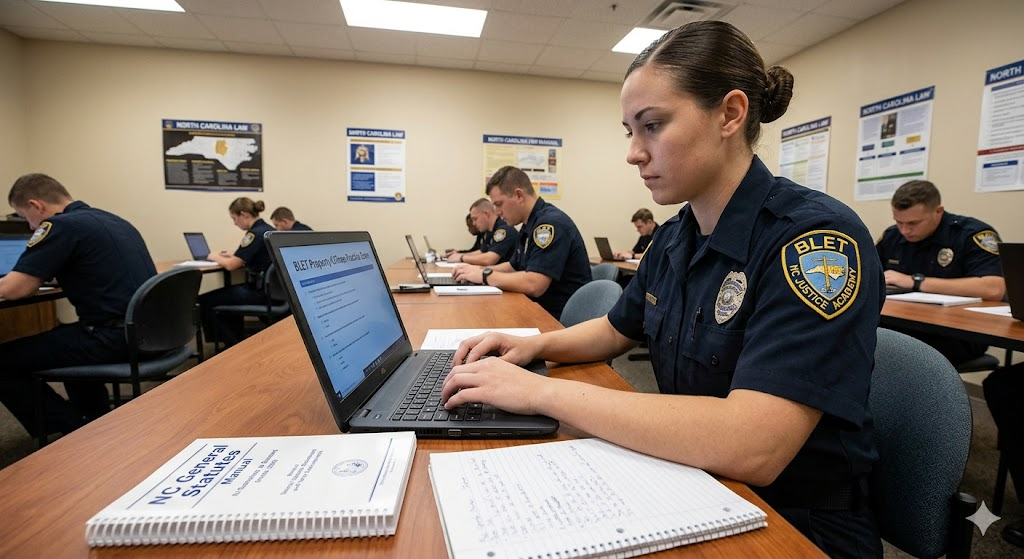
Additional Information
What the Course Entails and Exam Details
The Property Crimes course within BLET dives deep into the specific legal requirements needed to charge individuals with offenses against property. The course teaches cadets to dissect criminal scenarios and identify if all necessary components, or "elements," of a crime are present.
The syllabus primarily covers specific types of criminal activity, including:
Larceny: Both misdemeanor and felony definitions, elements of larceny from the person, and shoplifting statutes.
Burglary and Breaking or Entering: Defining first and second-degree burglary, felony breaking or entering of a building, and misdemeanor breaking or entering.
Arson and Burnings: The elements of common law arson and statutory burnings of other property, including vehicles.
Fraud and Financial Crimes: Topics such as obtaining property by false pretenses, forgery, and embezzlement.
Stolen Property: Possession and receipt of stolen goods.
Property Damage and Trespassing: Injury to real or personal property and first and second-degree trespassing.
What to Expect in the Final Exam
The actual Property Crimes final exam within your BLET course is a high-stakes, comprehensive assessment.
Exam Format
While individual academies may vary slightly, modular exams in BLET are almost universally multiple-choice. These questions do not just test rote memorization of statute numbers; they present complex legal scenarios (case studies) and ask you to apply the relevant law. You must determine the correct charge (e.g., Felony Larceny vs. Misdemeanor Larceny) based on the specific facts provided in the prompt.
Passing Score and Time Limits
BLET exams require a high degree of proficiency. To pass the module, cadets typically need a minimum score of 70% or higher. There is usually a strict time limit for the exam, challenging cadets to process legal scenarios quickly and accurately, mimicking real-world decision-making.
How to Study and Exam Centers
Preparation is critical. Do not underestimate the complexity of these legal modules.
Actionable Study Strategies
Flashcards for Elements: The most successful students build detailed flashcards. On one side, write the crime (e.g., First-Degree Burglary); on the other, list the precise legal elements: 1) The breaking and entering, 2) of the dwelling house, 3) of another, 4) in the nighttime, 5) with the intent to commit a felony or larceny therein. You must memorize these exact components.
Study North Carolina General Statutes: Spend significant time reading the exact language of the relevant NC statutes. Practice tests use the terminology found in these laws.
Practice with Scenarios: Use practice questions that provide brief scenarios and ask you to identify which crime has been committed. These scenarios test your ability to differentiate between similar offenses, such as Larceny vs. Obtaining Property by False Pretenses.
Time Management Practice: When taking practice tests, time yourself. You must become efficient at reading a legal scenario and identifying the core issue quickly.
Exam Centers
BLET Property Crimes exams are not administered as general certification tests (like a driver’s license or CPA exam) at third-party centers (like Pearson VUE). Instead, they are administered internally at the specific, authorized law enforcement training academy where you are enrolled (often located at community colleges or within police departments). You cannot take this exam as a standalone test; it must be completed as part of your comprehensive BLET training.
Job Opportunities from the Course
Mastering the BLET Property Crimes module is a mandatory requirement for graduation, and completing BLET as a whole unlocks various career opportunities in North Carolina law enforcement. Successful certification allows you to pursue careers as:
Police Officer (Municipal/City Departments)
Sheriff’s Deputy (County Departments)
State Highway Patrol Trooper
Campus Police Officer (University and College systems)
Company Police Officer
Wildlife Enforcement Officer (Specific additional training required)
Frequently Asked Questions
Reviews
5.0
Based on 0 reviews
Leave a Review
No reviews yet. Be the first to review!