
Bloodborne Pathogens (BBP) Certification Practice Test
$69.00
- Buy to unlock unlimited access to all Quiz questions and Answers in this Quiz.
- After purchase you can print a PDF of the whole quiz at any point. The PDF will contain the questions and the correct answers.
About this Exam
Welcome to your essential first step towards workplace safety and regulatory compliance. The Bloodborne Pathogens (BBP) Certification is a critical credential designed for any professional whose job duties entail a reasonable anticipation of contact with human blood or Other Potentially Infectious Materials (OPIM). This training isn’t just a bureaucratic requirement; it is a vital shield that equips you with the knowledge and skills necessary to recognize exposure risks and implement life-saving preventative measures. Whether you are entering the healthcare field, the body modification industry, or emergency services, obtaining your BBP Certification demonstrates your commitment to the highest standards of safety for both yourself and those in your care. This practice test study guide will ensure you are thoroughly prepared to ace your final assessment and enter your chosen field with confidence.
Ready to test your knowledge?
Buy Now to Access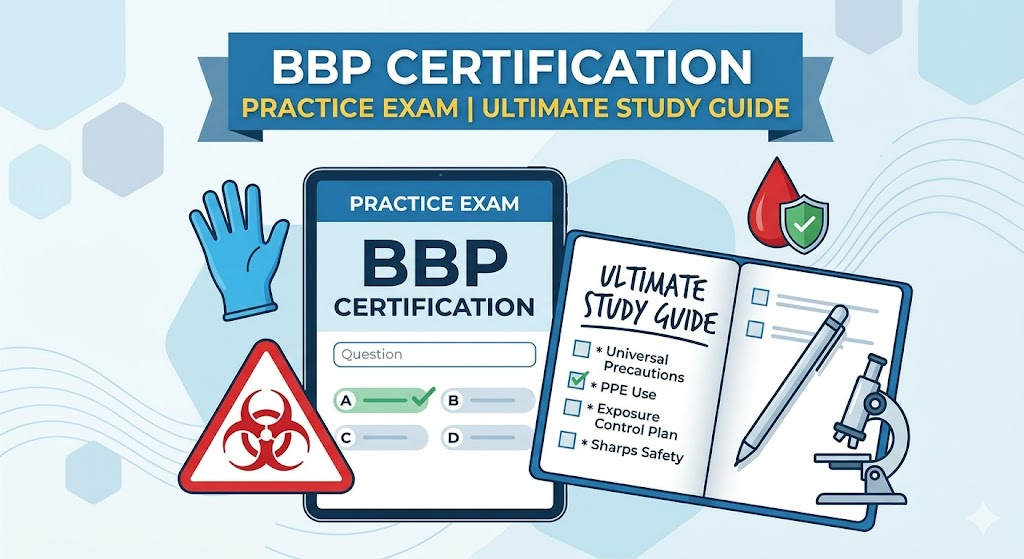
Additional Information
What the Course Entails and Exam Details
A comprehensive Bloodborne Pathogens course provides a deep dive into the fundamental principles of infection control and safe work practices as mandated by the Occupational Safety and Health Administration (OSHA). The syllabus typically covers the core definitions of bloodborne pathogens, focusing on major diseases of concern such as Hepatitis B (HBV), Hepatitis C (HCV), and Human Immunodeficiency Virus (HIV). You will learn precisely how these pathogens are transmitted in a workplace setting. The course details essential methods of control, including the concept of Universal or Standard Precautions, which requires treating all human blood and OPIM as if known to be infectious. Additional critical topics include the correct selection and use of Personal Protective Equipment (PPE), engineering and work practice controls, the importance of sharp object safety, the Hepatitis B vaccination series, procedures for managing exposure incidents, and the requirements of a workplace Exposure Control Plan.
What to Expect in the Final Exam
While the exact format can vary slightly by the accredited provider, you can generally expect a digital final exam that is straightforward and highly focused on practical knowledge application. The assessment is primarily composed of multiple-choice and true/false questions designed to test your retention of the core safety concepts covered in your training. You will not typically face any practical or hands-on components. To pass, most programs require a scoring threshold of at least 70% to 80%. These exams are often untimed or provide a very generous time limit, allowing you to carefully read and consider each scenario. The great news is that many online platforms offer the flexibility of immediate retakes, ensuring you can review the material and successfully demonstrate your competence if you do not succeed on your first attempt.
How to Study and Exam Centers
Preparation is the key to success. Start by thoroughly reading and summarizing your course study materials, focusing on definitions and the sequence of steps for safety protocols. Utilizing specialized Bloodborne Pathogens (BBP) Certification Practice Tests is one of the most effective study strategies. These practice tools help you familiarize yourself with the question style and identify specific areas where you need to dedicate more review time. Focus heavily on memorizing the hierarchy of controls and the immediate steps to take following a potential exposure. Regarding exam centers, the modern landscape for BBP Certification is highly accessible. The vast majority of standard BBP training and testing is conducted entirely online through accredited safety organizations, healthcare education portals, or vocational school websites. You can complete the entire process—training, studying, and taking the final exam—from the comfort of your own home or workplace.
Job Opportunities from the Course
A Bloodborne Pathogens Certification is either a required prerequisite or a highly valued asset across a surprisingly diverse array of industries. Earning this credential unlocks numerous career paths and job opportunities where occupational exposure is a daily reality. The specific job titles include:
Registered Nurse (RN) and Licensed Practical Nurse (LPN)
Medical Assistant and Phlebotomist
Emergency Medical Technician (EMT) and Paramedic
Laboratory Technician and Research Assistant
Tattoo Artist and Body Piercer
Dental Hygienist and Dental Assistant
First Responder, including Firefighters and Police Officers
Correctional Officer
Home Health Aide and Personal Care Attendant
Janitorial and Housekeeping Staff in healthcare facilities
School Nurse and designated school first-aid personnel
Daycare Provider and Childcare Worker
Athletic Trainer and Coach
Funeral Director and Embalmer
Laundry Worker handling contaminated linens
By investing in your BBP Certification, you are not just meeting a requirement; you are opening the door to a wide range of rewarding professions dedicated to care, safety, and service. Good luck with your study and your practice test!
Frequently Asked Questions
Reviews
5.0
Based on 0 reviews
Leave a Review
No reviews yet. Be the first to review!