
BLS for Health Care Providers Practice Test
$69.00
- Buy to unlock unlimited access to all Quiz questions and Answers in this Quiz.
- After purchase you can print a PDF of the whole quiz at any point. The PDF will contain the questions and the correct answers.
About this Exam
The Basic Life Support (BLS) for Healthcare Providers certification is a critical credential for medical professionals and emergency responders. This course, often administered by organizations like the American Heart Association (AHA), is designed for individuals who work in a healthcare setting—including doctors, nurses, EMTs, paramedics, respiratory therapists, and other allied health professionals. It provides the essential skills needed to recognize and respond to life-threatening emergencies, particularly cardiac arrest and choking, in an in-facility or pre-hospital environment. Earning this certification demonstrates that you possess the fundamental life-saving skills required to stabilize a patient until advanced life support can arrive.
/;’L,
Content: Questions will cover the AHA Guidelines for CPR and ECC, team dynamics, AED use, and the logic behind high-quality BLS techniques.
Time Limit: The written exam is generally timed, often giving you about 25-30 minutes to complete it.
Passing Score: To pass the written exam, you must achieve a score of 84% or higher. (This may vary slightly depending on the specific certifying body, but is the general standard).
Ready to test your knowledge?
Buy Now to Access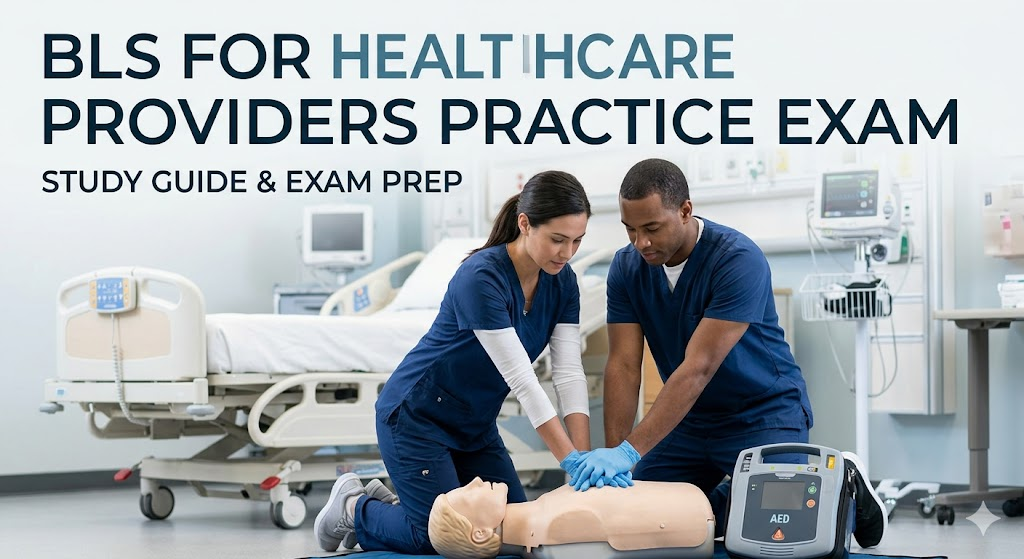
Additional Information
Content: Questions will cover the AHA Guidelines for CPR and ECC, team dynamics, AED use, and the logic behind high-quality BLS techniques.
Time Limit: The written exam is generally timed, often giving you about 25-30 minutes to complete it.
Passing Score: To pass the written exam, you must achieve a score of 84% or higher. (This may vary slightly depending on the specific certifying body, but is the general standard).
How to Study and Exam Centers
Preparing for the BLS exam requires a combination of understanding the key concepts and gaining hands-on practice.
Proven Study Strategies:
Read the Provider Manual: The official student workbook/manual is your primary resource. Read it thoroughly, focusing on the steps for CPR, AED use, and choking relief for each age group. Pay close attention to key definitions and figures.
Practice Hands-On: BLS is a physical skill. The best way to prepare is through actual practice. If you are taking an in-person class, maximize your time with the manikins and AED trainers. Practice the rhythm of compressions and the coordination of breaths.
Take Practice Tests: Utilizing practice questions is excellent for the written portion. They help you get used to the wording of the questions and identify areas where your knowledge is weak. Focus on understanding why a particular answer is correct.
Review the AHA Guidelines Summary: The American Heart Association publishes a summary of its current Guidelines for CPR and Emergency Cardiovascular Care. Reviewing this high-level document can reinforce the critical updates and core concepts.
Visualize Scenarios: Run through different scenarios in your mind (e.g., an adult collapses in a hallway, an infant is found unresponsive). Mentally practice the exact sequence of steps you must take.
Where and How to Take the Exam:
The BLS course and exam must be completed through an authorized training center or program.
American Heart Association (AHA): The AHA is the gold standard for BLS certification. You can find an authorized AHA Training Center (TC) near you using their online locator tool on the AHA website. TCs include hospitals, fire departments, colleges, and private training companies.
Authorized Training Providers: Other organizations like the American Red Cross or private healthcare training companies also offer BLS for Healthcare Providers courses. Ensure the course you choose meets the requirements of your employer or licensing board.
Course Formats:
In-Person Class: A traditional, instructor-led course held at a physical training center where both teaching and testing are completed in one session.
Blended Learning (HeartCode® BLS): A common, convenient option where you complete the cognitive portion (the "lecture" and written exam) online at your own pace. Then, you must attend an in-person "skills session" with an instructor to be evaluated on your physical skills. This is widely accepted and often preferred for its flexibility.
Pearson VUE: The BLS exam is not taken at Pearson VUE testing centers. BLS testing is conducted directly by the authorized training center where you complete your practical training or skills session.
Job Opportunities from the Course
A valid BLS for Healthcare Providers certification is often a mandatory prerequisite for employment in a wide range of healthcare roles. This credential unlocks numerous career paths and job opportunities:
Nurses: All types of nurses, including Registered Nurses (RNs), Licensed Practical Nurses (LPNs/LVNs), and Nurse Practitioners (NPs), are required to maintain current BLS certification.
Emergency Medical Services (EMS): EMTs (Emergency Medical Technicians) and Paramedics must have BLS as a baseline certification before pursuing advanced licensure.
Physicians and Physicians Assistants: Doctors (MDs/DOs) and PAs working in clinical settings require BLS to ensure they can manage acute emergencies.
Respiratory Therapists (RTs): Professionals who manage patient breathing are critical in resuscitation and must be certified in BLS.
Medical Assistants (MAs) and Nursing Assistants (CNAs): Clinical and support staff in hospitals, clinics, and long-term care facilities need BLS to respond to patient emergencies.
Dental Professionals: Dentists and dental hygienists are often required to be certified to handle emergencies that may occur in a dental office.
Physical Therapists (PTs) and Occupational Therapists (OTs): Therapists working with patients in diverse settings must be prepared to respond to acute events.
Hospital Support Staff: This includes roles such as patient transporters, monitor technicians, and other clinical support personnel.
Firefighters and Law Enforcement: As first responders, these professionals are often required to maintain BLS certification.
Clinical Research Coordinators: Professionals managing clinical trials involving human subjects may need BLS certification depending on the protocol.
Athletic Trainers: Professionals caring for athletes must be prepared for emergency situations during practice or competition.
Home Health Aides: Caregivers providing in-home care, especially for high-risk patients, are often required to be BLS-certified.
By mastering the skills required for BLS for Healthcare Providers, you are making a commitment to patient safety and preparing yourself for a rewarding career on the front lines of healthcare. Start studying today and take the first step toward becoming a certified lifesaver. Good luck on your exam!
Frequently Asked Questions
Reviews
5.0
Based on 0 reviews
Leave a Review
No reviews yet. Be the first to review!