
BLS Hospital Corpsman Practice Exam
$69.00
- Buy to unlock unlimited access to all Quiz questions and Answers in this Quiz.
- After purchase you can print a PDF of the whole quiz at any point. The PDF will contain the questions and the correct answers.
About this Exam
The Basic Life Support (BLS) Hospital Corpsman Practice Exam is a crucial preparatory tool designed specifically for United States Navy Hospital Corpsmen (HM) and those entering the Navy medical rating. This exam represents the foundational level of emergency cardiac and respiratory care required for all military healthcare providers. Its primary purpose is to ensure that Corpsmen possess the knowledge and instantaneous decision-making skills necessary to save lives in diverse environments, from combat zones to naval hospitals.
Maintaining current BLS certification is mandatory for all active duty Corpsmen, making this practice exam an indispensable resource for both initial training at A-School and subsequent recertification. It is designed for enlisted medical professionals who must deliver high-quality resuscitations under the highest pressure scenarios.
Ready to test your knowledge?
Buy Now to Access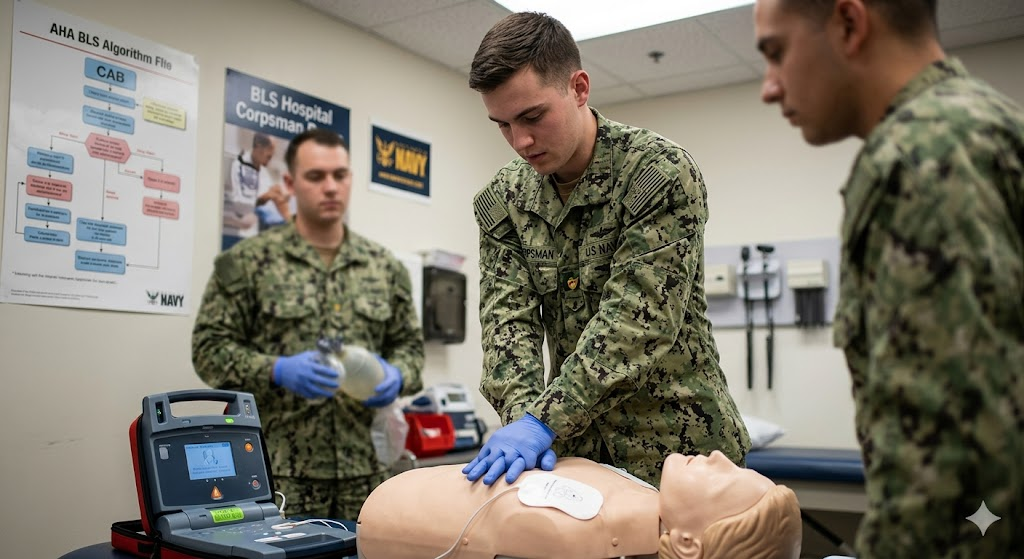
Additional Information
What the Course Entails and Exam Details
The final BLS certification course, usually adhering to American Heart Association (AHA) or Military Training Network (MTN) guidelines, provides the core life-saving techniques required for adult, child, and infant patients. A BLS Hospital Corpsman Practice Exam mirrors these standards, testing your knowledge of the essential resuscitation protocols.
The practice exam specifically focuses on the following core domains:
Recognition of Medical Emergencies: Identifying sudden cardiac arrest, respiratory arrest, and foreign-body airway obstruction (choking).
High-Quality CPR (Cardiopulmonary Resuscitation): Mastering the correct compression depth, rate (100–120 compressions per minute), hand placement, and ensuring full chest recoil for all age groups.
The C-A-B Sequence: Understanding the priority of Compressions, then Airway, then Breathing.
Automated External Defibrillator (AED) Use: Operating an AED quickly and correctly in single-rescuer and team scenarios.
Ventilation Techniques: Delivering effective rescue breaths using a barrier device or bag-mask device, and avoiding excessive ventilation.
Team Dynamics: Effective communication and role clarity within a multi-rescuer resuscitation team.
What to Expect in the Final Exam
While a practice exam prepares you, the final BLS certification is a two-part process. You cannot become certified without demonstrating hands-on proficiency to a certified instructor.
Here is what you must expect during the official examination:
1. The Written Examination:
Format: This section consists of approximately 25 to 35 multiple-choice questions.
Content: Questions are scenario-based and designed to test your critical thinking regarding the BLS algorithms and correct ratios for different age groups (e.g., 30:2 single rescuer vs. 15:2 two-rescuer for a child).
Passing Score: You typically must achieve a score of 84% or higher to pass this section.
2. The Skills Session (The Practical):
Format: This is a one-on-one or small group session where you must perform the actual skills on adult and infant mannequins in front of an authorized instructor.
Required Skills: You will be required to demonstrate perfect high-quality CPR (5 cycles of 30:2 in under 2 minutes), effective AED integration, and rescue breathing with a bag-mask device.
Standard of Performance: You must meet every criterion on the skill check-off sheet. Instructors will not assist or correct you during the evaluation; you must perform the steps flawlessly without hesitation.
How to Study and Exam Centers
Preparation is paramount, as a single error in the real-world execution of BLS can be fatal. Treat your practice exam time with the same seriousness as a real-world scenario.
Effective Study Strategies:
Master the Official Manual: Thoroughly read the official AHA or MTN BLS Provider Manual, which is the ultimate authority for the exam standards.
Focus on Algorithms: Don't just memorize ratios; memorize the decision-making flowcharts. What is the next step if there is a pulse but no breathing? What is the next step if the AED advises a shock?
Use Visual and Scenario-Based Tools: Utilize official video resources and scenario-based practice quizzes. Visualization helps you react faster than simple rote memorization.
Practice Hands-On (Crucial): If you are at A-School or near a Navy medical facility, seek out practice time on the mannequins. Physical muscle memory is what you rely on when time is critical.
Where to Take the Exam (Authorized Testing Centers):
Military Training Network (MTN) Sites: Hospital Corpsmen will primarily obtain and renew their BLS through the Military Training Network. Training is conducted on-site at naval hospitals, METC (Medical Education and Training Campus) at Joint Base San Antonio, and within fleet or Marine Corps unit medical departments.
Authorized Training Centers (Civilians or Reservists): For those outside active command, authorized American Heart Association (AHA) or American Red Cross training centers are the official hubs for obtaining a civilian BLS certification that is recognized by the military.
Job Opportunities from the Course
A current BLS certification is the absolute entry-level credential required for any Hospital Corpsman. It unlocks your fundamental ability to practice within the HM rating and serves as the foundation for all subsequent advanced medical training.
This certification unlocks the following career paths and job duties:
Active Duty Hospital Corpsman (All Environments): Mandatory credential for service on ships, submarines, with Marine Corps units (Greenside), and in all Navy medical facilities.
Emergency Room Technician: Providing stabilization in naval and civilian trauma centers.
Search and Rescue (SAR) Medical Technician: First responder duties in specialized aviation roles.
Submarine Force Independent Duty Corpsman (IDC): Fundamental prerequisite for advanced, isolated independent medicine training.
Civilian EMT-Basic (Transitioned Vets): The military BLS card often serves as the required CPR prerequisite for taking a civilian NREMT (EMT-Basic) course.
Allied Health Roles: The credential is required for many derivative roles such as Respiratory Therapist or Cardiovascular Technician (Navy NECs).
Frequently Asked Questions
Reviews
5.0
Based on 0 reviews
Leave a Review
No reviews yet. Be the first to review!