
Blue Badge Pre-Entry Practice Test
$69.00
- Buy to unlock unlimited access to all Quiz questions and Answers in this Quiz.
- After purchase you can print a PDF of the whole quiz at any point. The PDF will contain the questions and the correct answers.
About this Exam
The Blue Badge Tourist Guide qualification represents the absolute gold standard in British tour guiding. It is a prestigious accreditation awarded by the Institute of Tourist Guiding (ITG) and is recognized globally for its rigor and professional excellence. The full training course is incredibly demanding, typically spanning up to two years and requiring a massive commitment of time and study. Because the standard is so high, many training providers implement a competitive selection process. The Blue Badge Pre-Entry Practice Test is designed for aspiring guides who want to benchmark their existing general knowledge and aptitude before applying for a formal training course. This test is ideal for local history enthusiasts, linguists, and anyone passionate about sharing the heritage, culture, and architecture of their region with international visitors.
Ready to test your knowledge?
Buy Now to Access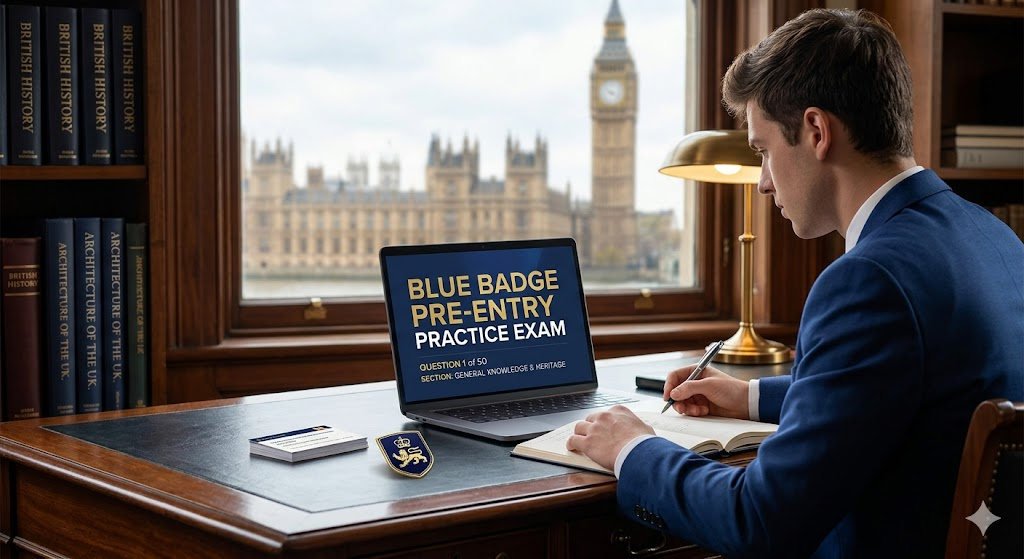
Additional Information
What the Course Entails and Exam Details
While this is a practice test for the pre-entry phase, it is vital to understand what the official pre-entry assessment covers to study effectively. The full training course will eventually cover exhaustive details on history, art, architecture, social development, geography, and current affairs specific to your qualified region. The Pre-Entry assessment, however, is designed to test your potential to learn this vast amount of information. It focuses on your existing foundation of general knowledge and your cognitive ability. You are not expected to be an expert yet, but you must demonstrate a strong academic base and a curious mind. The official selection process typically includes two main components: a written paper and an oral interview. The written Pre-Entry paper focuses on broad general knowledge, specific local knowledge (e.g., London landmarks, regional history), and sometimes logic or communication skills.
What to Expect in the Final Exam
It is important to differentiate between the Blue Badge Pre-Entry selection process and the final, badge-awarding examinations at the end of the full course. When you eventually sit the actual Pre-Entry selection assessment, you should expect a challenging environment. The final Pre-Entry written component is usually a timed, closed-book examination. This paper often consists of a mix of multiple-choice questions to test breadth of knowledge and short-answer questions to test depth. You might be required to identify famous buildings, match historical figures to events, or define architectural terms. Many assessments also include a short essay section to evaluate your written communication, ability to construct an argument, and command of English. There is usually a strict passing threshold required to proceed to the interview stage, where your practical suitability for guiding and language proficiency will be assessed live.
How to Study and Exam Centers
Preparation for the Blue Badge Pre-Entry Practice Test requires a distinct strategy focused on active learning and curiosity rather than passive memorization. Your primary strategy should be to become a "generalist expert" in your chosen region and basic British history. Read widely; consume newspapers, watch high-quality historical documentaries, and browse museum websites. Accessing past or practice question papers is the single most effective way to understand the required tone and depth of knowledge. We advise creating digital or physical flashcards for key dates, historical figures, famous architects, and major artistic movements. To prepare for the interview and essay components, practice describing popular tourist landmarks out loud, emphasizing their historical significance and unique features. The actual official selection assessments are not held at standard commercial testing centers like Pearson VUE. Instead, they are managed and administered directly by the accredited regional guiding schools or the Institute of Tourist Guiding (ITG). In London, for example, the entry test is typically administered by the training provider commissioned by the London region.
Job Opportunities from the Course
Successfully passing the selection process, completing the full course, and earning your Blue Badge unlocks some of the most prestigious and lucrative careers in the tourism industry.
Official Blue Badge Tourist Guide: This credential allows you to lead tours on a freelance basis for tour operators, corporate clients, or private groups.
Exclusive Attraction Guiding: Blue Badges are the only external guides permitted to deliver live tours inside some of the UK’s most famous landmarks, such as Westminster Abbey and the Tower of London.
Corporate and Incentive Tour Leader: You can work with high-end corporate groups, planning and executing bespoke cultural and historical itineraries.
Media and Cultural Consultant: Qualified guides often provide expert consultation for film productions, historical documentaries, and travel journalism.
Specialist Region/Theme Guide: You can develop your own niche business focusing on specific topics such as royal history, street art, or architecture.
University Lecturer or Guiding Trainer: Experienced Blue Badge guides often transition into teaching, training the next generation of guides at accredited institutions.
Frequently Asked Questions
Reviews
5.0
Based on 0 reviews
Leave a Review
No reviews yet. Be the first to review!