
BMS Mathematics Academic Team Practice Test
$69.00
- Buy to unlock unlimited access to all Quiz questions and Answers in this Quiz.
- After purchase you can print a PDF of the whole quiz at any point. The PDF will contain the questions and the correct answers.
About this Exam
The BMS Mathematics Academic Team Practice Test is a crucial diagnostic tool designed for ambitious students preparing to compete at the highest levels of middle school and introductory high school mathematics. This exam is not just a test of knowledge; it is a gateway to the stimulating world of academic competition, where students can showcase their problem-solving prowess, logical reasoning, and passion for mathematics.
This exam is primarily designed for members of school mathematics teams and individual students who want to benchmark their skills against a challenging curriculum. It provides a realistic simulation of competitive math scenarios, allowing participants to experience the unique pressure and complexity of team-based and individual academic contests. Successfully navigating this practice test signals a student's readiness to tackle advanced concepts and their potential for significant achievement in mathematics competitions and future STEM-related studies.
Ready to test your knowledge?
Buy Now to Access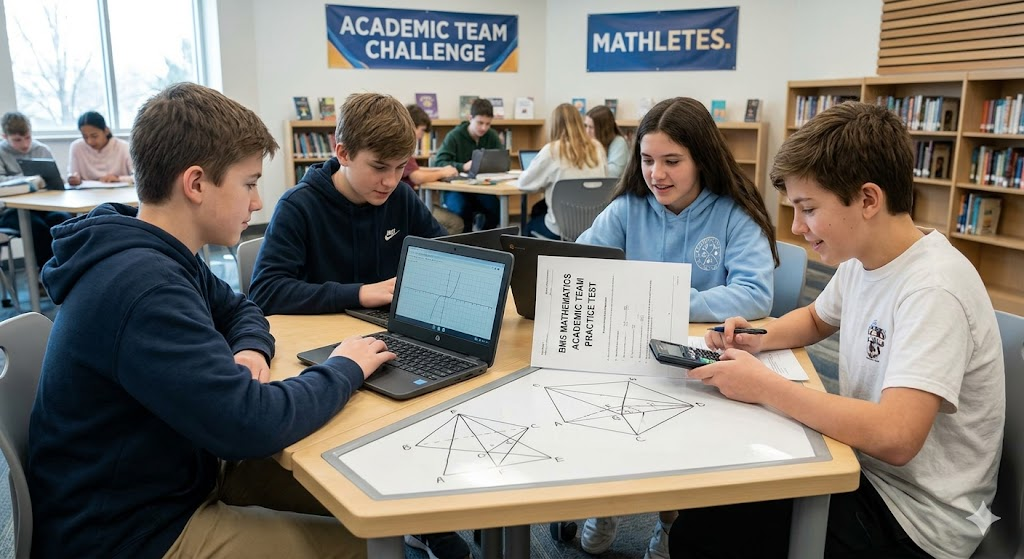
Additional Information
What the Course Entails and Exam Details
The BMS Mathematics Academic Team Practice Test covers a wide array of topics that go beyond the standard mathematics curriculum, blending accelerated middle school concepts with fundamental high school and introductory collegiate-level mathematics. Students must demonstrate mastery in a variety of domains to succeed.
The core syllabus encompasses:
Pre-Algebra and Algebra: Advanced multi-step equations, inequalities, systems of equations, polynomials, factoring, and the quadratic formula.
Geometry: Euclidean geometry concepts including triangles, circles, polygons, area, volume, coordinate geometry, and fundamental theorems.
Number Theory: Divisibility rules, prime factorization, greatest common divisor, least common multiple, modular arithmetic, and properties of numbers.
Counting and Probability: Combinatorics (permutations and combinations), basic probability, and complex counting strategies.
Introductory Advanced Math: Depending on the specific level of the practice test, topics may also include an introduction to matrices (operations, determinants), basic statistics (mean, variance, standard deviation), sequences and series, and functions.
The practice exam is designed to test not only computational accuracy but also visual reasoning and the ability to apply standard mathematical techniques to unusual and creative problems.
What to Expect in the Final Exam
The actual final competition format often varies slightly depending on the specific math league or organizing body, but the BMS Mathematics Academic Team Practice Test closely mimics the core components of these events. Students should be prepared for a multi-faceted evaluation.
Exam Format: The test is usually divided into two main components:
Individual Rounds: A series of short-answer or multiple-choice questions focusing on speed and accuracy across all syllabus topics. These are completed individually by each team member.
Team Round: A collaborative segment where all members of a school's mathematics team work together to solve a small number of extremely challenging, multi-part, or proof-oriented problems.
Time Limits: Speed is essential. The individual rounds are typically under tight time constraints (e.g., 20-40 minutes), requiring quick thinking and efficiency. The team round may allow more time (e.g., 30-60 minutes) but demands complex collaboration.
Scoring: Scoring systems can vary. Often, points are awarded for correct answers, with no partial credit in individual short-answer rounds. Incorrect answers might receive a small penalty to discourage guessing. The team round is usually heavily weighted.
Authorized Schools: The "final exam" is the competition itself. These are not taken at external centers like Pearson VUE; rather, they are hosted on specific dates by authorized schools that act as regional competition hubs. Your team coach or school administration will coordinate registration and provide details about the location of the host school for your division.
How to Study and Exam Centers
Preparation is paramount for success in academic mathematics competitions. Studying requires a structured, multi-pronged approach that balances conceptual understanding with practical application.
Actionable Study Strategies:
Master the Basics, Then Go Deep: Ensure you have a flawless understanding of your current grade-level math. Then, use textbooks and online resources specifically designed for math competitions (like those from Art of Problem Solving) to explore advanced topics in algebra, geometry, number theory, and counting.
Practice with Past Tests: This is the single most important activity. Obtain as many past BMS Mathematics Academic Team Practice Tests and actual competition papers from previous years as possible. Analyze the "how" and "why" behind the solutions, not just the "what."
Simulate Test Conditions: Regularly take timed practice tests. This helps you build the necessary speed, stamina, and mental agility required for the actual competition environment. Work on problem-selection strategies—knowing which problems to solve quickly and which to flag for later.
Join a Team or Study Group: Collaborate with other mathematically inclined students. Discussing different approaches to complex problems is a powerful way to expand your own problem-solving toolkit and prepare for the team round.
Learn Competition-Specific Tricks: Study standard competition techniques like complementary counting, casework, drawing auxiliary lines in geometry, and using modular arithmetic for number theory problems.
Where to Take the Exam:
It is important to understand that the "BMS Mathematics Academic Team Practice Test" is designed to prepare you for a live competition event.
No Centralized Testing Centers: You will not find this test offered at a testing facility. The practice test itself is a resource provided by your coach or accessible online.
Hosted at Authorized Schools: The actual competition that this practice test prepares you for takes place at specific physical testing centers or authorized schools. These host schools are designated each year by the regional or national math competition organization. Your school's math team coach will manage your team's entry and provide you with the location and date for the regional, state, or national finals.
Job Opportunities from the Course
While the BMS Mathematics Academic Team Practice Test is an academic hurdle rather than a direct professional certification, the skills and dedication it demonstrates are highly valued. Mastering advanced mathematics opens doors to a vast array of lucrative and intellectually stimulating career paths in the future.
Successfully participating on a mathematics academic team can act as a catalyst for future success in these fields:
Actuary
Cryptographer
Data Analyst
Data Scientist
Engineer (all disciplines, e.g., Aerospace, Mechanical, Electrical)
Financial Analyst
Mathematics Teacher (K-12 or University Professor)
Operations Research Analyst
Quantitative Analyst ("Quant")
Software Engineer / Developer
Statistician
Preparing for and excelling in these competitions provides a rigorous foundation that makes you a strong candidate for elite university programs and, ultimately, for high-demand roles in the quantitative and technology sectors.
Frequently Asked Questions
Reviews
5.0
Based on 0 reviews
Leave a Review
No reviews yet. Be the first to review!