
BNSF Conductor Practice Exam
$69.00
- Buy to unlock unlimited access to all Quiz questions and Answers in this Quiz.
- After purchase you can print a PDF of the whole quiz at any point. The PDF will contain the questions and the correct answers.
About this Exam
The BNSF Conductor Practice Exam is an essential preparatory tool for anyone aiming to become a certified Conductor for the Burlington Northern Santa Fe Railway (BNSF). This examination is the culmination of an intensive multi-week training program designed to equip new hires with the knowledge and safety protocols necessary to manage train movements. The role of a BNSF Conductor is dynamic and responsibility-driven, acting as the ground-level supervisor of the train crew, coordinating with the Locomotive Engineer and dispatchers, and ensuring the safe assembly and delivery of freight. This exam is specifically designed for BNSF employees engaged in the official Conductor Trainee program who must demonstrate mastery of operational rules before beginning their career in freight transportation.
Ready to test your knowledge?
Buy Now to Access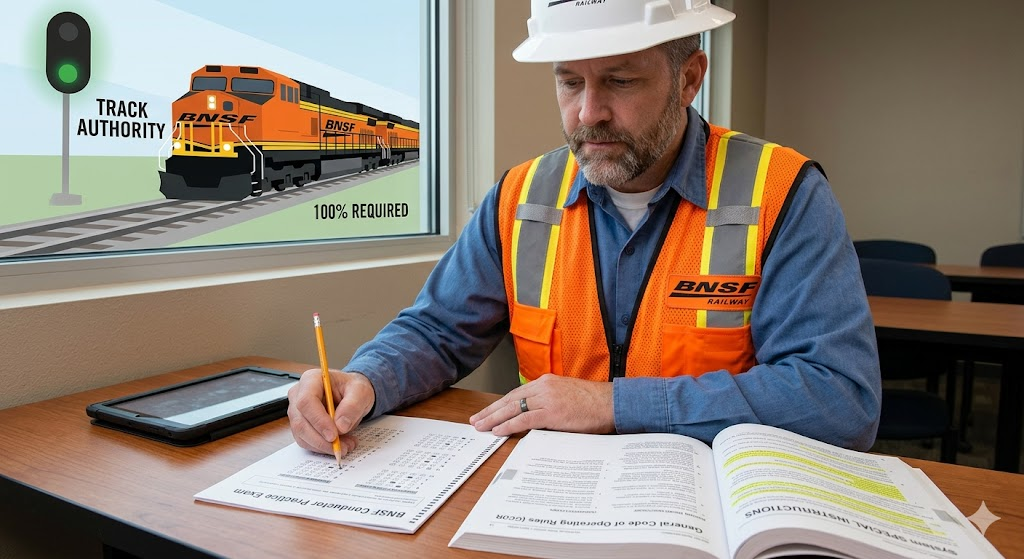
Additional Information
What the Course Entails and Exam Details
The official BNSF Conductor course covers a vast amount of material focused on the General Code of Operating Rules (GCOR), BNSF-specific network rules, and critical safety practices. The curriculum encompasses train handling principles, the mechanics of freight car air brake systems, and switching operations required for assembling trains in yards. Trainees will spend significant time learning how to interpret railway signals, execute track authority procedures, and safely manage the movement of trains on main tracks and sidings. The Conductor examination itself focuses heavily on these rules and their real-world application, testing a candidate's ability to operate safely and efficiently under various conditions.
What to Expect in the Final Exam
The final BNSF Conductor certification examination is a rigorous assessment consisting of multiple written modules or a comprehensive final test. The exam is usually presented in a multiple-choice or short-answer format, and trainees are typically given ample time—often up to three hours—to complete the final section. To successfully complete the certification, trainees must achieve a minimum score of 85% on the overall knowledge examination. However, candidates must be aware that certain critical sections, specifically those relating to railway signal identification, signal definitions, and track authority procedures, require a perfect score of 100%. Some portions of the exam may be open-book, allowing trainees to reference company rules manuals, necessitating quick navigation of regulatory documentation.
How to Study and Exam Centers
Effective preparation for this exam requires extensive study and a deep commitment to safety regulations. You must know your rulebook intimately; rely heavily on the General Code of Operating Rules (GCOR) and your specific BNSF System Special Instructions (SSI). Active learning is crucial—do not just read the rules, but practice applying them to hypothetical scenarios you might encounter in the field. Utilize the official daily quizzes and practice assessments provided by BNSF instructors during your training, as these closely mimic the style and wording of the final exam. Focus intense effort on memorizing signal aspects and definitions, as there is zero margin for error on these sections. It is vital to "read the question twice" during the actual test to avoid misunderstanding complex rule interactions. The final conductor certification exam is administered on-site at official BNSF training facilities, primarily the BNSF Technical Training Center (TTC) located in Overland Park, Kansas, or at designated regional training hubs during your cohort’s training cycle. Pre-employment assessments may be handled through different portals, but the actual certification occurs within the structure of the employment training program.
Job Opportunities from the Course
Successfully passing the BNSF Conductor Certification is the required gateway to a lifelong career in the railroad industry. This certification is mandatory to activate your employment as a fully qualified conductor. Completing this process unlocks specific operational roles and clear paths for future advancement within BNSF:
Conductor: The immediate role unlocked by certification, responsible for supervising train operations and ensuring regulatory and safety compliance.
Yard Conductor: A specialization involving the management of car movements, switching, and train assembly within a specific yard facility.
Locomotive Engineer: Through seniority and further dedicated training, many certified conductors choose to promote to the role of Locomotive Engineer, directly operating the locomotives.
Management Pathways: Highly experienced and safety-conscious conductors are often recruited for supervisory and management roles within terminal or network operations.
Frequently Asked Questions
Reviews
5.0
Based on 0 reviews
Leave a Review
No reviews yet. Be the first to review!