
Board Certified Autism Technician (BCAT) Practice Test
$69.00
- Buy to unlock unlimited access to all Quiz questions and Answers in this Quiz.
- After purchase you can print a PDF of the whole quiz at any point. The PDF will contain the questions and the correct answers.
About this Exam
The Board Certified Autism Technician (BCAT) certification is a premier credential for entry-level professionals dedicated to making a difference in the lives of individuals with autism spectrum disorder (ASD). It is designed specifically for behavior technicians who provide front-line, direct treatment using the principles of Applied Behavior Analysis (ABA). By obtaining this certification, which is accredited by the National Commission for Certifying Agencies (NCCA), you demonstrate to employers, families, and regulatory bodies that you possess the essential autism-specific competencies to deliver safe and effective care. This exam is perfect for those beginning their career in behavioral health or paraprofessionals in education seeking specialized recognition.
Ready to test your knowledge?
Buy Now to Access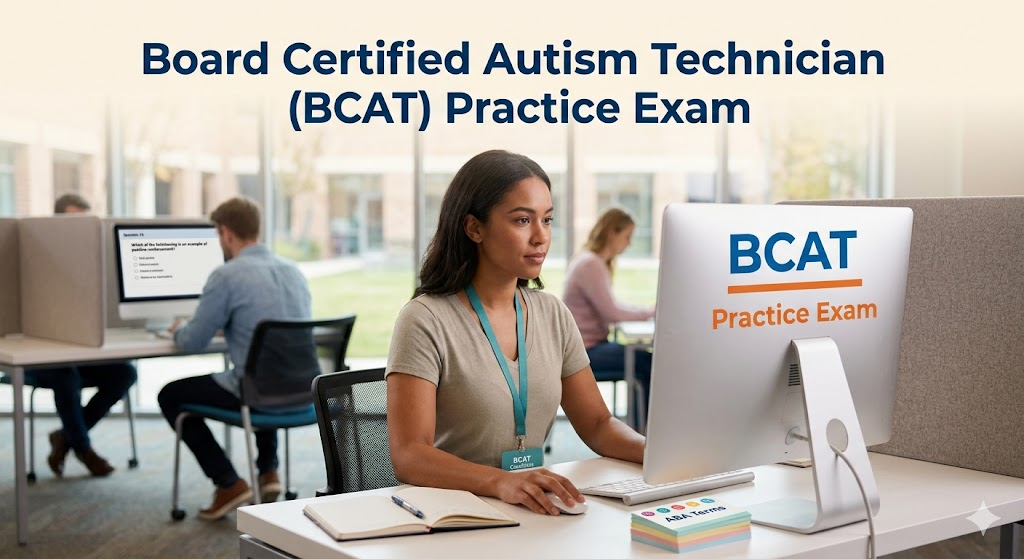
Additional Information
What the Course Entails and Exam Details
This certification validates that a candidate has mastered the foundational knowledge required to implement behavioral intervention plans under the close supervision of a qualified healthcare professional, such as a Board Certified Behavior Analyst (BCBA). The exam tests your understanding of core concepts in ABA and their specific application to autism treatment.
The comprehensive syllabus covers six critical domains:
Autism Spectrum Disorder: Understanding deficits, severity levels, and research.
Principles of ABA: Mastery of concepts like reinforcement, punishment, and extinction.
Treatment: Skill Acquisition: Methods for teaching new social, academic, and daily living skills.
Treatment: Reduction of Problem Behavior: Implementing behavior intervention plans.
Behavioral Data Collection: Accuracy in measurement and documentation of behavior.
Ethical/Legal Considerations: Safety, confidentiality, HIPAA, and maintaining professional boundaries.
To be eligible to take the exam, candidates must meet specific prerequisites, which typically include possessing a high school diploma, completing 40 hours of approved training based on the BCAT task list, and performing 15 hours of supervised direct fieldwork with individuals diagnosed with ASD.
What to Expect in the Final Exam
The BCAT exam is a rigorous assessment administered by the Behavioral Intervention Certification Council (BICC). It is designed to evaluate practical knowledge through scenario-based questions.
Here is a breakdown of what to expect on test day:
Format: The examination consists of 175 multiple-choice questions. 150 of these questions are scored and contribute to your final result, while 25 are unscored pretest items used for statistical validation.
Time Limit: You will be given a total of 3 hours to complete the entire exam.
Passing Score: The BICC uses a scaled scoring system to ensure fairness across different versions of the test. A scaled score of 400 is required to pass. A percentage raw score is not used.
Language: The primary language of the exam is English.
Calculators: Standard calculator use is usually permitted within the testing interface.
Effective time management is essential, as unanswered questions are counted as incorrect.
How to Study and Exam Centers
Preparation is key to succeeding on the BCAT. A multi-modal study approach will provide the best foundation for exam day.
Actionable Study Strategies:
Use the Content Outline: Treat the official BICC Examination Content Outline as your master checklist. If a topic is listed, ensure you can define it and provide an example of its application.
Leverage Flashcards: ABA is jargon-heavy. Flashcards are extremely effective for memorizing terms like "noncontingent reinforcement," "Premack principle," and the different types of chaining.
Take Multiple Practice Tests: This is crucial. Regular practice with high-quality BCAT practice exams will help you understand the question style, identify your weak areas, and build the necessary test-taking stamina for the three-hour session.
Review Clinical Cases: When studying a concept, always ask, "How would I see this during a session?" Apply theoretical knowledge to the direct work you performed during your eligibility fieldwork.
Exam Centers and Administration: The BCAT exam is computer-based. You will need to apply through the BICC website. Once your eligibility is confirmed and you have paid the exam fee, you will receive instructions on how to schedule your test. The BICC partners with a third-party test administrator to provide access to secure testing facilities. This typically allows candidates to take the exam at an authorized physical testing center, which may include dedicated testing facilities or specific authorized schools. Some options for secure online proctoring may also be available, depending on current BICC policies.
Job Opportunities from the Course
Earning the BCAT certification immediately signals to employers that you are a serious professional with validated skills. This credential opens doors to various rewarding career paths within clinical and educational settings.
This certification unlocks specific job titles and roles, including:
Behavior Technician (BT)
Certified Behavior Technician (CBT)
Registered Behavior Technician (RBT) – Note: While BCAT and RBT are different credentials from different boards, some employers accept either, and holding the BCAT qualifies you for "certified technician" status.
Senior Behavior Technician / Lead Technician
ABA Therapist
Paraprofessional (Special Education)
School Aide (specializing in autism support)
Direct Support Professional (DSP) in autism-specific residential or community programs
Furthermore, the BCAT provides an excellent foundation for individuals aiming to advance their careers and eventually pursue graduate-level education to become a Board Certified Assistant Behavior Analyst (BCaBA) or a Board Certified Behavior Analyst (BCBA).
Frequently Asked Questions
Reviews
5.0
Based on 0 reviews
Leave a Review
No reviews yet. Be the first to review!