
Board Certified Behavior Analyst (BCBA) Practice Test
$69.00
- Buy to unlock unlimited access to all Quiz questions and Answers in this Quiz.
- After purchase you can print a PDF of the whole quiz at any point. The PDF will contain the questions and the correct answers.
About this Exam
The Board Certified Behavior Analyst (BCBA) is a graduate-level certification in behavior analysis.
This credential is for professionals who have completed specific coursework, defined supervised fieldwork, and passed the BCBA examination.
Designed for educators, psychologists, and healthcare professionals, it validates expertise in designing, implementing, and monitoring behavior analytical interventions.
Passing the BCBA exam is the final, crucial step to legally and professionally practicing as a behavior analyst in many jurisdictions.
Ready to test your knowledge?
Buy Now to Access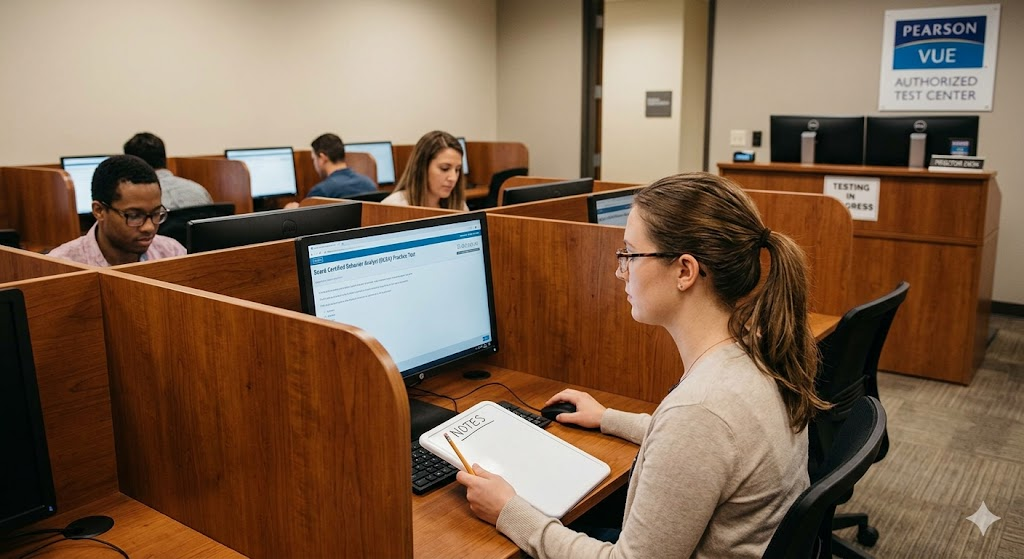
Additional Information
What the Course Entails and Exam Details
To even qualify for the exam, candidates must have completed a verified coursework sequence (VCS) or equivalent graduate degree.
The content of that coursework, which the exam rigorously tests, aligns directly with the BACB’s Fifth Edition Task List.
This Task List is the syllabus for your certification and covers two primary sections: Foundations and Applications.
Foundational topics include behavior-analytic principles, concepts, and experimental design.
Application areas focus on ethics, assessment, behavior-change procedures, and personnel supervision.
The practice exam mimics this distribution, forcing you to apply abstract theories to clinical scenarios.
What to Expect in the Final Exam
The actual BCBA exam is a computer-based test consisting of 160 multiple-choice questions.
You are given exactly four hours (240 minutes) to complete the examination.
It is critical to note that of the 160 items, only 150 are scaled score items used to calculate your final result.
The remaining 10 are pilot, or ‘pre-test,’ questions that are being evaluated for future exams and do not affect your score. You will not know which questions are which.
The exam uses a scaled score model, with a passing score set at 400 or higher.
The questions are written primarily at the application and analysis levels, meaning you must choose the ‘best’ behavioral response for specific client situations.
How to Study and Exam Centers
The most effective study strategy involves a three-pronged approach: content mastery, application fluency, and mock exam simulation.
First, achieve fluency in the vocabulary and concepts found on the BACB Task List; flashcards (like SAFMEDS) are exceptional for this.
Second, apply the concepts by analyzing case studies and previous professional experiences through a behavior-analytic lens.
Finally, dedicate significant time to taking full-length, timed BCBA practice exams.
Simulation is crucial for building the endurance needed for a four-hour test and identifying weak areas in your knowledge base.
The official BCBA examination is administered exclusively through Pearson VUE at their secure, physical testing centers.
You cannot take the final certification exam online from home; it must be completed at an authorized center to maintain testing integrity.
When you are approved by the BACB to take the exam, you will receive instructions on how to schedule your appointment at a Pearson VUE location convenient for you.
Job Opportunities from the Course
Obtaining the BCBA credential unlocks a wide variety of specialized, high-demand career paths in health, education, and organizational sectors.
Graduates and newly certified analysts can pursue job titles such as:
Board Certified Behavior Analyst (BCBA)
Clinical Director in ABA Agencies
School-Based Behavior Analyst
Behavioral Consultant for Residential Facilities
Organizational Behavior Management (OBM) Specialist
Early Intervention Specialist
Parent Educator and Trainer
Special Education Case Manager
Frequently Asked Questions
Reviews
5.0
Based on 0 reviews
Leave a Review
No reviews yet. Be the first to review!