
Board Certified Coaching Practice Exam
$69.00
- Buy to unlock unlimited access to all Quiz questions and Answers in this Quiz.
- After purchase you can print a PDF of the whole quiz at any point. The PDF will contain the questions and the correct answers.
About this Exam
The Board Certified Coach (BCC) credential is a prestigious, independent certification administered by the Center for Credentialing & Education (CCE). It signifies that a coaching professional has met rigorous global standards in education, training, experience, and ethical practice.
This certification is designed for individuals who have already established a foundation in social or behavioral sciences, such as counseling, social work, or psychology, and are seeking to distinguish themselves within the competitive coaching industry. By earning the BCC, you demonstrate to clients and employers a commitment to professional excellence and adherence to a strict code of ethics.
Ready to test your knowledge?
Buy Now to Access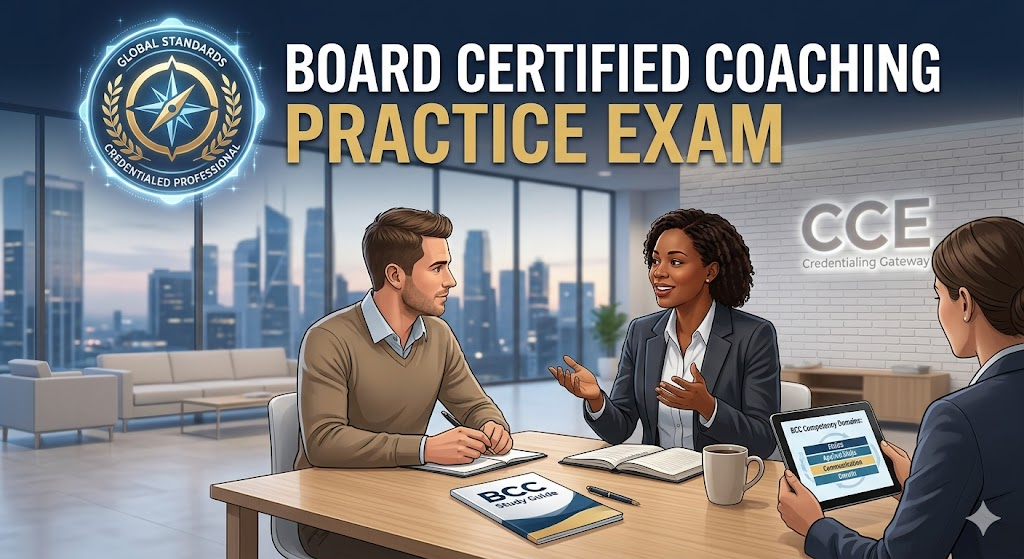
Additional Information
What the Course Entails and Exam Details
Preparing for the BCC certification involves comprehensive training that aligns with the CCE’s core coaching competencies. You must complete a minimum number of clock hours of training from a CCE-approved BCC training provider.
The curriculum covers six fundamental competency domains, ensuring a balanced mastery of theoretical knowledge and practical application:
Ethical and Professional Standards: Deep diving into the BCC Code of Ethics, regulatory guidelines, and maintaining professional boundaries.
Agreements and Goal-Setting: Mastering the art of co-creating clear coaching agreements and prioritizing client-driven, measurable outcomes.
Coach Presence and Applied Skills: Developing the mindset and active skills—such as powerful questioning and empathy—needed to build trust.
Effective Coach–Client Communication and Rapport: Cultivating essential communication strategies to initiate and maintain a strong coaching alliance.
Facilitating Client Growth and Accountability: Learning methodologies to help clients create action plans, monitor progress, and overcome obstacles.
Coaching Business Practices and Professional Development: Understanding the business basics and managing client records securely and ethically.
What to Expect in the Final Exam
The actual Board Certified Coach Examination (BCCE) is a unique, psychometrically sound assessment focused on situational judgement and case-based application. It does not solely rely on recall of definitions.
Exam Format: The BCCE is a computer-based examination consisting of 12 detailed case studies. Each case study presents a vignette of a realistic coaching scenario. You will answer 10 multiple-choice questions following each vignette, for a total of 120 questions.
Scoring Details: Of the 120 items, only 100 are scored; the remaining 20 are unscored field-test questions used for future exam development.
Time Limit: You will have precisely three hours to complete the entire examination.
Passing Score: The CCE uses a criterion-referenced scoring method. The raw passing score can vary slightly between different exam forms to maintain fairness, reflecting the minimum level of knowledge required to practice effectively.
How to Study and Exam Centers
Effective preparation for the BCC exam requires a mix of theoretical review and practical scenario simulation.
Actionable Study Strategies: Since the exam is case-based, use practice exams that utilize vignettes. Do not just focus on identifying the right answer; analyze why the other options are less ethical or less effective according to CCE standards. Join study groups and practice coaching sessions, applying the CCE competencies in real time.
Study Materials: Your primary resources are the official BCC Content Outline, the BCC Code of Ethics, and the training materials provided by your CCE-approved training program.
Exam Centers and Methods: The CCE partners with Pearson VUE to administer the examination globally. You have two primary options:
In-Person Testing: You can take the exam at any authorized Pearson VUE professional testing center worldwide.
Online Proctoring: For flexibility, you may opt for online proctoring via Pearson VUE's OnVUE platform, allowing you to take the exam from a secure, private location. You must schedule your appointment through your CCE Credentialing Gateway account after your application is approved.
Job Opportunities from the Course
The Board Certified Coach (BCC) credential is a powerful differentiator that opens doors across multiple industries, confirming your expertise in human development and behavior change.
Corporate Executive Coach: Partnering with C-suite leaders to enhance performance, leadership skills, and strategic decision-making.
Leadership and Management Coach: Helping mid-level managers develop core leadership competencies and manage teams effectively.
Career Coach: Guiding individuals through career transitions, job searches, or resume development within university or corporate settings.
Health and Wellness Coach: Supporting clients in achieving lifestyle behavior changes for improved physical and mental health.
Life Skills or Personal Development Coach: Working with individuals on personal goal attainment, work–life balance, or relationship dynamics.
Small Business and Entrepreneurial Coach: Assisting business owners with strategy, growth, and overcoming developmental bottlenecks.
Organizational Development (OD) Consultant: Applying coaching principles to facilitate change management and culture shifts within large organizations.
Frequently Asked Questions
Reviews
5.0
Based on 0 reviews
Leave a Review
No reviews yet. Be the first to review!