
Board of Registered Polysomnographic Technologists (BRPT) Practice Test
$69.00
- Buy to unlock unlimited access to all Quiz questions and Answers in this Quiz.
- After purchase you can print a PDF of the whole quiz at any point. The PDF will contain the questions and the correct answers.
About this Exam
Welcome to your essential resource for conquering the BRPT credentialing process. The Board of Registered Polysomnographic Technologists (BRPT) offers the premier credentials for healthcare professionals specializing in sleep medicine, most notably the Registered Polysomnographic Technologist (RPSGT) and the Certified Polysomnographic Technologist (CPSGT). This study guide article is specifically focused on the BRPT Practice Test. This practice exam is designed for individuals who are currently preparing to sit for their actual credentialing exam. It serves as an indispensable tool for students, respiratory therapists, and current sleep technicians looking to validate their knowledge, identify critical study gaps, and experience the pacing and difficulty of the official examination environment before the big day.
Ready to test your knowledge?
Buy Now to Access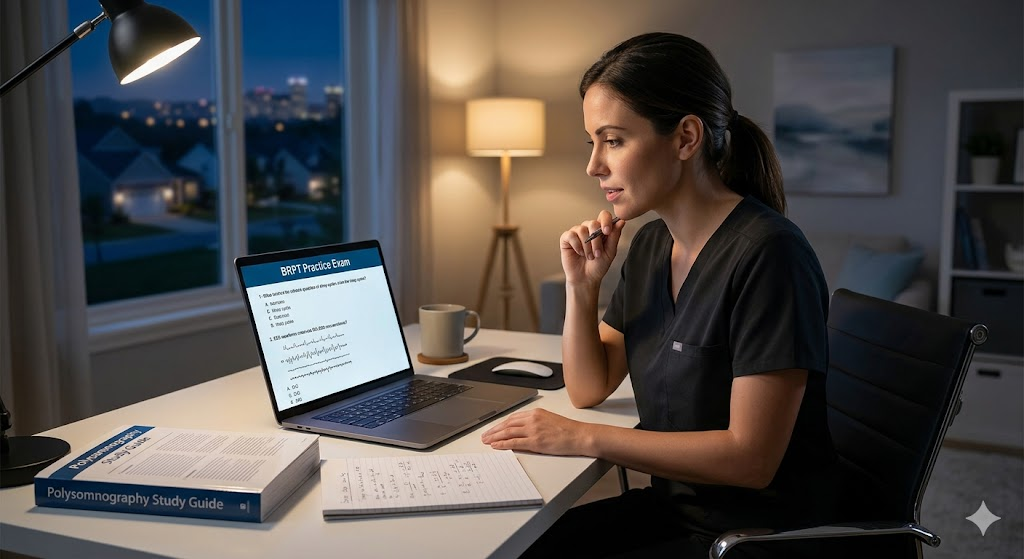
Additional Information
What the Course Entails and Exam Details
The BRPT Practice Test is engineered to be a mirror image of the actual credentialing exams. It encompasses the same core domains of knowledge required of a practicing sleep technologist. By taking this practice exam, you will encounter scenarios and questions covering the entire spectrum of polysomnographic technology. The course of study covered by the practice test focuses intensely on essential skills such as: patient setup and electrode application based on the 10-20 system; understanding various sleep disorders like apnea and narcolepsy; identifying complex EEG waveforms and sleep stages; performing real-time monitoring and therapeutic interventions like CPAP titration; and ensuring strict adherence to safety, emergency, and compliance protocols within a sleep center environment.
What to Expect in the Final Exam
While taking the BRPT Practice Test itself offers immediate feedback, it is crucial to understand what awaits you in the actual "final" credentialing exam it prepares you for. The actual BRPT exams (like the RPSGT) are computerized, multiple-choice tests administered under strict proctored conditions. You can expect approximately 175 to 200 multiple-choice questions, which must be completed within a strict three-to-four-hour time limit. The passing score is scaled, meaning raw scores are converted to a standardized scale ranging from 200 to 500, with a score of 350 usually required to pass. The exam environment is quiet and secure, and no external materials are allowed. Utilizing the practice test is the best way to get used to this format and manage the time constraints effectively.
How to Study and Exam Centers
Effective studying requires a combination of rote memorization and practical application. Begin by thoroughly reviewing the official BRPT Candidate Handbook for your specific exam. Use the current AASM Manual for the Scoring of Sleep and Associated Events as your primary clinical resource. Take the official BRPT Practice Test early in your study process to identify weak points, then use targeted study guides and flashcards to master those specific domains before retaking the practice test closer to your exam date.
When you are ready to take the actual credentialing exam (not the practice test, which is taken online), you must register through the BRPT website. The official examinations are administered worldwide at authorized physical testing centers, typically managed by testing partners such as Pearson VUE. After your application is approved, you will receive an authorization to test, allowing you to schedule your appointment at a convenient location.
Job Opportunities from the Course
Successfully utilizing the practice test to pass your BRPT credentialing exam opens the door to a specialized and growing field in healthcare. The demand for qualified sleep professionals continues to rise. Upon earning your RPSGT or CPSGT credential, you will unlock numerous career opportunities.
Potential job titles include:
Registered Polysomnographic Technologist (RPSGT)
Certified Polysomnographic Technologist (CPSGT)
Sleep Lab Coordinator
Clinical Sleep Educator
Sleep DME (Durable Medical Equipment) Specialist
Scoring Technologist
Sleep Center Manager
Research Sleep Technologist
Frequently Asked Questions
Reviews
5.0
Based on 0 reviews
Leave a Review
No reviews yet. Be the first to review!