
BoatUS Foundation's – Online Boating Safety Course Practice Test
$69.00
- Buy to unlock unlimited access to all Quiz questions and Answers in this Quiz.
- After purchase you can print a PDF of the whole quiz at any point. The PDF will contain the questions and the correct answers.
About this Exam
The BoatUS Foundation's Online Boating Safety Course Practice Test is an essential tool designed to help boaters prepare for their official state-approved boating safety final exam. This comprehensive practice test is tailor-made for new and experienced recreational boaters alike, offering a simulated exam environment to evaluate their knowledge of safe boating practices, navigation rules, and state-specific regulations. Successfully passing the eventual final exam often leads to obtaining a state-issued boating safety certificate, commonly known as a boater education card, which is a mandatory requirement for operating powered vessels in many states. It is the perfect resource for anyone seeking to build confidence, ensure compliance with the law, and promote a safer environment on the water for themselves and others.
Ready to test your knowledge?
Buy Now to Access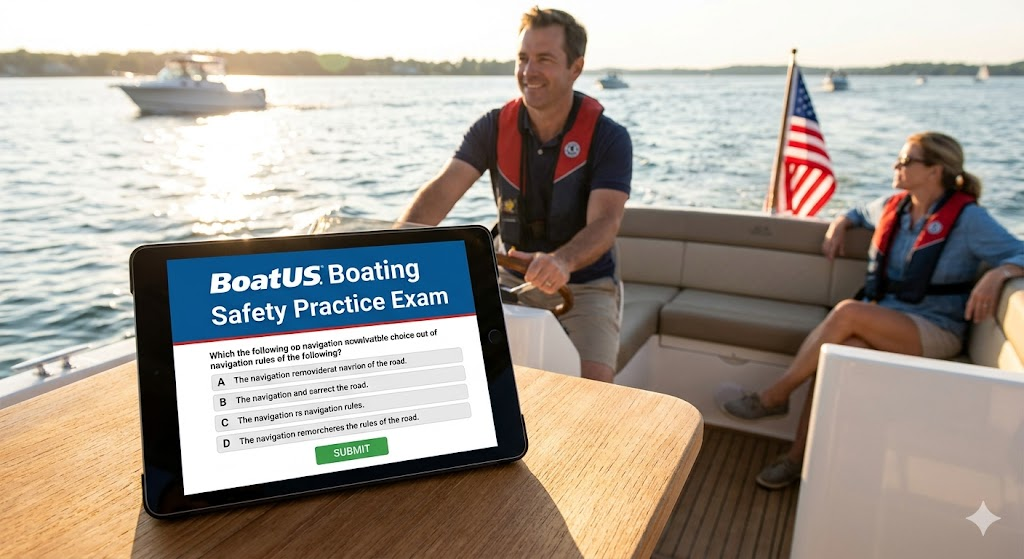
Additional Information
What the Course Entails and Exam Details
The complete BoatUS Foundation Online Boating Safety Course, for which this practice test prepares you, provides thorough instruction on a wide range of critical topics. While the exact syllabus can vary slightly by state to incorporate local laws, the core modules are standardized to meet NASBLA (National Association of State Boating Law Administrators) requirements. Students will cover the essentials of boat handling, fueling procedures, and required safety equipment, including personal flotation devices (PFDs) and fire extinguishers. The course details navigation rules of the road, aids to navigation (buoys and markers), and understanding sound and light signals. Additionally, learners are educated on emergency preparedness, responding to accidents, hypothermia prevention, and environmental responsibilities such as waste disposal and preventing the spread of aquatic invasive species.
What to Expect in the Final Exam
The final exam for the BoatUS Foundation's course is typically administered in an online, multiple-choice format, designed to be accessible and user-friendly. It is important to note that specific details regarding the exam, such as the total number of questions, time limits, and passing score requirements, are determined by individual state laws and can vary. For instance, some states may require a minimum score of 80% to pass, while others, like Virginia, require a 90%. Many state final exams contain between 50 and 75 questions and are open-book, allowing you to reference the course materials. While many states allow unlimited attempts to pass the final exam, some may have specific limits on the number of tries before requiring a retake of the course. The practice test is a close approximation of this final assessment, offering an excellent way to gauge readiness.
How to Study and Exam Centers
The most effective way to study for the final exam is to actively engage with the comprehensive study materials provided within the BoatUS Foundation's free online course. Go through each module at your own pace, taking advantage of the interactive elements and review questions. Utilizing the official study guide, which is often available as a downloadable PDF, can reinforce your learning. The cornerstone of your preparation strategy should be the practice test itself; take it multiple times to become familiar with the question formatting and identify any areas where your knowledge may be lacking. Unlike some professional certifications, the final exam for the boating safety certificate is not administered at physical testing centers such as Pearson VUE. Instead, the entire process—from registration and study to taking the practice and final exams—is conveniently completed within the BoatUS Foundation’s dedicated online portal, allowing you to learn from the comfort of your home.
Job Opportunities from the Course
Obtaining a boating safety certificate by successfully completing the course and final exam is a significant achievement that opens the door to numerous professional opportunities and can be a prerequisite for various career paths on or near the water. For many, this certification is the initial stepping stone toward more advanced maritime licenses or specializations. Potential job opportunities where having a basic boater education card is highly beneficial or mandatory include:
Boat Rental Agent or Livery Operator
Marina Attendant or Dockmaster
Fishing Guide or Charter Captain Support Staff
Water Sports Instructor (e.g., jet ski, water skiing)
Commercial Fishing Crew Member
Marine Patrol or Law Enforcement Support Roles (often requires additional specialized NASBLA training)
Excursion or Eco-Tour Boat Crew
Vessel Delivery Crew
Non-Profit Waterway Conservation Field Staff
By investing the time to prepare and excel in your boating safety exam, you are not only committing to safer boating but also enhancing your qualifications for a rewarding career in the maritime industry.
Frequently Asked Questions
Reviews
5.0
Based on 0 reviews
Leave a Review
No reviews yet. Be the first to review!