
BOC Athletic Training Practice Exam
$69.00
- Buy to unlock unlimited access to all Quiz questions and Answers in this Quiz.
- After purchase you can print a PDF of the whole quiz at any point. The PDF will contain the questions and the correct answers.
About this Exam
The Board of Certification (BOC) Athletic Training Exam is the decisive prerequisite for earning the esteemed ATC (Athletic Trainer, Certified) credential. This comprehensive examination is designed for graduates of athletic training programs accredited by the Commission on Accreditation of Athletic Training Education (CAATE). It serves as the standard entry-level competency check, ensuring that emerging healthcare professionals possess the knowledge and skills necessary to provide appropriate patient care. Achieving certification confirms your readiness to practice independently and is mandatory for licensure in most states within the U.S.
Ready to test your knowledge?
Buy Now to Access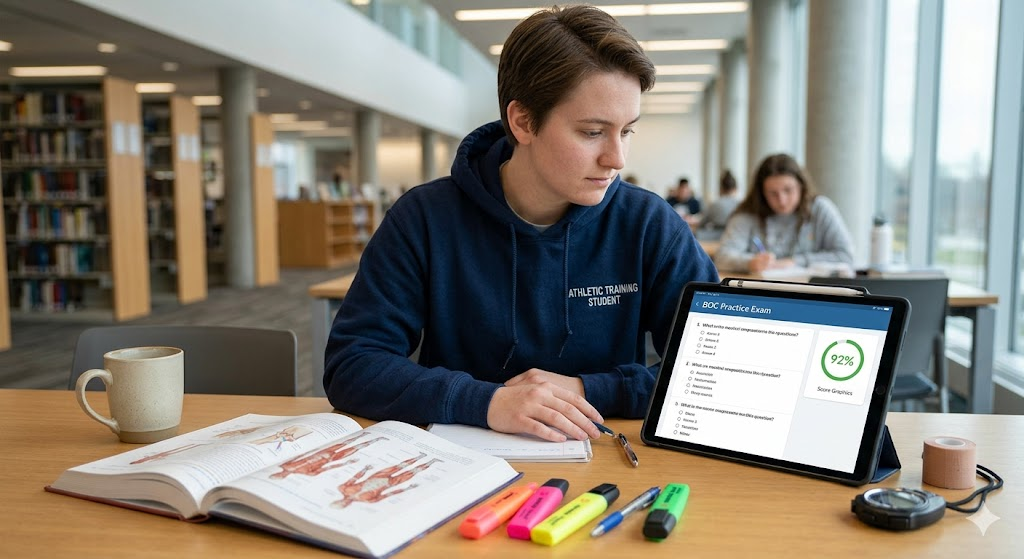
Additional Information
What the Course Entails and Exam Details
Preparing for this exam requires a mastery of the core educational concepts learned during your CAATE-accredited program, rather than completion of a single specific course. The BOC exam evaluates proficiency across the current five domains of athletic training as outlined in the Practice Analysis. These essential domains encompass crucial aspects of the profession, starting with Domain I: Injury and Illness Prevention and Wellness Promotion.
Following prevention, Domain II focuses on Examination, Assessment, and Diagnosis, assessing your ability to identify clinical pathologies. Domain III tests competency in Immediate and Emergency Care, vital for acute injury management. Domain IV covers Therapeutic Intervention, including rehabilitation strategies and modalities. Finally, Domain V centers on Healthcare Administration and Professional Responsibility, covering legal standards, documentation, and ethical practice.
What to Expect in the Final Exam
The BOC examination is administered as a computer-based test (CBT), employing a sophisticated format that includes both standard multiple-choice questions and alternative item types. Candidates should be prepared for multi-select questions, drag-and-drop scenarios, and hot-spot identifier items designed to test clinical application and critical thinking. The exam emphasizes scenario-based learning, requiring you to apply theoretical knowledge to realistic clinical situations.
The specific number of scored items may vary slightly per administration, but the total testing appointment is generally scheduled for four hours, which includes time for a tutorial and a post-exam survey. Scoring is not based on a raw percentage; rather, candidates must achieve a scaled score of 500 to pass.
How to Study and Exam Centers
Effective preparation must involve the use of high-quality practice exams, as these are critical for understanding the question formats and managing your timing. Leverage official BOC resources, including the BOC Candidate Handbook and any authorized self-assessment examinations to gauge your readiness. Utilize comprehensive review textbooks that organize content according to the five current domains. Focus heavily on practice scenarios and case studies to move beyond simple memorization toward clinical application. Group study can also be beneficial for discussing complex diagnostic and rehabilitation decisions.
The BOC exam is administered globally through the authorized testing partner, Pearson VUE. To take the exam, candidates must first register with the BOC and receive authorization to test. You can then schedule your exam session at a physical Pearson VUE professional testing center of your choice.
Job Opportunities from the Course
Passing the BOC exam and securing state licensure is the mandatory final step before launching a career in this dynamic field. Achieving the ATC credential unlocks diverse career paths across the healthcare and sports spectrum. Many athletic trainers work in secondary schools, serving as the primary healthcare provider for high school athletes.
Colleges and universities employ large staffs of ATs to manage the health and performance of their intercollegiate teams. Professional sports teams require certified athletic trainers to provide elite care for their athletes in the major leagues. Clinical settings, such as outpatient rehabilitation centers, utilize ATs to guide patient recovery. Emerging and expanding employment settings also include performing arts companies, law enforcement and public safety departments, the military, and occupational or industrial environments, where ATs manage workplace wellness and ergonomics.
Frequently Asked Questions
Reviews
5.0
Based on 0 reviews
Leave a Review
No reviews yet. Be the first to review!