
Body Composition Program Practice Exam
$69.00
- Buy to unlock unlimited access to all Quiz questions and Answers in this Quiz.
- After purchase you can print a PDF of the whole quiz at any point. The PDF will contain the questions and the correct answers.
About this Exam
Welcome to your essential first step toward becoming a recognized leader in health and fitness assessment. This study guide and its accompanying Body Composition Program Practice Exam are meticulously designed to bridge the gap between theoretical knowledge and practical mastery for aspiring Body Composition Specialists. This prestigious certification is engineered for dedicated health and fitness professionals, including personal trainers, strength and conditioning coaches, nutritionists, registered dietitians, and clinical wellness practitioners. The final exam validates your ability to move beyond simple weight metrics and BMI, enabling you to accurately assess, analyze, and interpret human body composition—differentiating between fat mass, lean muscle, bone density, and total body water to create truly personalized health strategies. It is designed for professionals who demand accuracy and seek to provide a higher standard of care for clients focused on weight management, athletic performance, and optimal longevity. Mastering this material is vital for demonstrating your dedication to evidence-based practice in a rapidly evolving wellness industry. Our practice exam simulates the rigor of the final certification to ensure you are fully prepared for success.
Ready to test your knowledge?
Buy Now to Access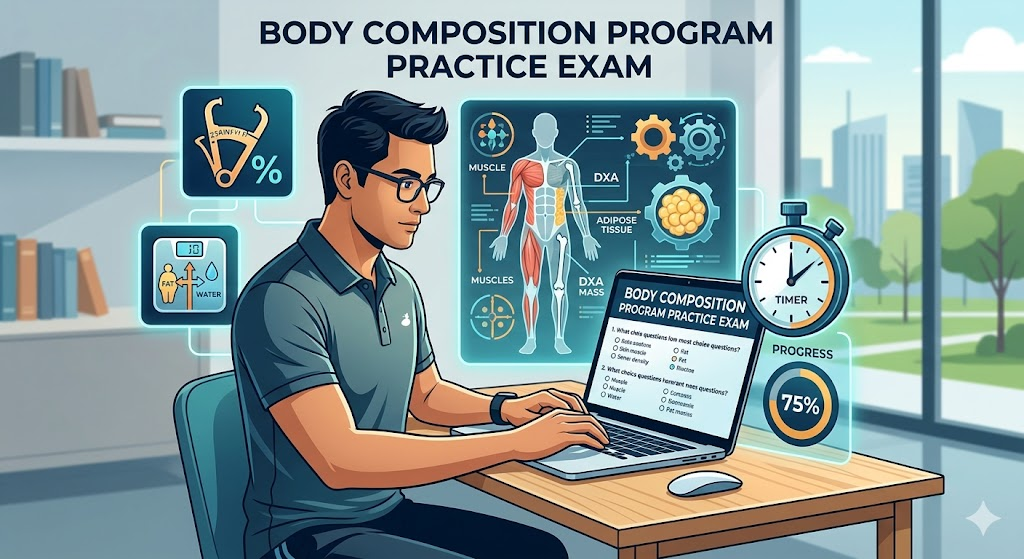
Additional Information
What the Course Entails and Exam Details
This comprehensive study program provides an in-depth exploration of the scientific principles and standardized procedures of body composition analysis. You will master human anatomy and physiology as they relate to tissue compartmentalization and metabolic health. The core focus is on the spectrum of modern assessment methodologies. This includes mastery of fundamental field methods, such as circumference measurements (tape testing) and skinfold caliper techniques. It also provides comprehensive instruction on advanced, technology-driven modalities, including bioelectrical impedance analysis (BIA), air displacement plethysmography (Bod Pod), and the clinical gold standard, Dual-Energy X-ray Absorptiometry (DXA). Furthermore, the course teaches critical data interpretation, patient and client communication strategies, and the ethics of sensitive health measurement. By the end, you will be proficient in choosing the appropriate assessment tool for any population, from pediatric to geriatric clients and elite athletes. The preparation focuses on both the technical precision required for accurate measurement and the analytical skills needed to translate raw data into actionable lifestyle prescriptions.
What to Expect in the Final Exam
The final certification exam is a comprehensive assessment designed to evaluate both your knowledge of body composition theory and your ability to apply it practically. While specific requirements may vary slightly by certifying organization, the final exam typically follows a rigorous, standardized format. Students can expect a proctored test consisting of approximately 75 to 125 multiple-choice questions. These questions are weighted across the core domains: Anatomy and Physiology, Assessment Methods (both field and technology-based), Standardized Protocols, Data Interpretation, and Ethical/Communication Standards. Candidates are generally allotted 90 to 120 minutes to complete the assessment. The typical required passing score is within the range of 70% to 75%. Most exams are conducted in a "closed-book" environment, meaning you must rely solely on your prepared knowledge. The focus is to ensure you have internalized critical information and can make safe, accurate assessments and recommendations without external assistance.
How to Study and Exam Centers
Effective preparation for this high-stakes exam requires a dual approach of rigorous academic study and hands-on practical application. Begin your preparation by thoroughly reviewing the official course textbook, study guides, and all provided lecture materials. Use the included practice exam to identify critical gaps in your knowledge, allowing you to focus your study sessions on areas needing improvement. Create flashcards for key anatomical terms, physiological equations, standard measurement site protocols, and tissue density constants. To master practical skills, perform at least 50 skinfold and circumference measurements on varied body types, comparing your results to standard benchmarks to improve reliability. You must dedicate time to interpreting sample data reports from various technologies. Regarding test logistics, most accrediting bodies deliver the theoretical exam online through secure, proctored testing portals. High-stakes or clinical-grade versions of the exam may require physical attendance at a designated testing center, such as those administered by Pearson VUE, or at authorized physical training facilities, universities, and specialized fitness schools. Always confirm specific delivery options with your primary certification provider.
Job Opportunities from the Course
A certification from a recognized Body Composition Program significantly enhances your professional credibility and unlocks diverse career opportunities in the health, fitness, and clinical wellness sectors. Potential job titles and career paths include:
Body Composition Specialist
Certified Personal Trainer (Advanced level)
Strength and Conditioning Coach
Exercise Physiologist
Registered Dietitian/Nutritionist (Enhanced specialty)
Health and Wellness Coach
Weight Management Consultant
Corporate Wellness Coordinator
Clinical Body Composition Technician (e.g., DXA operator)
Resort/Spa Fitness Specialist
Human Performance Lab Assistant
Bariatric Program Wellness Coordinator
Athletic Trainer (Assessment specialist)
Frequently Asked Questions
Reviews
5.0
Based on 0 reviews
Leave a Review
No reviews yet. Be the first to review!