
Boeing Airbus Practice Test
$69.00
- Buy to unlock unlimited access to all Quiz questions and Answers in this Quiz.
- After purchase you can print a PDF of the whole quiz at any point. The PDF will contain the questions and the correct answers.
About this Exam
The Boeing Airbus Proficiency Practice Exam serves as a critical preparatory tool for aviation professionals aimed at standardizing their knowledge of the world’s two largest commercial aircraft manufacturers.
This comprehensive evaluation is designed for aspiring commercial pilots, aircraft maintenance technicians, and aerospace engineers transitioning into type-rating courses or seeking roles within major airlines.
The exam bridges the gap between general aviation principles and the specific system operational philosophies of the Boeing 737 and Airbus A320 families.
It focuses heavily on comparison and contrast, ensuring candidates understand the nuances of how these two distinct aviation philosophies handle flight controls, logic, and automated systems.
Ready to test your knowledge?
Buy Now to Access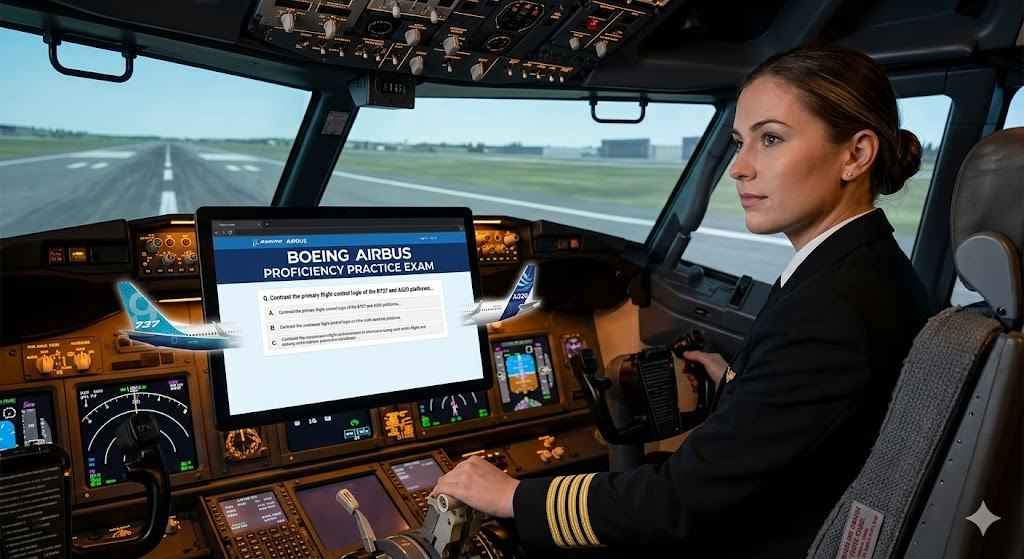
Additional Information
What the Course Entails and Exam Details
This exam assesses candidates on a wide range of cross-platform aviation systems and procedural knowledge.
Key focus areas include the critical comparison of flight control philosophies, such as Boeing’s conventional control feel versus Airbus’s fly-by-wire system architecture.
Candidates are tested on their understanding of complex onboard systems, including electronic flight bags (EFB), flight management computers (FMC/FMGS), fuel systems, hydraulics, and pneumatic architecture.
Furthermore, the exam covers essential differences in standard operating procedures (SOPs), crew resource management (CRM) specific to each platform, and diagnostic troubleshooting for maintenance crews.
The syllabus is carefully designed to mirror the actual entry-level assessment rigor applied by major global carriers.
What to Expect in the Final Exam
This rigorous practice examination is typically delivered through a sophisticated online testing environment.
The final exam format is entirely multiple-choice, comprising 100 to 120 questions designed to simulate the time pressure and technical complexity of official airline competency assessments.
To achieve a recommended "Ready for Certification" status, candidates should aim for a passing score of at least 80% or higher.
A typical time limit of 2 to 2.5 hours is enforced, requiring rapid recall and application of knowledge under pressure.
No unauthorized reference materials are permitted during the examination, ensuring candidates rely solely on their internal knowledge base.
How to Study and Exam Centers
Effective preparation requires a blend of conceptual understanding and rapid-recall memorization.
Start by deeply analyzing the Flight Crew Operating Manuals (FCOM) and Quick Reference Handbooks (QRH) for both specific aircraft families.
Engage with interactive computer-based training (CBT) modules that compare system behaviors side-by-side.
Consistent practice with high-fidelity, randomized practice question banks is the single most effective way to improve performance.
Since this is a simulated proficiency exam, it is accessible via verified online testing portals, and frequently offered through authorized aviation training centers and flight schools as a mandatory precursor to official type-rating simulator training.
Physical testing centers or authorized schools may offer supervised sessions, but online access is common.
Job Opportunities from the Course
Mastering the content of the Boeing Airbus Proficiency Practice Exam significantly strengthens a candidate’s resume and proficiency for several high-demand aviation careers.
Graduates of this practice examination frequently transition into roles such as:
First Officer (A320/B737) at commercial airlines.
Licensed Aircraft Maintenance Engineer (Category A or B).
Aviation Technical Instructor.
Flight Operations Dispatcher.
Quality Assurance Specialist (Aerospace Manufacturing).
Fleet Management Specialist.
Frequently Asked Questions
Reviews
5.0
Based on 0 reviews
Leave a Review
No reviews yet. Be the first to review!