
Boiler Operator Licensing Practice Exam
$69.00
- Buy to unlock unlimited access to all Quiz questions and Answers in this Quiz.
- After purchase you can print a PDF of the whole quiz at any point. The PDF will contain the questions and the correct answers.
About this Exam
The Boiler Operator Licensing Practice Exam is a crucial preparatory tool for individuals aiming to secure their boiler operator certification. This certification validates a professional’s competency in safely and efficiently operating, maintaining, and repairing both low-pressure and high-pressure boiler systems. This exam is ideal for entry-level applicants looking to start a career in facility maintenance or for existing workers seeking to formalize their skills and advance their career trajectory. Achieving this license is a fundamental requirement in many jurisdictions for roles that manage crucial heating and power systems in large facilities such as hospitals, schools, factories, and commercial buildings.
Ready to test your knowledge?
Buy Now to Access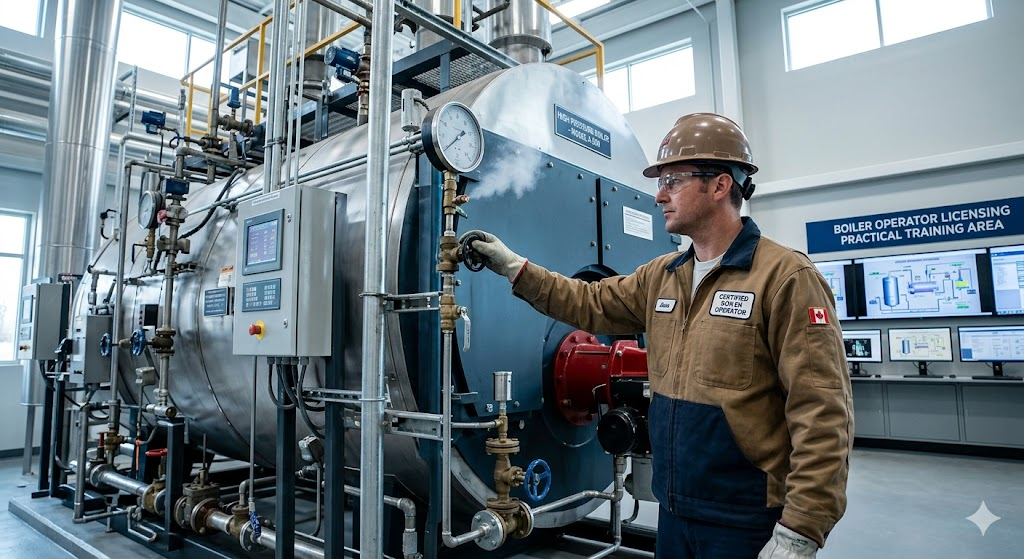
Additional Information
What the Course Entails and Exam Details
The knowledge base covered in this course and subsequent practice exam is extensive, ensuring operators possess a robust understanding of boiler systems. Key areas of study include:
Boiler Fundamentals and Types: Differentiating between fire-tube, water-tube, and cast-iron boilers, and understanding their unique operating principles and applications.
Combustion Processes and Systems: Mastering fuel-to-air ratios, types of fuels (natural gas, fuel oil, biomass), and combustion safety procedures.
Boiler Fittings, Controls, and Instrumentation: Identifying and understanding the functions of essential components like safety valves, low-water fuel cut-offs, feedwater regulators, and pressure gauges.
Water Treatment and Testing: Grasping the importance of treating feedwater to prevent scale and corrosion, and the procedures for regular water analysis.
Boiler Room Safety and Regulations: Strict adherence to ASME codes and local environmental regulations, and understanding emergency protocols for various potential failures.
Operations and Maintenance: Best practices for normal operations, shutdown procedures, and preventative and corrective maintenance to ensure system longevity.
What to Expect in the Final Exam
While the final examination format can vary by licensing jurisdiction (e.g., city, state, or specific regulatory body), it most commonly utilizes a rigorous multiple-choice questionnaire. The exam is typically comprehensive and challenging, testing both theoretical knowledge and practical understanding. A significant practical component may be included in some regions to evaluate your ability to apply knowledge in a real-world scenario. Passing score requirements are also set regionally, but usually range between 70% and 80%. Time limits are strictly enforced, ensuring applicants can process and apply information accurately under pressure. It is crucial for candidates to check the specific guidelines from their local licensing board for precise exam rules, as well as necessary documentation and identification required for entry.
How to Study and Exam Centers
Effective preparation for the boiler operator licensing exam requires a multifaceted approach. To succeed, students are encouraged to employ a variety of active study strategies. Thoroughly reading assigned textbooks is foundational. Online resources, including instructional videos and detailed technical guides, provide additional context. Forming or joining study groups allows for peer-to-peer learning and knowledge sharing. Crucially, taking numerous practice exams, like the one this guide supports, is indispensable for simulating the actual test environment, improving recall speed, and identifying knowledge gaps.
Regarding examination centers, exams are rarely administered in a universal, centralized location. They are most frequently taken at local licensing authority offices, designated technical schools, or community colleges that have partnered with the regulatory body. In some cases, recognized private testing agencies (such as Pearson VUE, depending on regional outsourcing) might host the test. Candidates must register through their specific local board, which will provide details on where and how to schedule their exam. Always confirm if online options are available, though physical testing is still standard in many areas.
Job Opportunities from the Course
Earning a boiler operator license opens the door to a variety of essential and stable career paths within different industry sectors. Common job titles include:
Boiler Operator (High Pressure or Low Pressure): The primary role, focusing on the day-to-day operations and basic maintenance of steam and hot water boiler systems.
Stationary Engineer: A more advanced role that often manages not only boiler systems but also larger, integrated facility equipment like HVAC systems, refrigeration, and electric generators.
Power Plant Operator: Specialized positions focusing on the operation of boilers used in electrical power generation.
Facility Maintenance Technician: A versatile role where boiler operation is a component of comprehensive mechanical and building systems maintenance.
HVAC Service Technician: Leveraging boiler knowledge for the specialized service and repair of industrial and large-scale residential heating systems.
Plant Maintenance Manager: A potential career progression, overseeing the maintenance staff and operational budget of an entire facility's equipment, including boilers.
Frequently Asked Questions
Reviews
5.0
Based on 0 reviews
Leave a Review
No reviews yet. Be the first to review!