
Bone Density Registry Practice Exam
$69.00
- Buy to unlock unlimited access to all Quiz questions and Answers in this Quiz.
- After purchase you can print a PDF of the whole quiz at any point. The PDF will contain the questions and the correct answers.
About this Exam
Achieving certification in Bone Densitometry represents a crucial step in the professional development of medical imaging technologists. This specialized credential, often administered through organizations like the ARRT (American Registry of Radiologic Technologists) or ISCD (International Society for Clinical Densitometry), validates an individual's expertise in measuring bone mineral density to help diagnose conditions such as osteoporosis. It is designed for Registered Radiologic Technologists or eligible healthcare practitioners who wish to formalize their skills in this vital imaging modality. Earning this registry status demonstrates a commitment to high standards of patient care and technical precision in a growing healthcare sector.
Ready to test your knowledge?
Buy Now to Access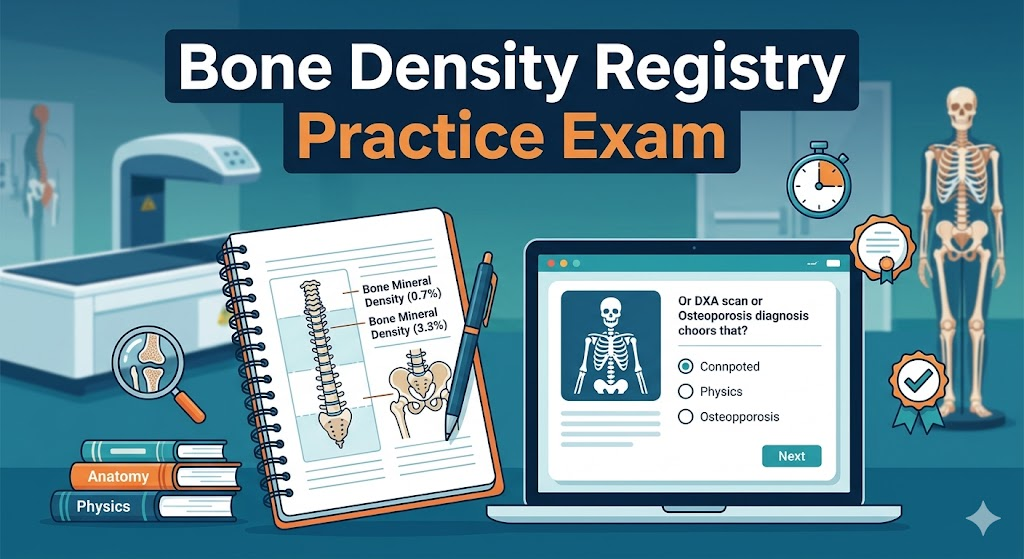
Additional Information
What the Course Entails and Exam Details
Preparing for the registry exam requires a deep understanding of several core domains relevant to dual-energy X-ray absorptiometry (DXA) scanning and bone health.
The content specs generally cover four major areas: Patient Care, Image Production, Procedures, and Equipment/Quality Control.
In the Patient Care section, you will study osteoporosis overview, fracture risk assessment (such as FRAX), patient preparation, and essential safety protocols.
Image Production focuses on the technical aspects of how DXA equipment creates images and calculates density, covering physics principles, beam geometry, and factors affecting precision.
Procedures are the clinical "how-to," detailing correct patient positioning for standard scan sites like the proximal femur, lumbar spine, and forearm, along with appropriate analysis practices.
Finally, Equipment and Quality Control teaches the critical, mandatory steps needed to ensure equipment accuracy, including phantom scanning, plotting QC data, and performing precision studies.
What to Expect in the Final Exam
The actual Registry Exam is a computer-based test that assesses both theoretical knowledge and practical application through multiple-choice questions.
The exam length can vary depending on the certifying body, but candidates typically have between 90 minutes and three hours to complete roughly 75 to 125 scored questions.
Passing scores are generally determined by a "scaled score," with a score of 75 often being the standard require threshold for certification.
The test may include "pilot" questions—unscored questions integrated into the exam to test new material—which do not impact your final score.
Specific rules, such as ID requirements and prohibited items (like phones or non-approved calculators), are strictly enforced at the testing centers.
How to Study and Exam Centers
Successfully passing the Bone Density Registry requires a dedicated and multifaceted study strategy.
First, obtain the official content specifications or exam blueprint from your certifying organization to prioritize your studying correctly.
Utilizing a high-quality Bone Density Registry Practice Exam is one of the most effective methods to simulate the testing environment and identify personal knowledge gaps.
Combine this practice testing with textbook review, focusing on diagrams of standard DXA positioning and understanding the clinical markers of osteoporosis.
For logistics, official registry exams are rarely taken online at home; instead, they are administered at secure, proctored computer-based testing facilities, such as Pearson VUE centers, located globally.
You must schedule your exam window in advance after receiving eligibility clearance from your registry, ensuring you select a date that provides ample study time.
Job Opportunities from the Course
Validating your skills with a registry credential opens significant doors within hospital imaging departments, outpatient clinics, orthopedic offices, and specialized rheumatology or endocrinology practices.
Having this formal certification often makes you more competitive for specialized roles and can lead to increased salary potential compared to non-registered technologists.
Key job titles and career paths this certification unlocks include:
Bone Densitometry Technologist (DXA Tech)
Lead/Chief DXA Technologist
Osteoporosis Coordinator/Program Manager
Mobile Imaging Specialist
Clinical Research Coordinator (focusing on bone health trials)
Imaging Department Manager (leveraging specialized knowledge for career progression)
Frequently Asked Questions
Reviews
5.0
Based on 0 reviews
Leave a Review
No reviews yet. Be the first to review!