
Boom and Scissor License Practice Exam
$69.00
- Buy to unlock unlimited access to all Quiz questions and Answers in this Quiz.
- After purchase you can print a PDF of the whole quiz at any point. The PDF will contain the questions and the correct answers.
About this Exam
Operating Mobile Elevating Work Platforms (MEWPs) requires specialized knowledge and validated skills.
The Boom and Scissor License Practice Exam is designed to prepare operators for the challenging certification tests mandated by modern workplace safety regulations.
This practice exam serves as a robust educational tool for construction workers, maintenance technicians, facility managers, painters, electricians, and any professional required to perform tasks at elevated heights.
By utilizing this resource, you will gain the confidence needed to demonstrate proficiency in both theoretical safety concepts and critical operational procedures, ultimately ensuring legal compliance (e.g., OSHA standards) and a safer job site for everyone involved.
Ready to test your knowledge?
Buy Now to Access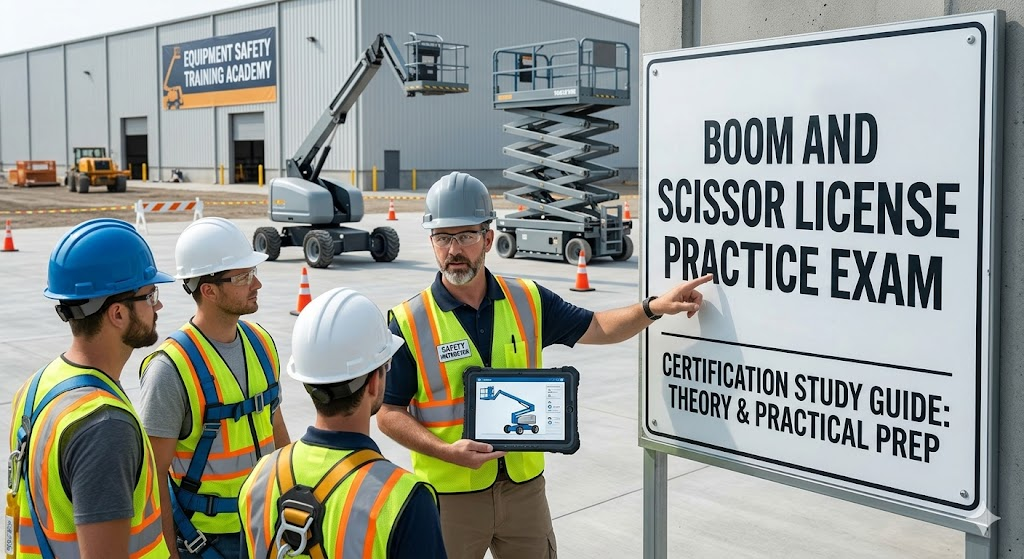
Additional Information
What the Course Entails and Exam Details
This course is designed to equip operators with comprehensive knowledge of MEWP safety, focusing specifically on both types of platforms (Group B: Boom Lifts and Group A: Scissor Lifts). The curriculum covers essential safety principles and technical procedures required for a recognized certification.
The core areas of study, which are reflected in the final exam questions, include:
Regulations and Standards: Deep understanding of OSHA regulations, ANSI/SAIA standards, and manufacturer specific operating manuals.
Machine-Specific Fundamentals: The mechanical differences between boom lifts (articulating and telescopic) and scissor lifts, and their respective stability dynamics.
Hazard Recognition: Identification and mitigation strategies for common site hazards, such as power lines, unstable ground, wind limitations, and tip-over risks.
Pre-Operation Inspection: Detailed protocols for performing daily safety checks on controls, structural components, hydraulic systems, and emergency fallback systems.
Workplace Inspection: Methods for evaluating the ground and overhead environment before initiating work.
Safe Operating Procedures: Techniques for platform loading, traveling (stowed and elevated), proper use of personal fall protection equipment (PPE), and emergency control operation.
What to Expect in the Final Exam
The final certification exam for a Boom and Scissor License is structured in two distinct phases to verify both comprehension and practical application.
Phase 1: The Written (Theory) Examination
Format: This section is typically a multiple-choice exam, delivered either digitally (online portal) or in a physical classroom setting.
Question Types: Questions will cover regulatory knowledge, equipment mechanics, safety procedures, and hazard management scenarios. Some questions may involve analyzing diagrams.
Time Limits: Candidates generally have between 60 to 90 minutes to complete the written portion, though exact times vary by training provider.
Passing Score: Most recognized safety organizations require a score of 80% or higher to pass the theory component. You must pass this before advancing.
Rules: No reference materials or mobile devices are permitted during the examination.
Phase 2: The Practical (Hands-On) Evaluation
Format: A qualified evaluator will observe and score your ability to operate the equipment safely.
Assessment Areas: You will be evaluated on your ability to conduct a thorough pre-start inspection and execute basic maneuvers (such as raising the platform to maximum height, extending the boom, and navigating a set course or "driving track").
Passing Score: The evaluation is typically scored on a pass/fail basis, with the primary objective being the 100?herence to all safety protocols and lack of machine-misuse.
How to Study and Exam Centers
Preparation is critical for success in this certification process.
How to Study
Effective preparation involves a combination of regulatory review, practical familiarity, and simulated testing:
Review Official Documentation: Study the training materials provided by your course provider and review the relevant OSHA standards (e.g., 29 CFR 1926.453 and 1910.67) and ANSI (American National Standards Institute) regulations.
Focus on the Manufacturer's Manual: For the practical component, familiarize yourself with the Operation & Safety Manual of the specific machine you will be operating.
Utilize the Practice Exam: The most effective way to prepare for the written component is to repeatedly take the [Boom and Scissor License Practice Exam]. This mimics the real test environment, helps you identify knowledge gaps, and reinforces the memory of critical safety protocols.
Develop Mnemonics for Inspections: Create simple acronyms or checklists to memorize the sequence of the daily inspection routine for both machines.
Exam Centers and Testing Logistics
You can complete the necessary training and testing through several authorized avenues:
Authorized Safety Schools and Training Institutes: These are specialized facilities dedicated to heavy equipment training. They offer comprehensive classroom instruction, simulation, and on-machine training.
Company-Led Training (On-Site): Many larger construction and facility management companies have internal safety departments that can deliver authorized training directly on the work site.
Equipment Rental Centers: Major equipment rental yards (such as United Rentals, Sunbelt, or H&E Equipment Services) frequently host certification courses that are open to the public or commercial clients.
Online Training Portals: The theory (written) portion of the course is increasingly available through online training portals (such as National Safety Council or specialized OSHA-compliant providers). However, you must still schedule a physical location for the final, practical hands-on evaluation with a certified instructor.
Job Opportunities from the Course
Earning this dual certification significantly enhances your employability and validates your skills in the industrial and construction sectors. A valid Boom and Scissor License is often a mandatory requirement for hiring and promotion.
Obtaining this certification unlocks numerous career paths, including:
Commercial Construction Laborer
Maintenance Technician (Facility and Property Management)
Commercial Painter and Industrial Coating Applicator
Master Electrician and High-Voltage Lineman
HVAC and R (Heating, Ventilation, Air Conditioning, and Refrigeration) Technician
Solar Panel Installer and Maintenance Worker
Window Cleaner and Exterior Building Services Technician
Arborist and Commercial Tree Care Worker
Sign and Billboard Installer
Event and Stage Technician (Set Construction and Lighting)
Infrastructure Inspection Specialist (Bridges and Buildings)
Frequently Asked Questions
Reviews
5.0
Based on 0 reviews
Leave a Review
No reviews yet. Be the first to review!