
BOPC Maryland Law Assessment (MLA) Practice Exam
$69.00
- Buy to unlock unlimited access to all Quiz questions and Answers in this Quiz.
- After purchase you can print a PDF of the whole quiz at any point. The PDF will contain the questions and the correct answers.
About this Exam
Welcome to your essential roadmap for the BOPC Maryland Law Assessment (MLA). This mandatory assessment is administered by the Maryland Board of Professional Counselors and Therapists (BOPC). It is specifically designed for mental health professionals seeking licensure or certification within the state of Maryland. The primary goal of the MLA is to ensure that all practicing counselors and therapists possess a thorough understanding of the unique state laws, regulations, and ethical codes governing their profession. Whether you are aiming to become a licensed professional counselor, marriage and family therapist, or alcohol and drug counselor, this guide will help you understand how to navigate this required hurdle efficiently. Successfully navigating this process demonstrates your commitment to safe, legal, and effective practice within Maryland's diverse communities.
Ready to test your knowledge?
Buy Now to Access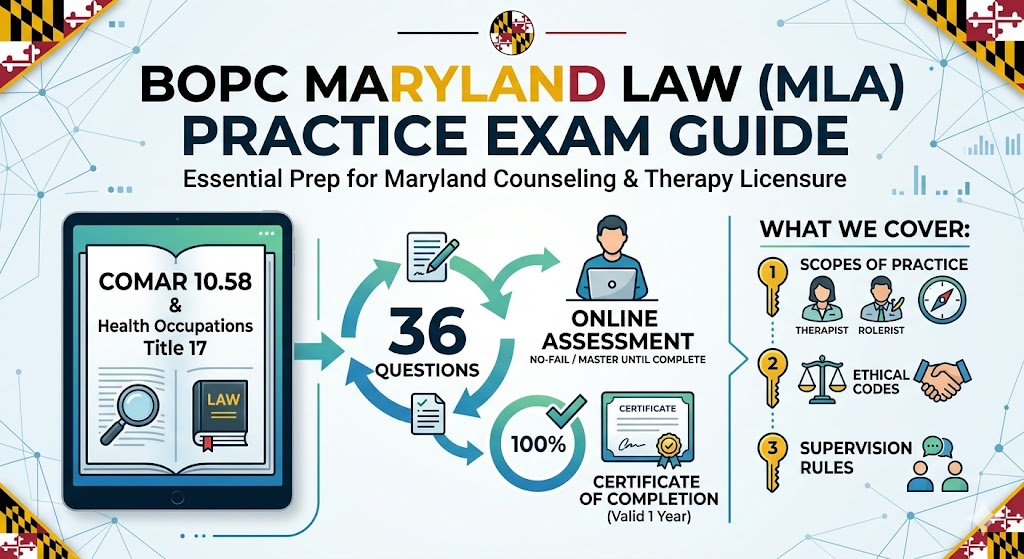
Additional Information
What the Course Entails and Exam Details
Preparing for the MLA requires familiarizing yourself with the core regulatory framework of Maryland. While you do not take a standard 'course' beforehand, you must master specific legal documents. The assessment is designed around the Code of Maryland Regulations (COMAR) and the Maryland Annotated Code, Health Occupations Article, Title 17. The core content areas you must review include, but are not limited to, scope of practice definitions for various counseling licenses, regulations concerning supervision requirements for graduate counselors, the required ethical code of conduct, continuing education requirements, and the specific disciplinary processes of the Board. The MLA typically consists of approximately 36 items that measure your familiarity with these foundational legal and ethical standards.
What to Expect in the Final Exam
It is crucial to understand that the Maryland Law Assessment is not a standard pass/fail, scored examination. Instead, it is an educational, interactive assessment designed to ensure mastery of the material. There is no numeric passing score requirement because the format itself demands a perfect result before completion. You will be presented with specific readings from the COMAR or Health Occupations regulations, followed by corresponding questions. You must continue reviewing the material and answering questions until all 36 items are answered correctly in their entirety. Upon successfully answering every item correctly, you will be issued a Certificate of Completion. This certificate is valid for exactly one year from the date you complete the assessment, meaning you must submit your final application for licensure or certification within that time frame, or you will be required to take the MLA again at your own expense.
How to Study and Exam Centers
Because the MLA functions as an education-until-mastery assessment, your best study strategy is detailed, attentive reading of the primary sources. We highly recommend downloading and printing current copies of COMAR 10.58 (the main regulations for counselors and therapists) and Health Occupations Article, Title 17. When navigating the actual assessment, read the provided regulatory excerpts very carefully before attempting to answer the question, as the answer is often contained directly within the text. Treat the process as a thorough, open-resource learning exercise rather than a test of recall. Unlike standard national licensing exams, the MLA is not taken at third-party test centers like Pearson VUE. It is an online assessment taken through the authorized portal provided by the BOPC, currently hosted by the CCE Academy. You are responsible for accessing the portal and completing the assessment independently. Prior Board approval is not required to register for or take the MLA, but the fee is non-refundable.
Job Opportunities from the Course
Successfully completing the MLA and subsequently obtaining your Maryland license or certification unlocks a wide range of career paths in various clinical, educational, and community settings. Mastery of these laws is the key that opens doors to many fulfilling counselor and therapist roles within the state. Below is a list of job opportunities this credential helps unlock:
Licensed Clinical Professional Counselor (LCPC) in private practice, hospitals, or community mental health centers.
Licensed Graduate Professional Counselor (LGPC) engaging in supervised practice towards clinical licensure.
Licensed Clinical Marriage and Family Therapist (LCMFT) treating couples and families.
Certified Associate Counselor-Alcohol and Drug (CAC-AD) in substance abuse treatment facilities.
Certified Professional Counselor-Alcohol and Drug (CPC-AD) specialized in addiction therapy.
School Counselor in Maryland public and private schools (requiring additional MSDE certification).
Addiction Program Manager or Clinical Supervisor within behavioral health organizations.
Mental Health Consultant for state and non-profit agencies.
Frequently Asked Questions
Reviews
5.0
Based on 0 reviews
Leave a Review
No reviews yet. Be the first to review!