
Border Patrol Law 2 Practice Test
$69.00
- Buy to unlock unlimited access to all Quiz questions and Answers in this Quiz.
- After purchase you can print a PDF of the whole quiz at any point. The PDF will contain the questions and the correct answers.
About this Exam
The Border Patrol Law 2 exam is a summative assessment within the specialized law enforcement academy training for aspiring U.S. Border Patrol Agents. This rigorous exam is specifically designed to evaluate a trainee’s comprehensive understanding and ability to apply complex federal laws to real-world scenarios encountered in the line of duty. It acts as a primary benchmark to ensure that agents possess the precise legal knowledge required to operate lawfully, effectively, and safely within their authority on the nation's borders. The exam is intended for dedicated individuals who have been selected for the academy and are committed to a career safeguarding our borders.
Ready to test your knowledge?
Buy Now to Access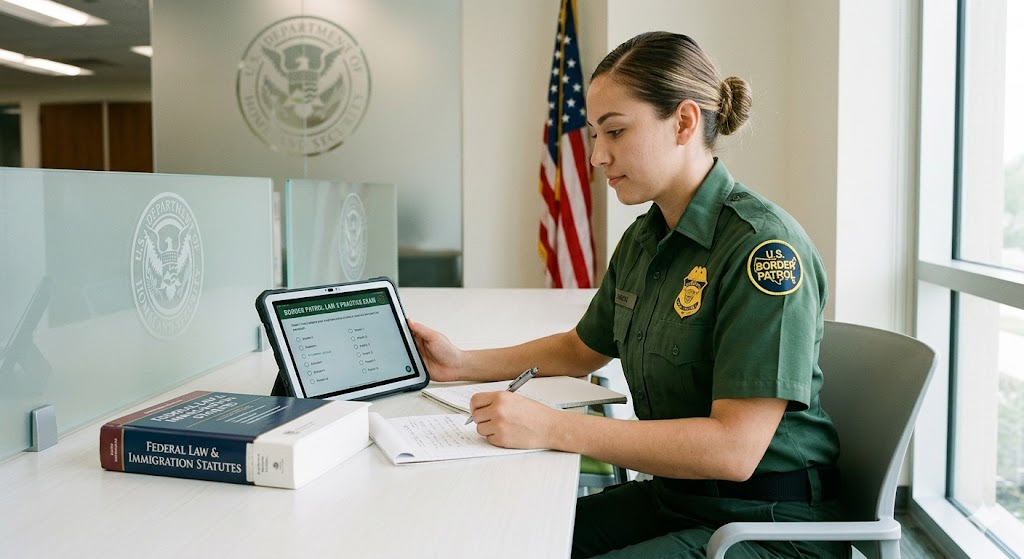
Additional Information
What the Course Entails and Exam Details
This examination does not test general knowledge but rather focuses on a sophisticated curriculum of federal jurisprudence vital to an agent's success. The course leading to Law 2 entails an in-depth exploration of core legal principles, legal concepts, and procedural rules. Key topics and skills covered in your studies and subsequent exam include:
Constitutional Law: Extensive study of the Fourth, Fifth, and Sixth Amendments, focusing on legal authority for search, seizure, arrests, and the use of force, specifically within the "border search exception" doctrine.
Federal Immigration Law: Comprehensive mastery of the Immigration and Nationality Act (INA), including classifications of non-citizens, grounds for inadmissibility and removability, and administrative processing.
Federal Criminal Law and Procedure: Analysis of specific federal statutes relating to alien smuggling, drug trafficking, and other transnational crimes, as well as the rules governing initial appearances and grand jury procedures.
Law of Evidence: Understanding rules of relevancy, privilege, and hearsay, ensuring evidence collected is admissible in federal court.
Ethical Decision Making: Applying statutory and constitutional frameworks to maintain high ethical standards in all actions.
What to Expect in the Final Exam
The final Law 2 exam is a timed, high-stakes academic test administered in a controlled, supervised environment at the training academy. It typically follows a structured multiple-choice format, requiring you to analyze complex, multi-paragraph factual scenarios and select the single most legally sound conclusion or course of action.
Expect a stringent passing score, often requiring a result of 70% to 80% or higher to advance to the next phase of training. While specific question counts and time limits may vary by course session, the exam is notoriously comprehensive, typically granting several hours for completion.
You are expected to recall specific legal authorities, code sections, and precedent-setting Supreme Court cases discussed during your training. It is an internal academic milestone, and failure can lead to recycling through training or separation from the program.
How to Study and Exam Centers
Effective preparation for Border Patrol Law 2 requires a proactive and strategic approach to learning, far beyond simple memorization. Implement these actionable study strategies to excel:
Scenario-Based Practice: Utilize provided practice tests to simulate the exam’s logical reasoning structure. Do not just find the correct answer; analyze why it is correct based on legal authority and why the other options are incorrect.
Flashcards for Case Law and Statutes: Create flashcards for landmark cases (e.g., Terry v. Ohio, Almeida-Sanchez v. United States) and key sections of the INA and Title 18. Know the ruling, the facts, and the impact on agent authority.
Form Study Groups: Collaborating with your academy classmates is highly effective. Debate hypothetical scenarios, take turns teaching complex legal doctrines, and quiz each other on procedural steps.
Active Reading: When studying law texts, take detailed notes, create outlines, and visualize how the legal principles apply to common duties like line watch or checkpoint operations.
Time Management: Practice timed quizzes to ensure you can read, analyze, and answer complex questions efficiently without rushing.
Regarding testing centers, the Border Patrol Law 2 exam is not administered through public centers like Pearson VUE or online portals. This is an exclusive internal academic exam taken on-site at the U.S. Border Patrol Academy (part of the Federal Law Enforcement Training Centers, FLETC) in Artesia, New Mexico, or an authorized training command facility. You will be provided with specific scheduling details during your training.
Job Opportunities from the Course
Successfully passing Border Patrol Law 2 is not just about an academic score; it is a vital passport that unlocks your remaining academy requirements and opens the door to a rewarding federal law enforcement career. By mastering this critical component of your training, you are on a direct path to the following career opportunities:
U.S. Border Patrol Agent: Graduation from the academy, including passing Law 2, is the primary requirement to enter duty as a federal agent.
Journeyman Agent (GL-9 to GS-12): Successful initial service leads to competitive promotion potential, increased salary, and additional responsibilities.
Supervisory Border Patrol Agent: With experience and proven leadership, agents compete for promotion to supervisory ranks.
Special Operations/Specialized Units: Specialized training and experience can lead to roles within prestigious units like BORTAC, BORSTAR, Mobile Response Teams, or Intelligence.
CBP Management and Leadership: The foundational legal knowledge is essential for progression into upper management and executive leadership roles within U.S. Customs and Border Protection.
Your dedication to mastering this material today builds the foundation for your successful career in federal law enforcement, safeguarding the nation's borders with competence and integrity.
Frequently Asked Questions
Reviews
5.0
Based on 0 reviews
Leave a Review
No reviews yet. Be the first to review!