
Boston Bartending School Practice Test
$69.00
- Buy to unlock unlimited access to all Quiz questions and Answers in this Quiz.
- After purchase you can print a PDF of the whole quiz at any point. The PDF will contain the questions and the correct answers.
About this Exam
The Boston Bartending School certification process is a structured training program designed to prepare individuals for the fast-paced and rewarding world of professional mixology.
This comprehensive curriculum is created for aspiring bartenders, students, and hospitality professionals in the New England area who want to formalize their training and gain a competitive edge in the local job market.
The program aims to blend fundamental knowledge with practical speed, ensuring that all graduates are confident and ready to work in high-volume environments upon completion.
Utilizing a practice exam is an essential step for students to test their comprehension, identify knowledge gaps, and familiarize themselves with the testing format before attempting the official certification.
Ready to test your knowledge?
Buy Now to Access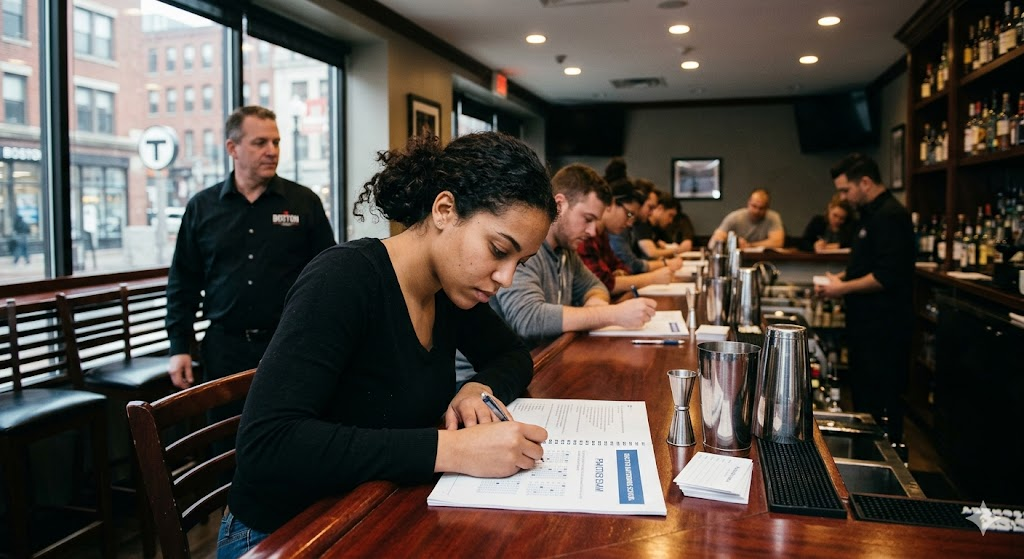
Additional Information
What the Course Entails and Exam Details
The core syllabus of a reputable Boston bartending course covers the complete spectrum of skills required by modern hospitality establishments.
You will study the history of distillation, classification of spirits (Vodka, Gin, Rum, Tequila, Whiskey, Brandy), and the flavor profiles of essential liqueurs.
A significant portion of the course involves mastering classic cocktail recipes, understanding proper ratios, and learning standard preparation methods such as shaking, stirring, muddling, and building drinks.
Crucially, the curriculum includes mandatory training on Massachusetts-specific liquor liability laws, checking identification, recognizing intoxication, and the principles of responsible alcohol service.
Students will also practice bar setup (mise en place), tool maintenance, hygiene standards, effective customer service techniques, and cash-handling procedures.
What to Expect in the Final Exam
The final certification exam required by the Boston Bartending School typically consists of both a theoretical and a practical assessment component.
The theoretical portion is usually a multiple-choice written test that covers recipes, alcohol awareness, and operational knowledge.
The passing score for the written component is typically around 80% to ensure a strong foundational understanding of the curriculum.
Following the written exam, you must successfully pass a time-based practical examination.
During the practical, an instructor will order a specific list of several different drinks (e.g., three cocktail recipes) simultaneously, simulating a real busy shift.
You are graded on your speed, accuracy of measurement, correct glassware usage, proper garnish, and the cleanliness of your station during the pour.
A failure in the practical exam, such as making a recipe mistake or exceeding the time limit, will require a retake.
How to Study and Exam Centers
Effective preparation for the Boston Bartending School certification requires a balanced approach of mental study and physical practice.
Memorizing cocktail recipes is fundamental, so utilize flashcards to quiz yourself on the exact ingredients, measurements, and garnishes for classic drinks.
Practice "speed pouring" using water-filled bottles and specialized pour spouts to master exact measurements without relying on a jigger for speed.
Use online practice tests, like the Boston Bartending School Practice Exam, repeatedly to become comfortable with the wording of theoretical questions and to improve recall speed.
For practical practice, try timing yourself while "mock-making" complex drink orders, focusing on minimizing redundant movements.
The official certification and examination are conducted strictly in person at designated Authorized Testing Schools located throughout the Boston metropolitan area.
There is no recognized online-only equivalent for the physical speed and accuracy portion of the examination; you must attend a physical center for evaluation.
Job Opportunities from the Course
Upon earning your bartending certification through a reputable program in Boston, you will be qualified to pursue a wide variety of roles in the hospitality sector.
Potential job opportunities include:
Restaurant Bartender (at both casual and fine-dining establishments)
High-Volume Nightclub Bartender
Hotel Lounge or Banquet Bartender
Craft Cocktail Specialist
Private Event or Wedding Bartender
Bar Manager (often requires initial experience, but certification aids promotion)
Catering Beverage Director
Service Bartender (focused on speed rather than customer interaction)
Brand Ambassador for liquor companies (representing specific products)
Frequently Asked Questions
Reviews
5.0
Based on 0 reviews
Leave a Review
No reviews yet. Be the first to review!