
Boy Scout First Aid Practice Test
$69.00
- Buy to unlock unlimited access to all Quiz questions and Answers in this Quiz.
- After purchase you can print a PDF of the whole quiz at any point. The PDF will contain the questions and the correct answers.
About this Exam
The Boy Scout First Aid qualification is a vital milestone for young Scouts, representing a core pillar of emergency preparedness and character development.
This certification is designed to equip Scouts BSA members with the essential, life-saving skills needed to respond confidently and effectively to various medical situations.
Whether managing minor injuries in the wilderness or stabilizing a patient during a critical event, this training is paramount to a Scout’s readiness to serve others.
Success in the practice test ensures that a Scout is prepared not only for rank advancement but also to be a responsible, helpful citizen when emergencies arise.
Ready to test your knowledge?
Buy Now to Access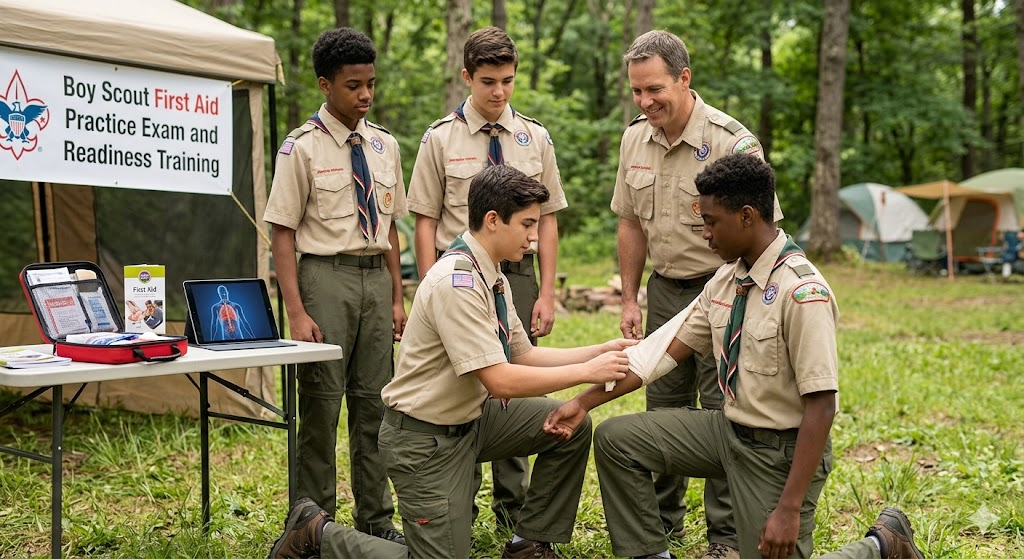
Additional Information
What the Course Entails and Exam Details
This training covers a comprehensive curriculum that blends theoretical knowledge with mandatory practical application.
Scouts are required to master the "triage" approach, focusing on identifying and prioritizing the most critical injuries in any given scenario.
Key skills within the syllabus include, but are not limited to, controlling bleeding with direct pressure, applying various bandages and splints, administering CPR (Cardiopulmonary Resuscitation), managing shock, and treating burns, bites, and heat- or cold-related illnesses.
The course frequently incorporates simulation exercises where the Scout must quickly assess a mock scene, ensure their own safety, and provide appropriate care using items typically found in a personal or troop first aid kit.
What to Expect in the Final Exam
The final assessment is generally split into two distinct components to evaluate both comprehension and hand-on capability.
Theoretical Component: You can expect a written examination, often consisting of multiple-choice questions, true/false scenarios, and matching exercises that test your recall of terminology, symptoms, and sequential treatment steps.
Practical Component: This is often the most critical part of the exam. Scouts will be asked to demonstrate specific skills in real-time under the supervision of a Merit Badge Counselor or qualified instructor.
You may be required to show exactly how to tie a sling, perform chest compressions on a mannequin, or move an injured person safely.
While specific passing scores may vary by Troop, an overall masterly of 80% or higher is a common benchmark, and immediate failures are often triggered by serious safety errors or neglecting universal precautions.
There may or may not be strict time limits, depending on the scenario, but examiners prioritize correct technique over speed.
How to Study and Exam Centers
Effective preparation requires a balance between reviewing core literature and consistent physical practice.
Begin by studying the official Scouts BSA First Aid Merit Badge Pamphlet extensively, as it contains the precise terminology and methods you will be tested on.
Utilize flashcards for symptoms and treatments, and form study groups with fellow Scouts to drill one another on scenario-based questions.
The most effective study strategy, however, is hands-on repetition; practice bandaging and splinting on family members or other Scouts until you can do it flawlessly without looking at the instructions.
Testing Centers: Unlike standardized national certifications that use Pearson VUE, the Boy Scout First Aid exam is typically administered internally through your local Troop.
Assessments are conducted at designated troop meeting locations, during organized district-level Camporees, or at official Scouts BSA Summer Camps by authorized Merit Badge Counselors.
Consult with your Scoutmaster or Senior Patrol Leader to locate an authorized counselor and schedule your practical testing session.
Job Opportunities from the Course
While this certification is specifically tailored for advancement within the Scouts BSA program and is not a professional-level medical license, the foundational knowledge it provides is a significant first step toward several emergency response and safety-oriented career paths.
It serves as excellent introductory training that builds the confidence necessary to pursue future professional certifications.
The foundational skills mastered during First Aid training are highly relevant to the following career paths:
Emergency Medical Technician (EMT) / Paramedic (foundation)
Wilderness First Responder
Lifeguard
Camp Counselor / Outdoor Educator
Search and Rescue Volunteer or Professional
Firefighter (introductory safety knowledge)
Occupational Health and Safety Officer (foundational)
Park Ranger (emergency response capability)
Frequently Asked Questions
Reviews
5.0
Based on 0 reviews
Leave a Review
No reviews yet. Be the first to review!